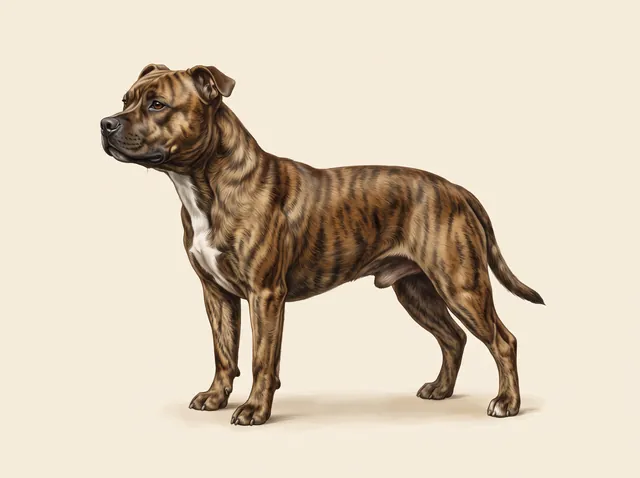
Where the Staffordshire Bull Terrier comes from
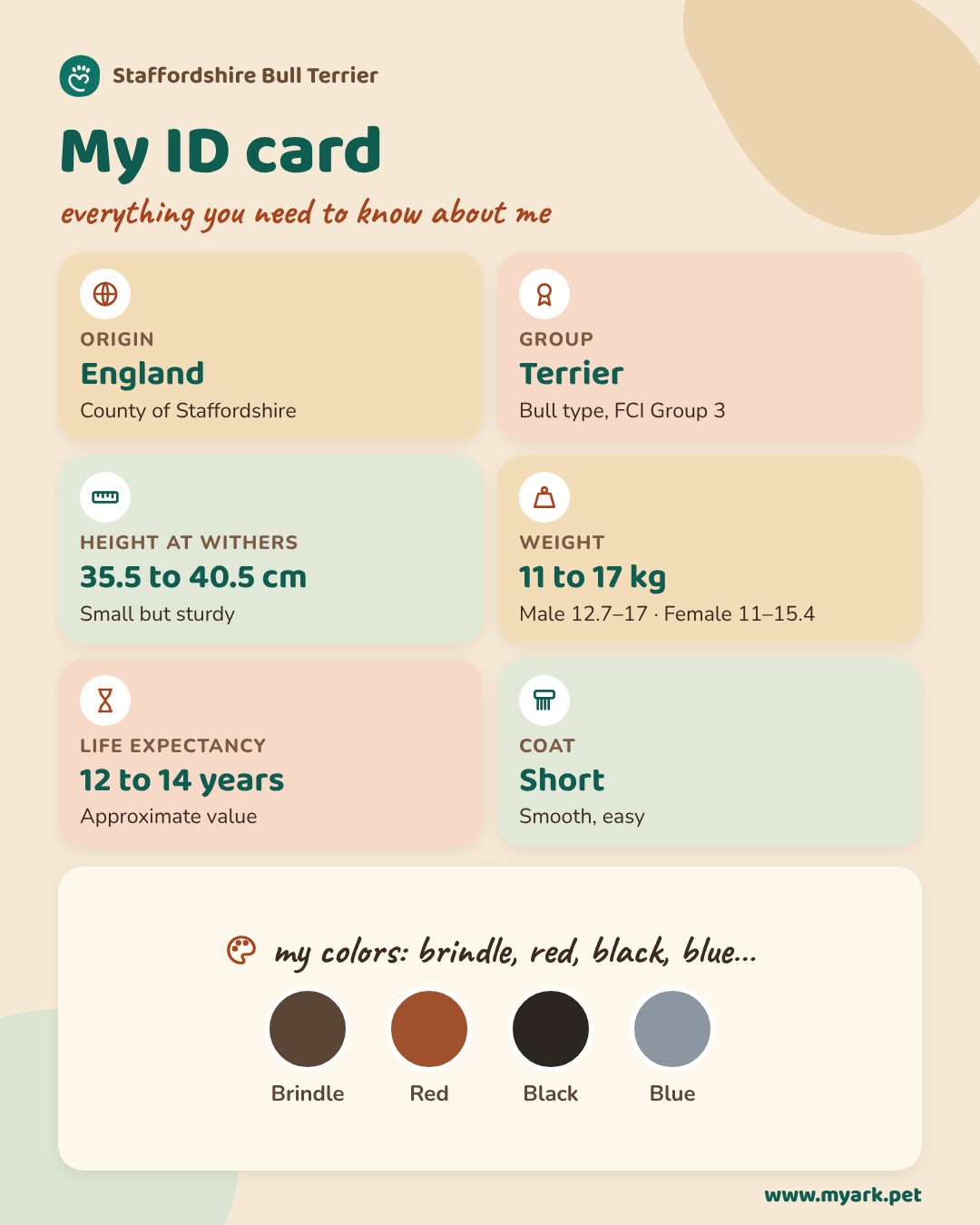
A bull-type terrier from the county of Staffordshire, in England, fixed in the 19th century. It is often called the “Staffie” — not to be confused with the larger American Staffordshire Terrier.
The FCI standard describes it as of indomitable courage and tenacity, highly intelligent and affectionate, especially with children; bold, fearless and totally reliable.
Height at the shoulder (FCI standard): 35.5–40.5 cm (14–16 in).
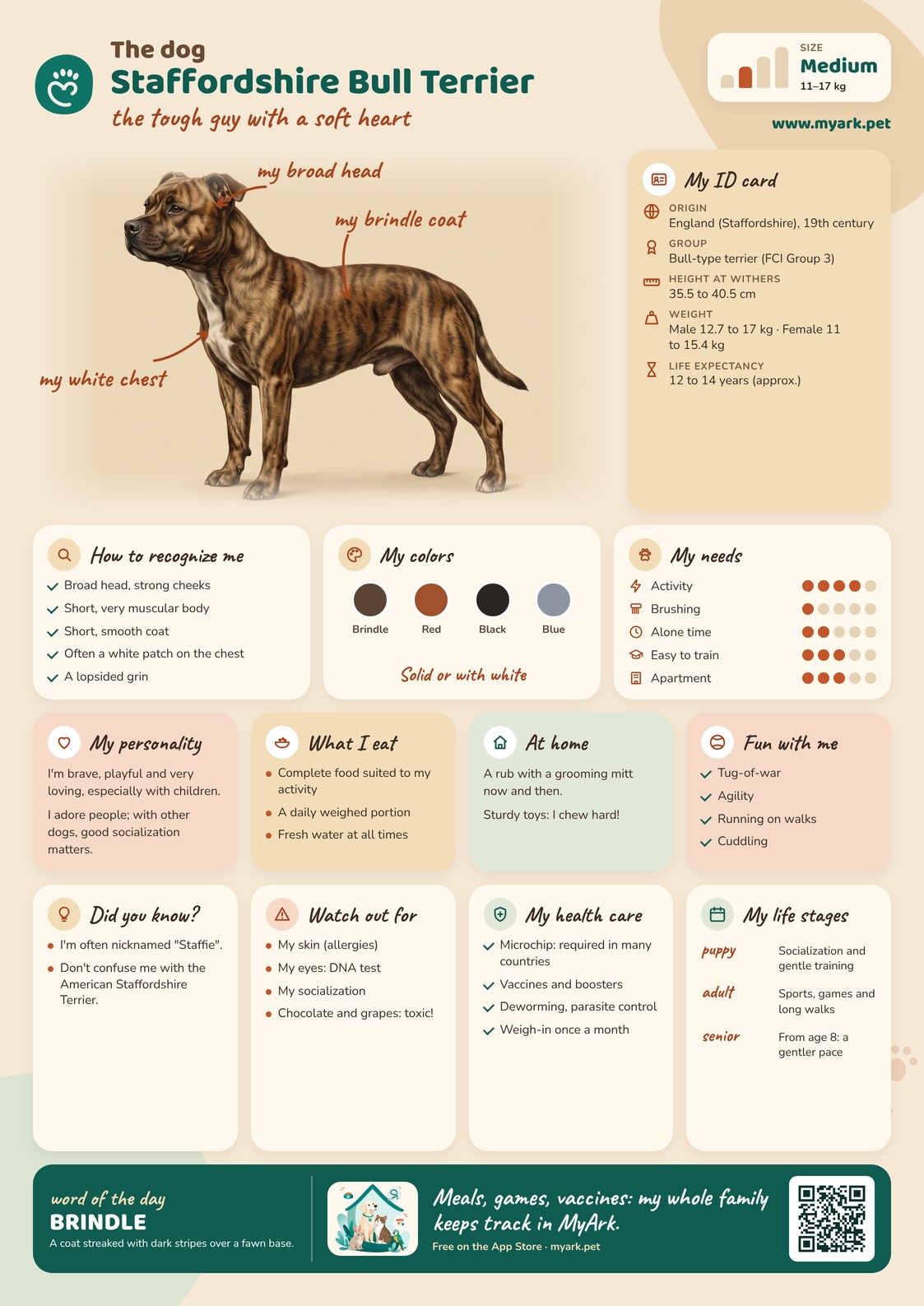
How to recognise me
- broad head, marked cheeks
- short, very muscular body
- short, smooth coat
- often a white patch on the chest
- a lopsided grin
My colours
- Brindle
- Red
- Black
- Blue
What a Staffordshire Bull Terrier needs day to day
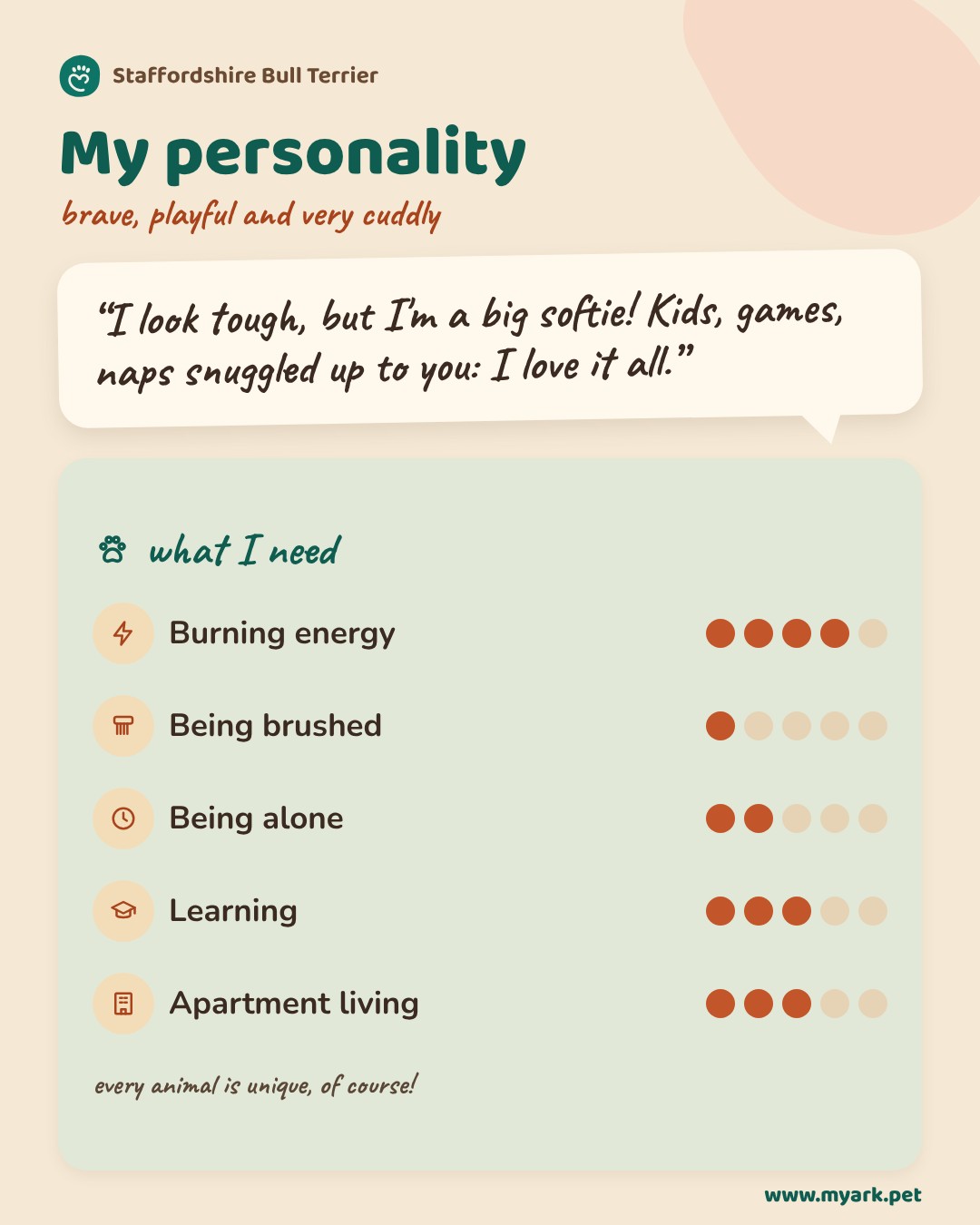
“I look like a tough guy, but I’m a big softie! Children, games, naps pressed against you: I love it.”
Its exercise needs are fairly high: brisk walks, tug games and agility. It is strong for its size and enjoys structured play.
At a glance
- Exercise
- 4 out of 5
- Grooming
- 1 out of 5
- Coping alone
- 2 out of 5
- Ease of training
- 3 out of 5
- Flat living
- 3 out of 5
every dog is unique, of course!
With me, we can go…
- tug of war
- agility
- running on walks
- cuddles
Living with a Staffordshire Bull Terrier: who does what
Most of a dog’s care is repeated, shared and easy to forget. Here is the Staffordshire Bull Terrier’s routine at a glance, and how a household can split it without a single “did anyone…?” message.
The routine at a glance
- every day
- a weighed daily ration; two brisk walks; a tug or ball game with rules.
- every week
- a quick brush; a skin and ear check.
- every month
- a weigh-in; flea, tick and worming treatment on your vet’s schedule; a nail check.
- every year
- the vet check-up and vaccine boosters.
Sharing it out
- Meetings with other dogs need a plan: the same calm approach from everyone, from puppyhood.
- Tug games are great for children, with clear “drop it” rules.
- An adult holds the lead around other dogs.
Before it arrives, agree on…
- how it meets other dogs
- the rules for tug and play
- who walks it near other dogs
- the rules on sofas
- who covers long days away
How MyArk helps the household keep track
Dog walk log
Log each walk so it gets its daily exercise.
See the featurePet health record
Skin notes, eye tests and vaccinations in one place.
See the featurePet weight tracker
A monthly weigh-in keeps it lean and strong.
See the featurePet sitter instructions
Rules around other dogs and contacts in one sheet.
See the featureFeeding, grooming and health routine
The coat is easy to keep: an occasional brush removes the dead hair.
What I eat
- a complete food suited to its age
- a weighed ration every day
- fresh water at all times
My health routine
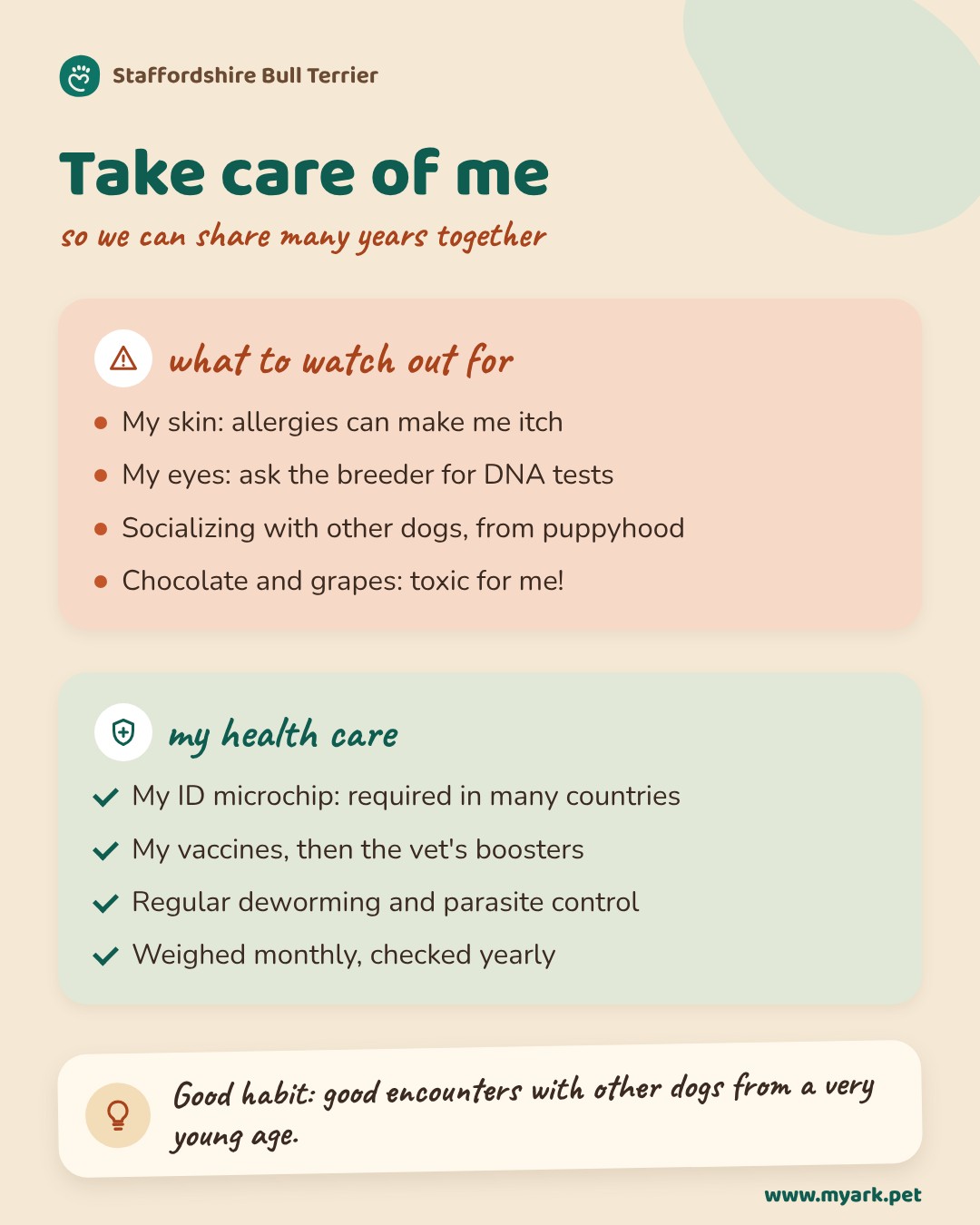
- a microchip registered with your details (a legal requirement in many countries, including the UK and France)
- core vaccinations, then boosters on the schedule your vet sets
- worming and flea and tick treatment on a regular schedule
- a weigh-in every month and a vet check-up every year
The stages of my life
- puppy
- Socialisation and gentle, reward-based training.
- adult
- Sport, games and long walks.
- senior
- From about 8 years old, a gentler pace.
What to keep an eye on
MyArk describes predispositions through visible body shape and simple checks rather than a list of diseases: it is what you can verify from the outside, and act on when choosing a breeder.
Skin
Allergies can make it itch: mention scratching, licking or redness to your vet.
Eyes
Ask the breeder for the parents’ DNA test results for inherited eye conditions.
Socialisation
Introduce it to many calm dogs from puppyhood.
Chocolate, grapes and raisins
All are toxic to dogs: keep them out of reach and call your vet straight away if your dog eats any.
And, as for every dog:
- weight: extra kilos strain the joints, heart and breathing
- teeth, ears and nails, checked regularly
- parasite prevention and the vaccination schedule, with your vet
Is it the right dog for your household?
A dog is a social animal that copes badly with long days alone: the real question is less the breed than the time your household has. Before committing, consider rescues and rehoming charities too.
- Home
- Copes with a flat if exercised every day (3 out of 5).
- Young children
- Renowned for its affection with children; supervise, as it is strong.
- Other pets
- Needs early socialisation with dogs; take care with small pets.
- First dog
- Possible for a well-informed, consistent household.
- Time alone
- Copes poorly with long absences (2 out of 5).
Staffordshire Bull Terrier: straight answers
Is a Staffordshire Bull Terrier good with children?
It is renowned for its affection with children; as with any strong dog, supervise them together.
Is a Staffie the same as an American Staffordshire Terrier?
No: the Staffie is smaller and British; the AmStaff is larger and American.
How big does a Staffordshire Bull Terrier get?
The FCI standard gives 35.5 to 40.5 cm at the shoulder, for an adult weight of roughly 11 to 17 kg.
What colours does the Staffordshire Bull Terrier come in?
The usual colours are brindle, red, black and blue.