
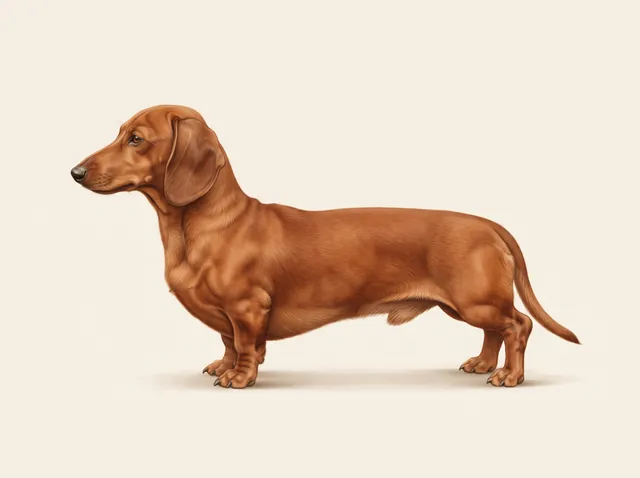
Where the Dachshund comes from
Known since the Middle Ages, the Dachshund was bred from scent hounds to go underground after badgers and foxes. It became one of the most versatile hunting dogs.
The FCI standard describes it as friendly, neither nervous nor aggressive, and a passionate, persistent hunter with an excellent nose — qualities that still show on every walk.
Height at the shoulder (FCI standard): three sizes, defined by chest girth in the FCI standard: standard (over 35 cm and up to 47 cm), miniature and rabbit (Kaninchen).
How to recognise me
- long body, short legs
- long drop ears
- smooth, long or wire coat
- three sizes: standard, miniature, rabbit
- tail continuing the line of the back
My colours
- Red
- Black and tan
- Chocolate
- Dapple
What a Dachshund needs day to day
“I have a hunter’s nose and a cuddler’s heart. But mind my back: no jumping off the sofa!”
Its exercise needs are moderate: regular walks with plenty of sniffing suit it better than intense running. Scent games at home are a great way to tire it out without stressing its back.
At a glance
- Exercise
- 3 out of 5
- Grooming
- 2 out of 5
- Coping alone
- 2 out of 5
- Ease of training
- 2 out of 5
- Flat living
- 4 out of 5
every dog is unique, of course!
With me, we can go…
- sniffing walks
- finding hidden toys
- tracking
- digging, in the right place
Living with a Dachshund: who does what
Most of a dog’s care is repeated, shared and easy to forget. Here is the Dachshund’s routine at a glance, and how a household can split it without a single “did anyone…?” message.
The routine at a glance
- every day
- two weighed meals — extra weight strains its back; walks with time to sniff; a scent game; using ramps or being lifted on and off furniture.
- every week
- brushing suited to its coat type; an ear check.
- every month
- a weigh-in; flea, tick and worming treatment on your vet’s schedule; a nail check.
- every year
- the vet check-up and vaccine boosters.
Sharing it out
- Teach everyone, including children and visitors, the right way to lift it: one hand under the chest, one under the hindquarters.
- One “no jumping” rule for the whole household: if one person lets it leap off the sofa, the habit comes back.
- Treats count: put a small daily allowance in a jar, and when it is empty, it is empty.
Before it arrives, agree on…
- where ramps or steps go (sofa, bed, car)
- whether it is allowed on furniture at all
- the daily ration and treat allowance
- who handles training — it can be stubborn and needs consistent patience
- which emergency vet to call if it shows back pain
How MyArk helps the household keep track
Pet weight tracker
Weight is a back issue for a Dachshund: a monthly weigh-in and a curve everyone can read.
See the featurePet feeding tracker
Log meals so treats and second dinners do not creep in.
See the featurePet sitter instructions
A ready-made sheet with the lifting and no-jumping rules for whoever looks after it.
See the featurePet health record
Keep vet visits and any back episodes in one record.
See the featureFeeding, grooming and health routine
The coat needs regular brushing, more often during the moult.
What I eat
- a complete food suited to its size
- a weighed ration — extra weight damages its back
- fresh water at all times
My health routine
- a microchip registered with your details (a legal requirement in many countries, including the UK and France)
- core vaccinations, then boosters on the schedule your vet sets
- worming and flea and tick treatment on a regular schedule
- a weigh-in every month and a vet check-up every year
The stages of my life
- puppy
- Socialisation and gentle, reward-based training.
- adult
- Sniffing walks and games, without jumping.
- senior
- From about 8 years old, a gentler pace.
What to keep an eye on
MyArk describes predispositions through visible body shape and simple checks rather than a list of diseases: it is what you can verify from the outside, and act on when choosing a breeder.
Long body on short legs
This build puts its spine at risk. Limit jumping off sofas and use of stairs, install ramps, and keep its weight strict: every extra kilo weighs directly on the back.
Slipped disc
This is its weak point: at the slightest sign of pain or difficulty walking, see a vet without delay. To carry it, support both the back and the hindquarters.
Drop ears
Ears that hang down let less air into the ear canal, which makes infections more likely. A weekly check, and drying the ears after every swim, makes a real difference.
Strong chase instinct
The urge to chase can kick in faster than the recall. Plan how it will meet the household’s small pets, and keep off-lead time to fenced areas until the recall is reliable.
And, as for every dog:
- weight: extra kilos strain the joints, heart and breathing
- teeth, ears and nails, checked regularly
- parasite prevention and the vaccination schedule, with your vet
Is it the right dog for your household?
A dog is a social animal that copes badly with long days alone: the real question is less the breed than the time your household has. Before committing, consider rescues and rehoming charities too.
- Home
- Copes well with a modest home (4 out of 5), ideally with few stairs or with ramps.
- Young children
- Possible with supervision: a small dog is vulnerable to falls and being picked up badly.
- Other pets
- Take care with small pets: the urge to chase can override the recall.
- First dog
- Accessible to a well-informed first-time household that accepts its independent streak.
- Time alone
- Rated 2 out of 5: it can bark when left alone too long.
Dachshund: straight answers
Is a Dachshund a good family dog?
It is affectionate and fun, and suits households that will protect its back, watch its weight and train it patiently.
How do you protect a Dachshund’s back?
Limit jumping and stairs, use ramps, keep it lean and lift it with one hand under the chest and one under the hindquarters. See a vet without delay at any sign of back pain.
What sizes do Dachshunds come in?
The FCI standard defines three sizes by chest girth: standard, miniature and rabbit (Kaninchen). There are also three coat types: smooth, long and wire.
How long do Dachshunds live?
Roughly 12 to 16 years, depending on the individual and its health.
What colours does the Dachshund come in?
The usual colours are red, black and tan, chocolate and dapple.