
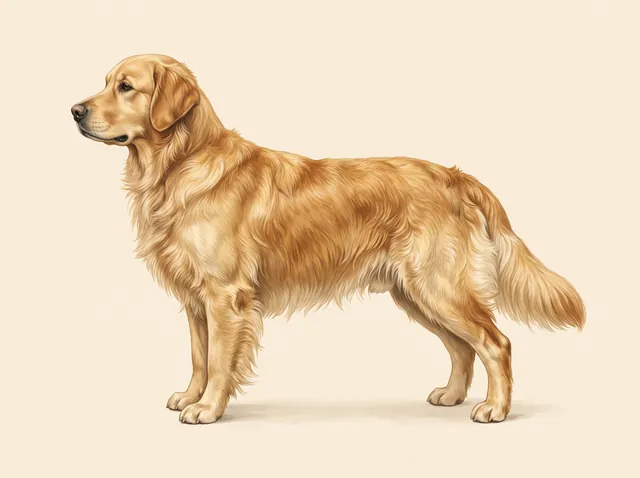
Where the Golden Retriever comes from
The Golden Retriever was developed in Scotland in the 19th century, on Lord Tweedmouth’s estate, from a yellow wavy-coated retriever and the now-extinct Tweed Water Spaniel. Its job was to bring back shot game from land and water.
That job still explains its character: it carries things gently in its mouth, loves water and is happiest working alongside people. The FCI standard describes it as kindly, friendly and confident.
Height at the shoulder (FCI standard): 56–61 cm (22–24 in) for males, 51–56 cm (20–22 in) for females.
How to recognise me
- medium-length coat with generous feathering
- dense, water-resistant undercoat
- drop ears and a broad head
- feathered tail carried level with the back
- balanced, powerful build
My colours
- Cream
- Light golden
- Golden
- Dark golden
What a Golden Retriever needs day to day
“I love to please and I learn fast. I’m patient with children… but being left alone all day? No thanks!”
A Golden needs real exercise every day: walks long enough to sniff and explore, free running somewhere safe, and games that use its retrieving instinct. Under-exercised or left alone for long stretches, it tends to chew, dig or bark — not out of spite, but because the energy has to go somewhere.
At a glance
- Exercise
- 5 out of 5
- Grooming
- 3 out of 5
- Coping alone
- 1 out of 5
- Ease of training
- 5 out of 5
- Flat living
- 2 out of 5
every dog is unique, of course!
With me, we can go…
- hiking
- fetch and swimming
- learning tricks
- canicross
Living with a Golden Retriever: who does what
Most of a dog’s care is repeated, shared and easy to forget. Here is the Golden Retriever’s routine at a glance, and how a household can split it without a single “did anyone…?” message.
The routine at a glance
- every day
- two weighed meals — it will always ask for more; two or three walks, including one long outing; a short training or play session; drying the ears after any swim.
- every week
- two or three brushing sessions (daily during the spring and autumn moults); an ear check.
- every month
- a weigh-in, logged so everyone sees the trend; flea, tick and worming treatment on your vet’s schedule; a nail check.
- every year
- the vet check-up and vaccine boosters.
Sharing it out
- Split by time of day rather than by task: whoever is home in the morning does breakfast and the first walk; the evening person does dinner and the long walk.
- Give children jobs that suit their age — refilling the water bowl, brushing, rewarding a trick — with an adult holding the lead of a 30 kg dog.
- Agree on one treat rule. With a dog this food-motivated, small extras from four people quickly become a weight problem.
Before it arrives, agree on…
- who covers the middle of the day on work days
- where it sleeps, and whether the sofa is allowed
- one set of training words for everyone (“sit”, “down”, “leave it”)
- the daily ration and the treat allowance
- who books and takes it to vet appointments
How MyArk helps the household keep track
Pet feeding tracker
Log each meal in one tap, so nobody serves a second dinner to a very convincing Golden.
See the featureDog walk log
See who took it out and when, so the long daily walk really happens.
See the featurePet weight tracker
A monthly weigh-in and a curve the whole household can read.
See the featureFamily pet chores
Visible chores, so the work is shared fairly between adults and children.
See the featureFeeding, grooming and health routine
The coat needs regular brushing, more often during the moult.
What I eat
- a complete food suited to its age
- a weighed ration — it is a glutton
- fresh water at all times
My health routine
- a microchip registered with your details (a legal requirement in many countries, including the UK and France)
- core vaccinations, then boosters on the schedule your vet sets
- worming and flea and tick treatment on a regular schedule
- a weigh-in every month and a vet check-up every year
The stages of my life
- puppy
- Socialisation and gentle, reward-based training.
- adult
- Sport, games and long walks.
- senior
- From about 8 years old, a gentler pace.
What to keep an eye on
MyArk describes predispositions through visible body shape and simple checks rather than a list of diseases: it is what you can verify from the outside, and act on when choosing a breeder.
Drop ears
Ears that hang down let less air into the ear canal, which makes infections more likely. A weekly check, and drying the ears after every swim, makes a real difference.
Hips and elbows
Ask the breeder for the hip and elbow screening results of both parents before you commit.
Chocolate, grapes and raisins
All are toxic to dogs: keep them out of reach and call your vet straight away if your dog eats any.
And, as for every dog:
- weight: extra kilos strain the joints, heart and breathing
- teeth, ears and nails, checked regularly
- parasite prevention and the vaccination schedule, with your vet
Is it the right dog for your household?
A dog is a social animal that copes badly with long days alone: the real question is less the breed than the time your household has. Before committing, consider rescues and rehoming charities too.
- Home
- Suits a house with a garden, or a flat only if the walks and daily exercise genuinely happen.
- Young children
- Usually patient, but a large, bouncy young dog can knock a toddler over: clear rules on both sides and supervised interactions.
- Other pets
- Generally sociable; introduce it gradually and give each animal somewhere to retreat.
- First dog
- A good choice for a well-prepared first-time household that has the time.
- Time alone
- Its weakest point (1 out of 5): plan a dog walker, a midday visit or flexible working before it arrives.
Golden Retriever: straight answers
Is a Golden Retriever a good family dog?
Often, yes: it is sociable, patient and easy to train. It suits households that can give it daily exercise and company — it copes badly with long days alone.
How much exercise does a Golden Retriever need?
A lot: several outings a day, at least one of them long, plus play and training. Swimming and retrieving games are ideal outlets.
Do Golden Retrievers shed a lot?
Yes. The double coat sheds all year, with heavier moults in spring and autumn. Brush two or three times a week, and daily during a moult.
How big does a Golden Retriever get?
According to the FCI standard, 56 to 61 cm at the shoulder for males and 51 to 56 cm for females, for an adult weight of roughly 25 to 34 kg.
What colours does the Golden Retriever come in?
The usual colours are cream, light golden, golden and dark golden.