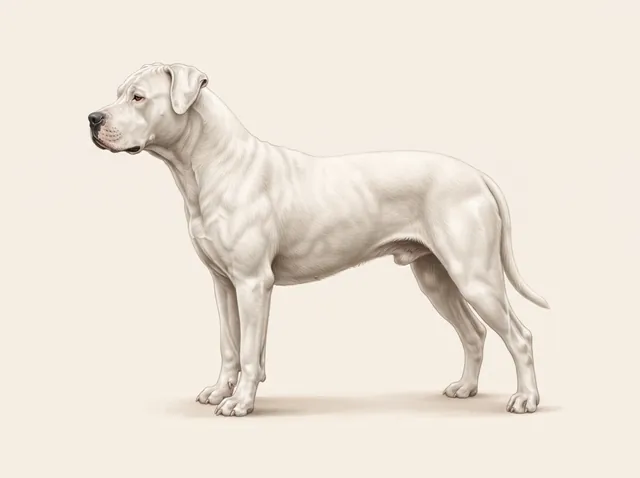
Where the Dogo Argentino comes from
The breed was created in the province of Córdoba by the surgeon Antonio Nores Martínez (1907–1956), from the old Córdoba fighting dog methodically crossed with other breeds.
The FCI standard describes it as silent on the trail, with a fine nose; agile, powerful, tough and very brave, never aggressive towards people.
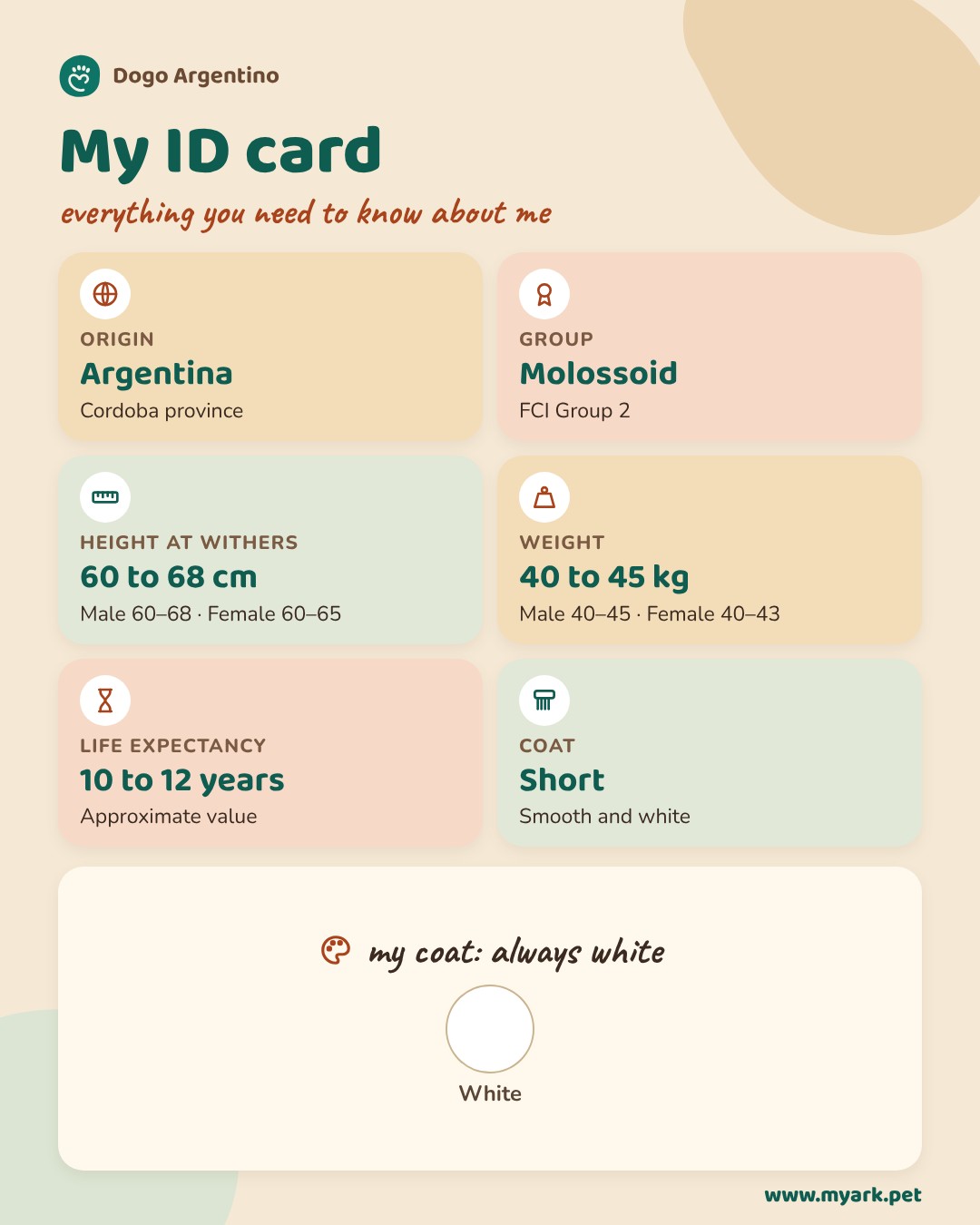
Height at the shoulder (FCI standard): 60–68 cm (23.5–27 in) for males, 60–65 cm (23.5–25.5 in) for females.
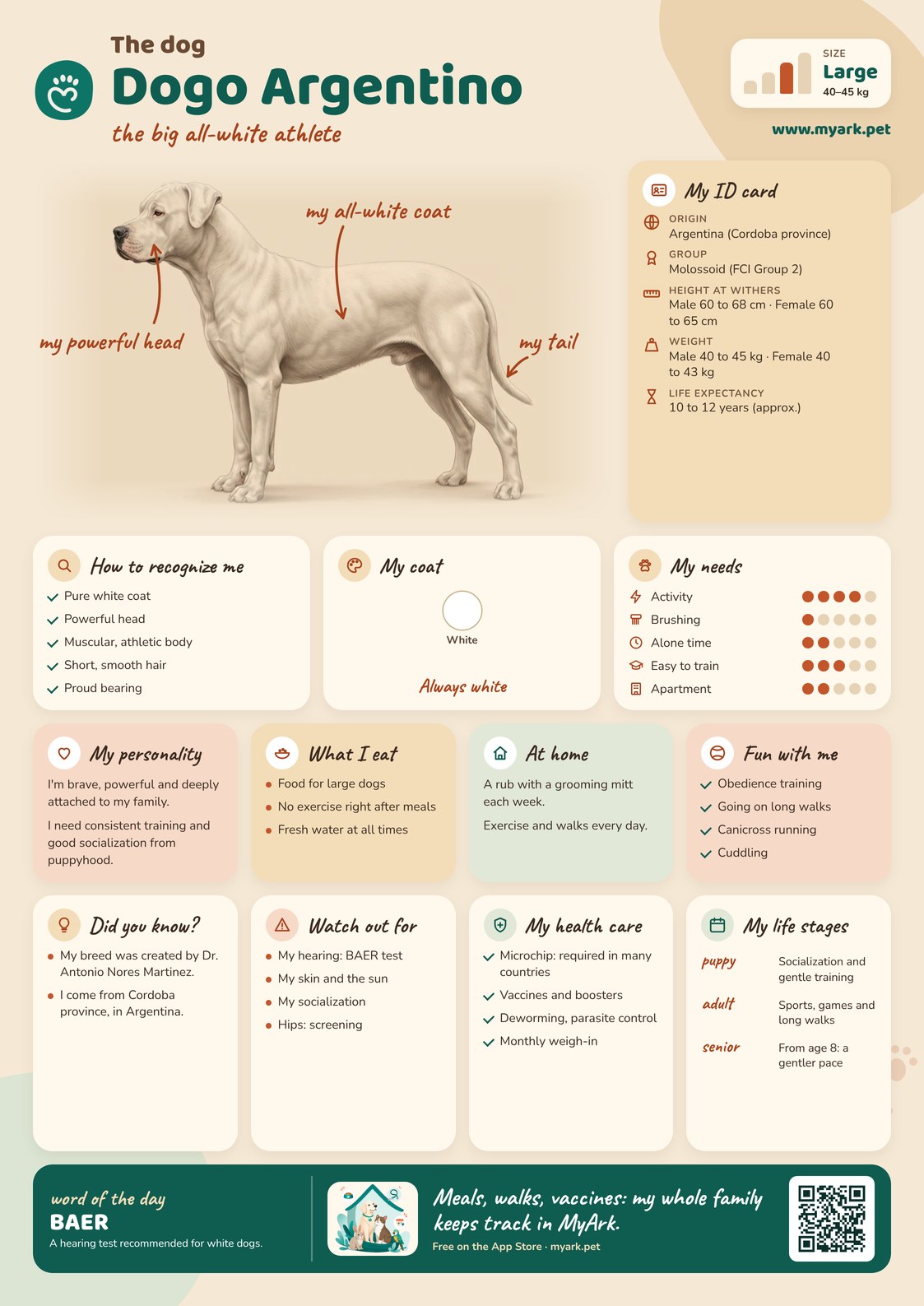
How to recognise me
- all-white coat
- broad, powerful head
- muscular, athletic body
- short, smooth coat
- confident bearing
My colours
- White
What a Dogo Argentino needs day to day
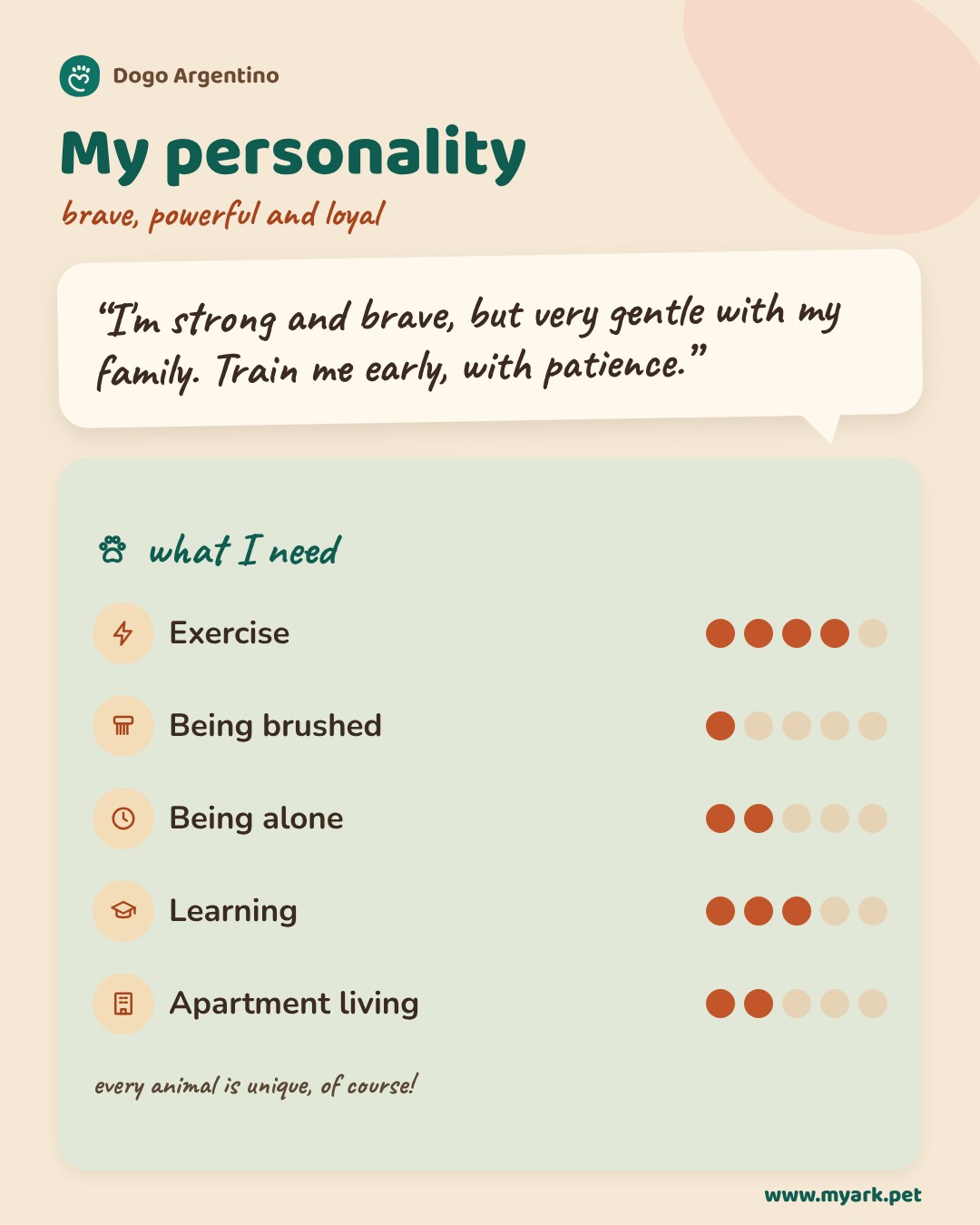
“I’m big, white and very strong, but gentle with my family. Socialise me early!”
Its exercise needs are fairly high: long walks, running and training every day.
At a glance
- Exercise
- 4 out of 5
- Grooming
- 1 out of 5
- Coping alone
- 2 out of 5
- Ease of training
- 3 out of 5
- Flat living
- 2 out of 5
every dog is unique, of course!
With me, we can go…
- long walks
- running
- obedience
- tracking
Living with a Dogo Argentino: who does what
Most of a dog’s care is repeated, shared and easy to forget. Here is the Dogo Argentino’s routine at a glance, and how a household can split it without a single “did anyone…?” message.
The routine at a glance
- every day
- two meals, with no running straight after; two walks, one long; a training session.
- every week
- a quick brush; a skin check; sun cream on pink areas in summer.
- every month
- a weigh-in; flea, tick and worming treatment on your vet’s schedule; a nail check.
- every year
- the vet check-up and vaccine boosters.
Sharing it out
- Adults handle the lead and meetings with other dogs.
- Socialisation is a household project from day one.
- Sun protection on hot days.
Before it arrives, agree on…
- who walks it — adults only
- how it meets other dogs
- local rules on large breeds
- sun protection
- who covers long days away
How MyArk helps the household keep track
Pet health record
Hearing test, screenings and vaccinations in one place.
See the featureDog walk log
Log the daily walks.
See the featurePet weight tracker
A monthly weigh-in.
See the featurePet sitter instructions
Handling rules and contacts for a sitter.
See the featureFeeding, grooming and health routine
The coat is easy to keep: an occasional brush removes the dead hair.
What I eat
- a complete food for large dogs
- no running straight after a meal
- fresh water at all times
My health routine
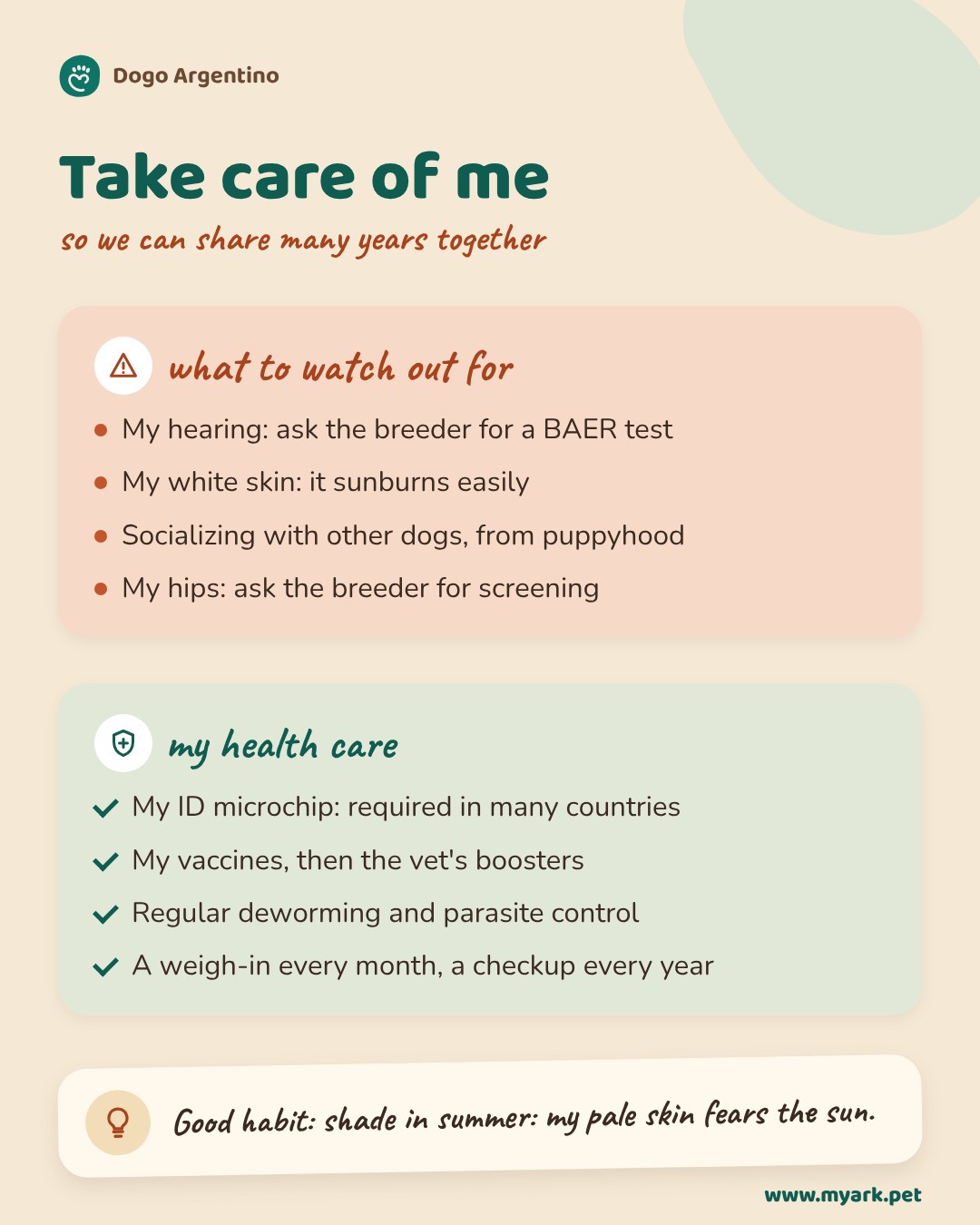
- a microchip registered with your details (a legal requirement in many countries, including the UK and France)
- core vaccinations, then boosters on the schedule your vet sets
- worming and flea and tick treatment on a regular schedule
- a weigh-in every month and a vet check-up every year
The stages of my life
- puppy
- Socialisation and gentle, reward-based training.
- adult
- Sport, games and long walks.
- senior
- From about 8 years old, a gentler pace.
What to keep an eye on
MyArk describes predispositions through visible body shape and simple checks rather than a list of diseases: it is what you can verify from the outside, and act on when choosing a breeder.
Hearing
Ask the breeder for the puppy’s BAER hearing test.
White skin
It burns easily in the sun.
Socialisation
Many calm meetings with dogs from puppyhood.
Hips
Ask the breeder for the hip screening results of both parents.
And, as for every dog:
- weight: extra kilos strain the joints, heart and breathing
- teeth, ears and nails, checked regularly
- parasite prevention and the vaccination schedule, with your vet
Is it the right dog for your household?
A dog is a social animal that copes badly with long days alone: the real question is less the breed than the time your household has. Before committing, consider rescues and rehoming charities too.
- Home
- Better with a house and garden (2 out of 5 in a flat).
- Young children
- Gentle with its family; its strength calls for supervision.
- Other pets
- Can be reactive with other dogs; a strong hunter of small pets.
- First dog
- Best with an experienced owner.
- Time alone
- Copes poorly with long absences (2 out of 5).
Dogo Argentino: straight answers
Is a Dogo Argentino a good family dog?
With an experienced owner and early socialisation, it is loyal and gentle with its family.
Is the Dogo Argentino a restricted breed?
In some countries, including the UK, it is banned or restricted: check the law where you live.
How big does a Dogo Argentino get?
The FCI standard gives 60 to 68 cm at the shoulder for males and 60 to 65 cm for females, for an adult weight of roughly 40 to 45 kg.
What colours does the Dogo Argentino come in?
The usual colours are and white.