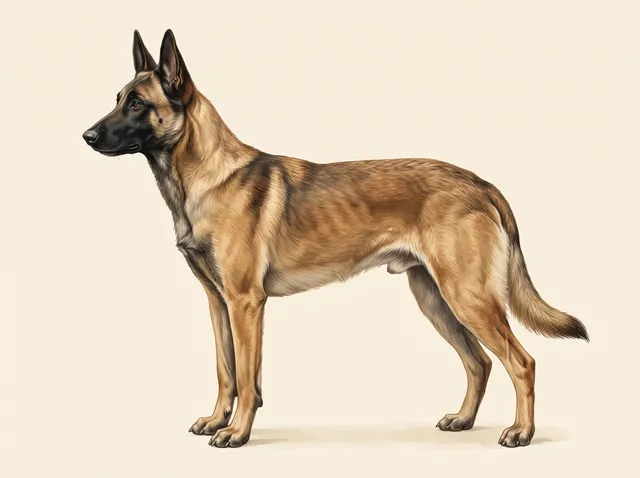
Where the Belgian Malinois comes from
The Malinois is one of the four varieties of Belgian Shepherd, with the Groenendael, the Tervueren and the Laekenois. They were fixed between 1891 and 1897 from Belgian herding dogs, and the Malinois is the short-coated, fawn and charcoal one. Its name comes from the town of Mechelen — Malines in French.
Once a sheepdog, it is now best known as a working dog for guarding, protection and tracking. The FCI standard describes it as watchful, active, bursting with vitality and always ready for action.
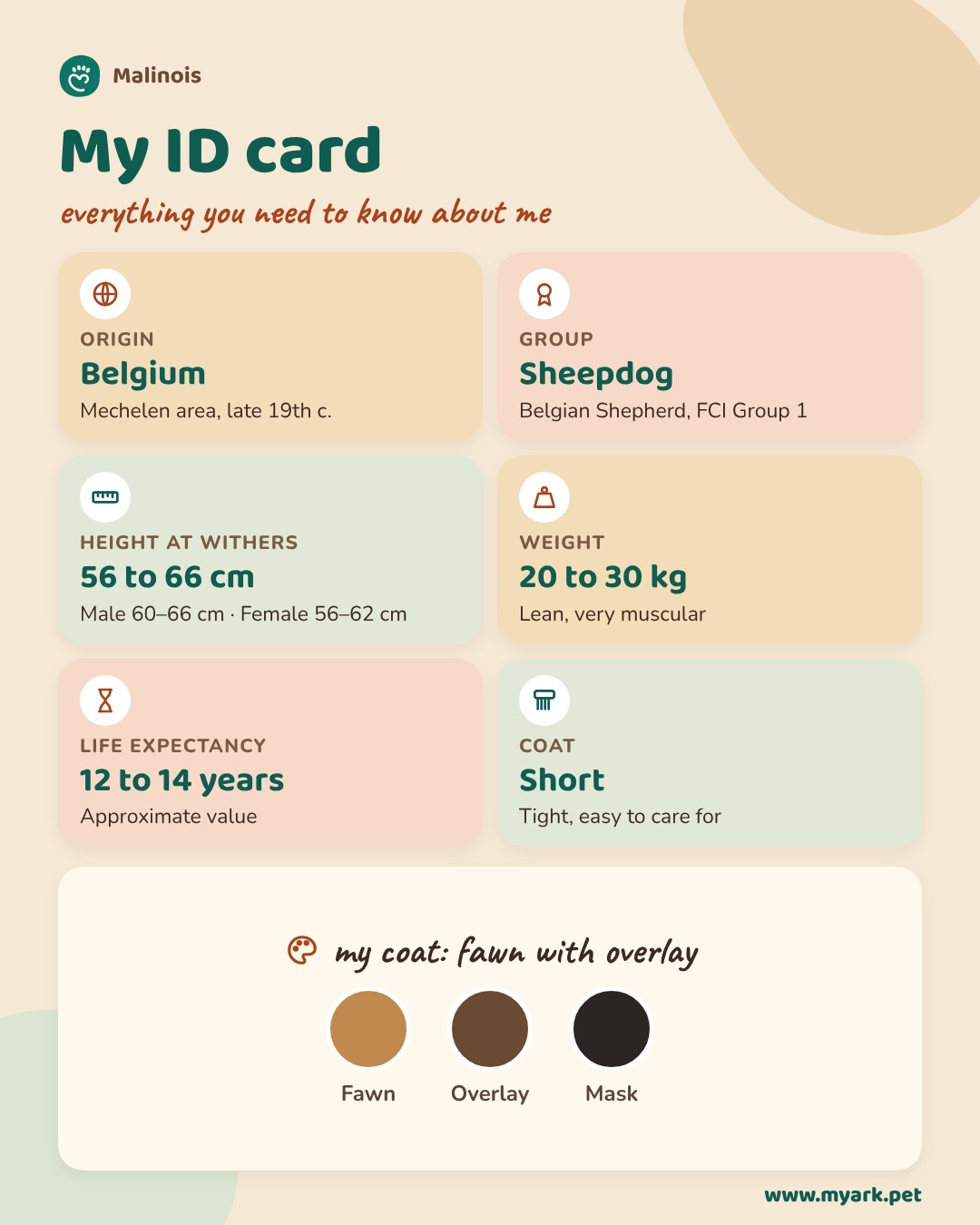
Height at the shoulder (FCI standard): about 62 cm (24 in) for males, 58 cm (23 in) for females.
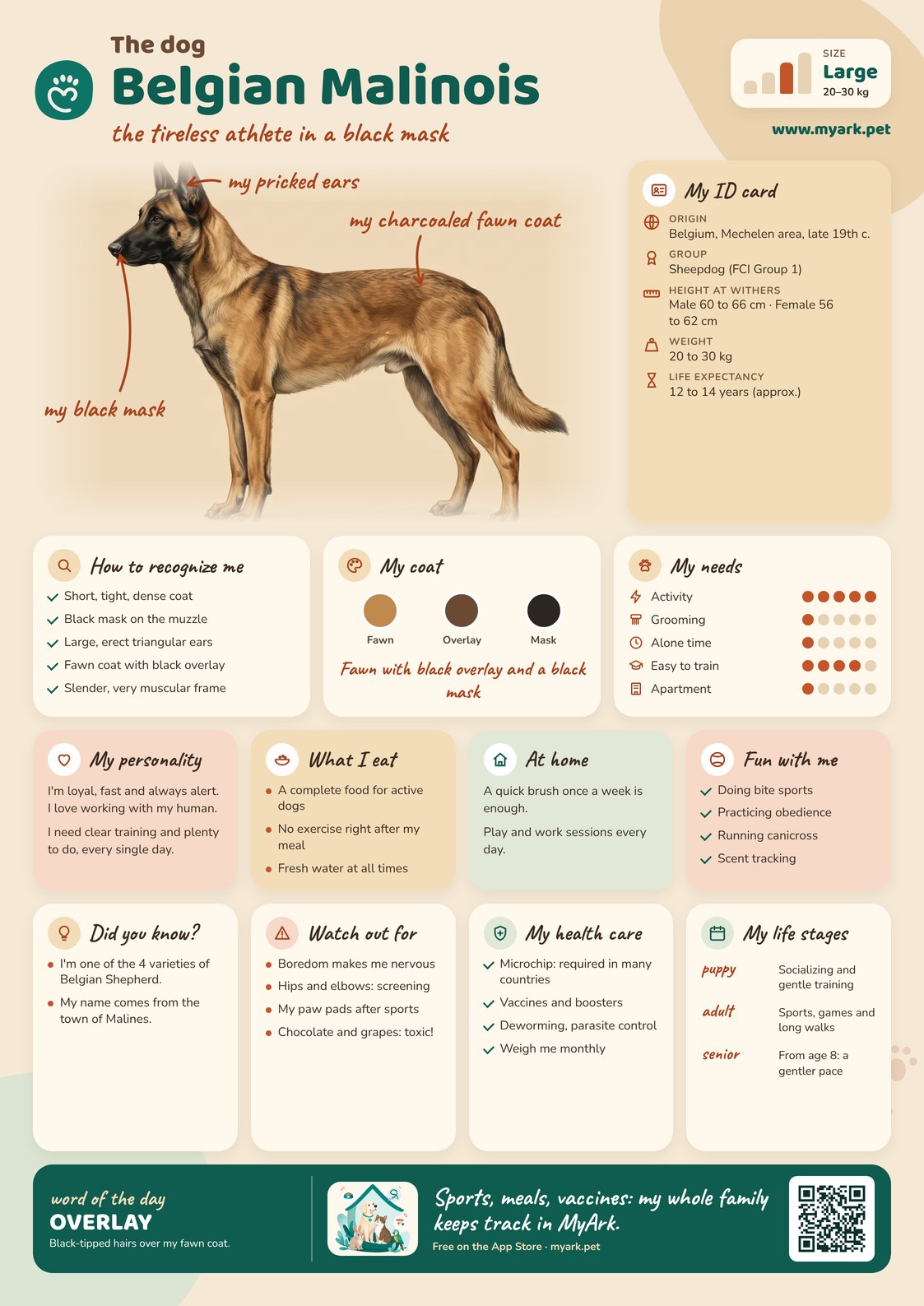
How to recognise me
- short, close, dense coat
- black mask on the muzzle
- large, upright triangular ears
- fawn coat tipped with black
- slender, very muscular build
My colours
- Fawn
- Charcoal-tipped
- Black mask
What a Belgian Malinois needs day to day
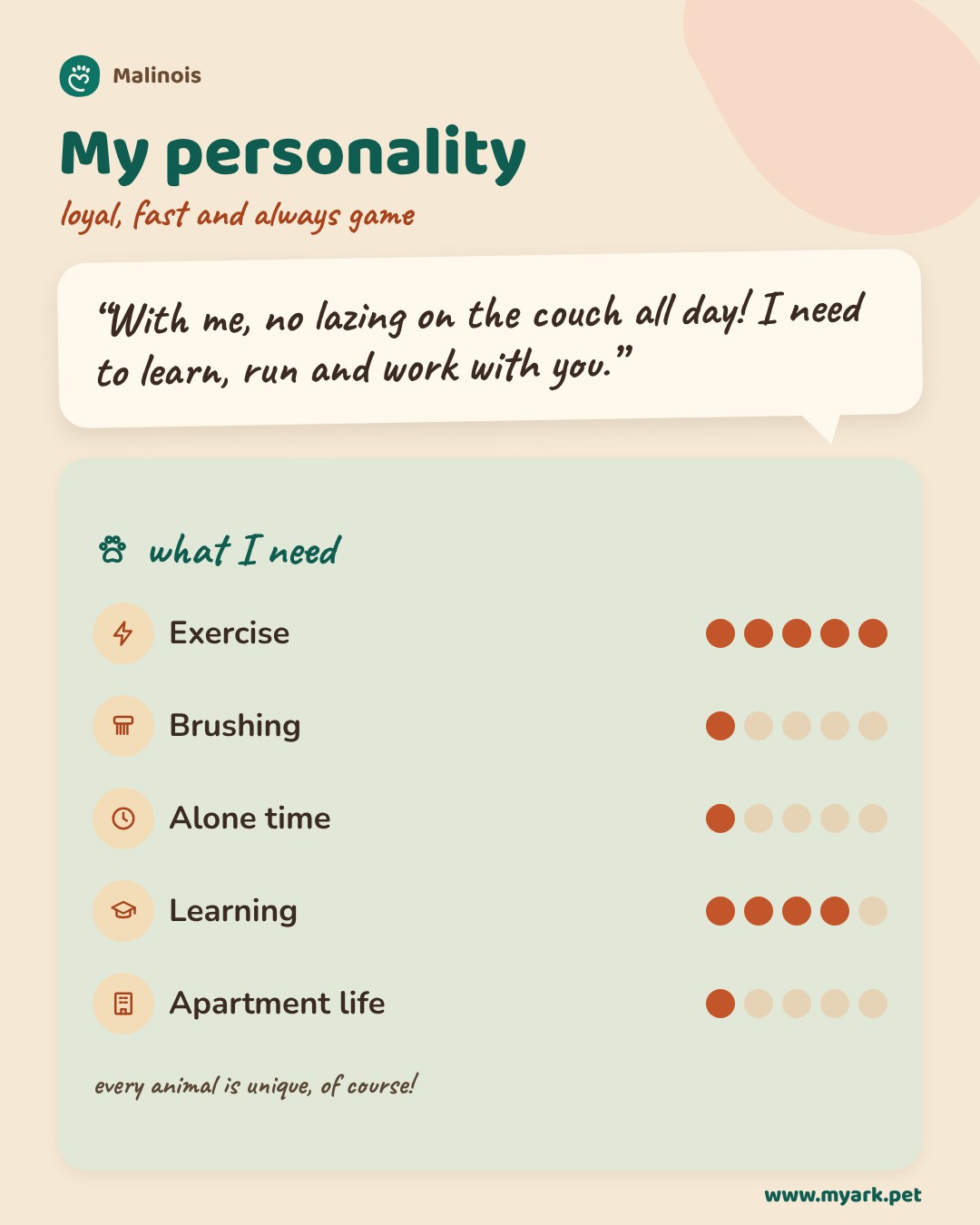
“With me, there’s no lying on the sofa all day! I need to learn, to run and to work with you.”
Its exercise needs are very high, and physical exercise alone is not enough: it needs daily training, problem-solving and a canine sport. Under-occupied, it becomes nervous and can turn its drive against the furniture — or the neighbours’ cat.
At a glance
- Exercise
- 5 out of 5
- Grooming
- 1 out of 5
- Coping alone
- 1 out of 5
- Ease of training
- 4 out of 5
- Flat living
- 1 out of 5
every dog is unique, of course!
With me, we can go…
- protection sports
- obedience
- canicross
- tracking
Living with a Belgian Malinois: who does what
Most of a dog’s care is repeated, shared and easy to forget. Here is the Belgian Malinois’s routine at a glance, and how a household can split it without a single “did anyone…?” message.
The routine at a glance
- every day
- two meals, with no hard exercise straight after; two long outings, one with real running; a training session of 15 to 20 minutes; a brain game or chew.
- every week
- a quick brush; a sport or club session; a pad check after sport.
- every month
- a weigh-in; flea, tick and worming treatment on your vet’s schedule; a nail check.
- every year
- the vet check-up and vaccine boosters.
Sharing it out
- One trainer, one set of cues: a Malinois learns fast and exploits any inconsistency, so the household agrees on words and rules before it arrives.
- The long run and the training session are separate jobs: put each on a name, not on whoever has time.
- Children can take part in calm games and simple tricks, but handling on lead and in sport is an adult’s job.
Before it arrives, agree on…
- who is the main trainer, and which cues everyone uses
- which sport or club it will do, and who takes it
- who covers the middle of the day — it copes badly alone
- how visitors and deliveries are handled at the door
- the plan for days when no one has time for a long outing
How MyArk helps the household keep track
Dog walk log
See who took it out, for how long, so the real exercise happens every day.
See the featureFamily pet chores
Put the run, the training session and the feeding on names, not on goodwill.
See the featurePet weight tracker
A monthly weigh-in to adjust the food to the season’s workload.
See the featurePet sitter instructions
Hand over cues, rules and contacts in one sheet before a sitter takes it.
See the featureFeeding, grooming and health routine
The coat is easy to keep: an occasional brush removes the dead hair.
What I eat
- a complete food for active dogs
- no hard exercise straight after a meal
- fresh water at all times
My health routine
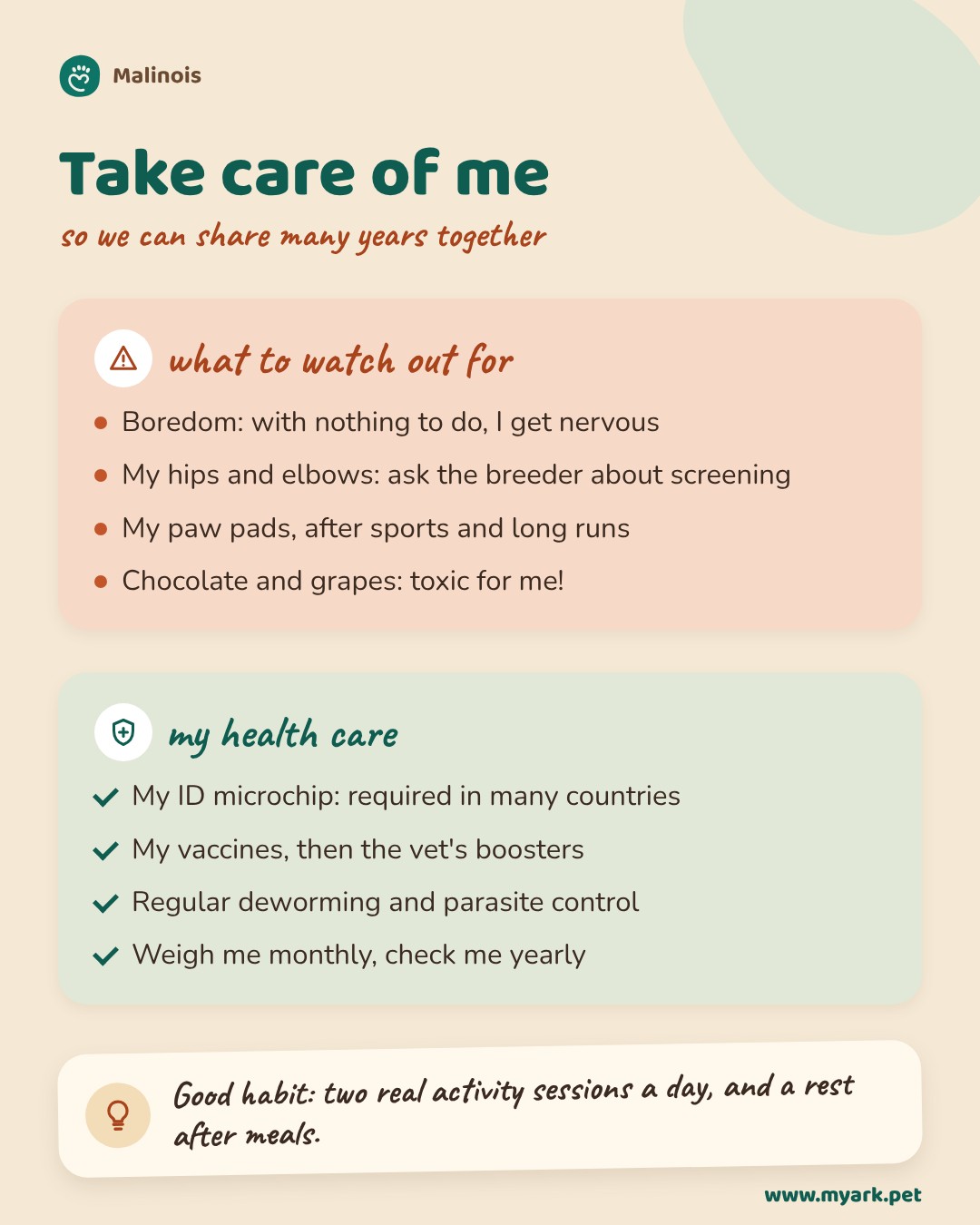
- a microchip registered with your details (a legal requirement in many countries, including the UK and France)
- core vaccinations, then boosters on the schedule your vet sets
- worming and flea and tick treatment on a regular schedule
- a weigh-in every month and a vet check-up every year
The stages of my life
- puppy
- Socialisation and gentle, reward-based training.
- adult
- Sport, games and long walks.
- senior
- From about 8 years old, a gentler pace.
What to keep an eye on
MyArk describes predispositions through visible body shape and simple checks rather than a list of diseases: it is what you can verify from the outside, and act on when choosing a breeder.
Boredom
Without something to do, it becomes nervous: daily mental work matters as much as running.
Hips and elbows
Ask the breeder for the hip and elbow screening results of both parents before you commit.
Paw pads
Check them after sport and long runs, especially on hard or hot ground.
Chocolate, grapes and raisins
All are toxic to dogs: keep them out of reach and call your vet straight away if your dog eats any.
And, as for every dog:
- weight: extra kilos strain the joints, heart and breathing
- teeth, ears and nails, checked regularly
- parasite prevention and the vaccination schedule, with your vet
Is it the right dog for your household?
A dog is a social animal that copes badly with long days alone: the real question is less the breed than the time your household has. Before committing, consider rescues and rehoming charities too.
- Home
- A house with a securely fenced garden suits it far better than a flat (1 out of 5).
- Young children
- Can live with children it is raised with, under supervision: its energy and herding reflexes can knock over or nip little ones.
- Other pets
- Socialise it early; its chase drive is strong with cats and small pets.
- First dog
- Not recommended: best with an experienced owner who already trains dogs.
- Time alone
- Its weakest point (1 out of 5): bored and alone, it gets anxious and destructive.
Belgian Malinois: straight answers
Is a Belgian Malinois a good family dog?
In an active, experienced household that trains it every day, yes. For a family looking for a calm companion, it is usually too demanding.
What is the difference between a Malinois and a German Shepherd?
The Malinois is lighter, faster and short-coated, with even more drive. Both need serious daily work.
How much exercise does a Malinois need?
Several outings a day, including real running, plus training or a canine sport. Exercise without mental work is not enough.
How big does a Belgian Malinois get?
The FCI standard gives about 62 cm at the shoulder for males and 58 cm for females, for an adult weight of roughly 20 to 30 kg.
What colours does the Belgian Malinois come in?
The usual colours are fawn, charcoal-tipped and black mask.