
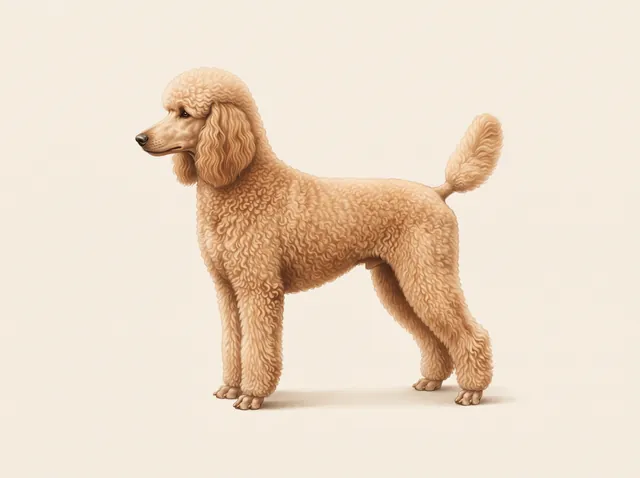
Where the Poodle comes from
The Poodle was originally a water dog, used to retrieve waterfowl. Its French name, “caniche”, is thought to come from “cane”, the female duck; the English name comes from the German “Pudel”, linked to splashing in water.
It is closely related to the Barbet, a curly-coated French water dog. The FCI recognises it as a French breed in four sizes, and describes it as loyal and exceptionally easy to train.
Height at the shoulder (FCI standard): four sizes: standard 45–60 cm (18–24 in), medium 35–45 cm (14–18 in), miniature 28–35 cm (11–14 in) and toy 24–28 cm (9–11 in).
How to recognise me
- dense, woolly, curly coat
- four different sizes
- fine head and long ears
- proud, elegant gait
- tail carried high
My colours
- Apricot
- Black
- White
- Grey
What a Poodle needs day to day
“I understand everything, or almost! Teach me tricks gently, and I’ll be your best pupil.”
Its exercise needs are moderate and depend on its size: daily walks and play suit a toy or miniature, while a standard Poodle enjoys longer outings. All sizes need something to think about — they learn fast and get bored easily.
At a glance
- Exercise
- 3 out of 5
- Grooming
- 5 out of 5
- Coping alone
- 2 out of 5
- Ease of training
- 5 out of 5
- Flat living
- 4 out of 5
every dog is unique, of course!
With me, we can go…
- agility
- learning tricks
- swimming
- fetch
Living with a Poodle: who does what
Most of a dog’s care is repeated, shared and easy to forget. Here is the Poodle’s routine at a glance, and how a household can split it without a single “did anyone…?” message.
The routine at a glance
- every day
- weighed meals suited to its size; walks and play suited to its size; a short training session; a quick brush of the areas that tangle (behind the ears, legs, armpits).
- every week
- a thorough brush and comb to the skin; toothbrushing several times a week; an ear check.
- every month
- a weigh-in; flea, tick and worming treatment on your vet’s schedule; a professional groom every six to eight weeks.
- every year
- the vet check-up, an eye check and vaccine boosters.
Sharing it out
- Split grooming into small jobs: a few minutes of daily brushing anyone can do, and one adult in charge of booking the groomer.
- Older children are often great at teaching tricks: a Poodle learns quickly from anyone who uses rewards consistently.
- Keep one shared list of cues — a fast learner also learns inconsistencies.
Before it arrives, agree on…
- which size suits your home and lifestyle
- the grooming budget and who books the groomer
- who does the daily brushing and the weekly toothbrushing
- the cues and house rules everyone uses
- who covers long days — it dislikes being alone
How MyArk helps the household keep track
Recurring pet care reminders
Recurring reminders for the groomer, toothbrushing and parasite treatment.
See the featurePet weight tracker
Track its weight with a curve, especially for small sizes.
See the featureFamily pet chores
Make brushing and training visible chores the whole household can share.
See the featurePet health record
Keep eye checks, dental notes and treatments in one record.
See the featureFeeding, grooming and health routine
Coat care is a real commitment: frequent, sometimes daily brushing, and grooming appointments to budget from the start.
What I eat
- a food suited to its size
- a ration weighed every day
- fresh water at all times
My health routine
- a microchip registered with your details (a legal requirement in many countries, including the UK and France)
- core vaccinations, then boosters on the schedule your vet sets
- worming and flea and tick treatment on a regular schedule
- a weigh-in every month and a vet check-up every year
The stages of my life
- puppy
- Socialisation and gentle, reward-based training.
- adult
- Sport, games and long walks.
- senior
- From about 8 years old, a gentler pace.
What to keep an eye on
MyArk describes predispositions through visible body shape and simple checks rather than a list of diseases: it is what you can verify from the outside, and act on when choosing a breeder.
Continuously growing coat
The coat does not moult: it grows all the time and needs care for life. Plan very regular brushing and a professional groom every six to eight weeks, and include it in the budget from the start.
Eyes
Have its eyes checked regularly by the vet.
Kneecaps
Especially in small sizes, tell your vet about any limping or a leg held up.
Teeth
Tartar builds up easily: ask your vet how to look after its teeth.
And, as for every dog:
- weight: extra kilos strain the joints, heart and breathing
- teeth, ears and nails, checked regularly
- parasite prevention and the vaccination schedule, with your vet
Is it the right dog for your household?
A dog is a social animal that copes badly with long days alone: the real question is less the breed than the time your household has. Before committing, consider rescues and rehoming charities too.
- Home
- Copes well with a modest home (4 out of 5), as long as it gets outings and stimulation.
- Young children
- Possible with clear rules and supervision; small sizes are fragile with toddlers.
- Other pets
- Usually fine with gradual introductions and a place for each animal to retreat.
- First dog
- Easy to train, but its grooming makes it a real commitment: first-time owners should plan for it from day one.
- Time alone
- Rated 2 out of 5: it is attached to its people and dislikes long absences.
Poodle: straight answers
Is a Poodle a good family dog?
Yes for many households: it is loyal, playful and very easy to train. Choose the size that suits your home, and budget for grooming.
Do Poodles shed?
Very little: the coat does not moult but grows continuously. That is why it needs very regular brushing and a professional groom every six to eight weeks.
What sizes do Poodles come in?
The FCI recognises four: standard (45 to 60 cm at the shoulder), medium (35 to 45 cm), miniature (28 to 35 cm) and toy (24 to 28 cm).
How long do Poodles live?
Roughly 12 to 16 years, depending largely on size and individual health.
What colours does the Poodle come in?
The usual colours are apricot, black, white and grey.