
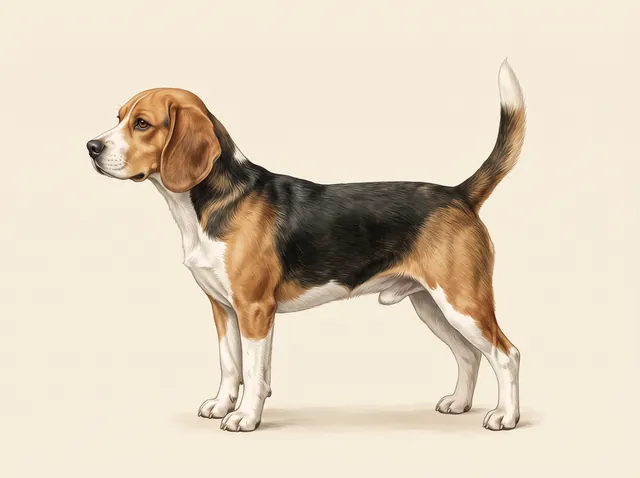
Where the Beagle comes from
The Beagle is a British scent hound, bred to hunt hare in packs alongside hunters on foot. Life in a pack explains its sociability with other dogs — and its dislike of being alone.
The FCI standard describes it as merry, bold and very active, with great stamina, alert, intelligent and even-tempered.
Height at the shoulder (FCI standard): 33–40 cm (13–16 in).
How to recognise me
- long, soft drop ears
- tricolour or two-colour coat
- tail carried high, with a white tip
- short, close coat
- compact, sturdy body
My colours
- Tricolour
- Lemon and white
- Red and white
What a Beagle needs day to day
“I’m always in a good mood! But careful: one interesting smell, and I forget everything else.”
Its exercise needs are high: long walks with plenty of sniffing, scent games and play with other dogs. A bored Beagle howls, digs or raids the kitchen.
At a glance
- Exercise
- 5 out of 5
- Grooming
- 1 out of 5
- Coping alone
- 1 out of 5
- Ease of training
- 2 out of 5
- Flat living
- 3 out of 5
every dog is unique, of course!
With me, we can go…
- sniffing walks
- finding hidden treats
- tracking
- playing with other dogs
Living with a Beagle: who does what
Most of a dog’s care is repeated, shared and easy to forget. Here is the Beagle’s routine at a glance, and how a household can split it without a single “did anyone…?” message.
The routine at a glance
- every day
- two weighed meals, food kept out of reach; two or three walks on a lead or long line, one of them long; a scent game at home; closing gates and doors behind you.
- every week
- a quick brush; an ear check; a walk round the garden fence.
- every month
- a weigh-in; flea, tick and worming treatment on your vet’s schedule; a nail check.
- every year
- the vet check-up and vaccine boosters.
Sharing it out
- One rule for everyone: the lead stays on outside fenced areas until the recall is proven — no exceptions on “quiet” walks.
- Food security is a household job: bins closed, bags on high shelves, plates never left on the coffee table.
- Children love scent games: hiding treats for the Beagle to find is a perfect job for them.
Before it arrives, agree on…
- the lead and long-line rules everyone follows
- where food, bins and school bags are kept
- who checks the garden fence and gates
- who covers the middle of the day — it hates being alone
- what to do, and who to call, if it gets out
How MyArk helps the household keep track
Pet feeding tracker
Log each meal: a Beagle will always swear it has not eaten.
See the featureDog walk log
See who took it out and when, so the long sniffing walk happens every day.
See the featurePet weight tracker
A monthly weigh-in and a curve, because it is very greedy.
See the featurePet sitter instructions
Hand over the lead rules, food rules and contacts in a ready-made sheet.
See the featureFeeding, grooming and health routine
The coat is easy to keep: an occasional brush removes the dead hair.
What I eat
- a complete food suited to its age
- a weighed ration — it is very greedy
- fresh water at all times
My health routine
- a microchip registered with your details (a legal requirement in many countries, including the UK and France)
- core vaccinations, then boosters on the schedule your vet sets
- worming and flea and tick treatment on a regular schedule
- a weigh-in every month and a vet check-up every year
The stages of my life
- puppy
- Socialisation and gentle, reward-based training.
- adult
- Sport, games and long walks.
- senior
- From about 8 years old, a gentler pace.
What to keep an eye on
MyArk describes predispositions through visible body shape and simple checks rather than a list of diseases: it is what you can verify from the outside, and act on when choosing a breeder.
Escaping
Its nose can lead it far: keep it on a lead until the recall is reliable, and check the garden fence.
Drop ears
Ears that hang down let less air into the ear canal, which makes infections more likely. A weekly check, and drying the ears after every swim, makes a real difference.
Strong chase instinct
The urge to chase can kick in faster than the recall. Plan how it will meet the household’s small pets, and keep off-lead time to fenced areas until the recall is reliable.
Chocolate, grapes and raisins
All are toxic to dogs: keep them out of reach and call your vet straight away if your dog eats any.
And, as for every dog:
- weight: extra kilos strain the joints, heart and breathing
- teeth, ears and nails, checked regularly
- parasite prevention and the vaccination schedule, with your vet
Is it the right dog for your household?
A dog is a social animal that copes badly with long days alone: the real question is less the breed than the time your household has. Before committing, consider rescues and rehoming charities too.
- Home
- Copes with a flat only if the walks and daily exercise genuinely happen; a securely fenced garden is a plus.
- Young children
- Usually very sociable, with clear rules on both sides and supervision.
- Other pets
- Good with other dogs; take care with small pets, as the urge to chase can override the recall.
- First dog
- Accessible to a well-informed first-time household ready for patient training.
- Time alone
- Its weakest point (1 out of 5): a pack dog, it howls and gets bored alone.
Beagle: straight answers
Is a Beagle a good family dog?
It is cheerful, sociable and usually good with children. It suits active households that can manage its nose, its appetite and its dislike of being alone.
Can a Beagle be let off the lead?
Only in fenced areas until its recall is truly reliable: once it has picked up a scent, it may not come back.
Are Beagles easy to train?
They are intelligent but independent, and their nose competes with your voice. Short, regular, reward-based sessions work best.
How big does a Beagle get?
According to the FCI standard, 33 to 40 cm at the shoulder, for an adult weight of roughly 10 to 15 kg.
What colours does the Beagle come in?
The usual colours are tricolour, lemon and white and red and white.