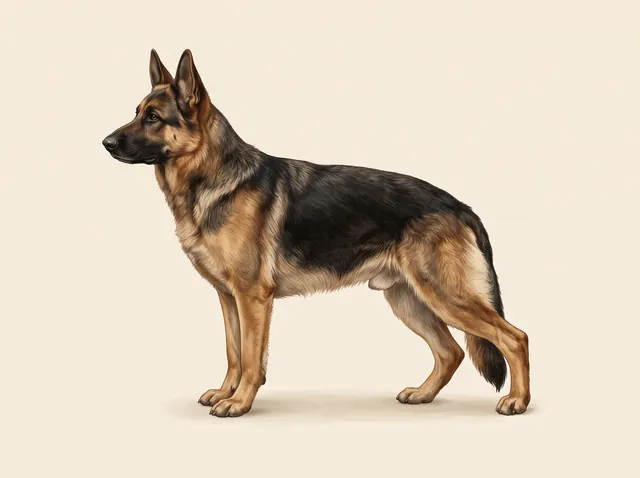
Where the German Shepherd Dog comes from
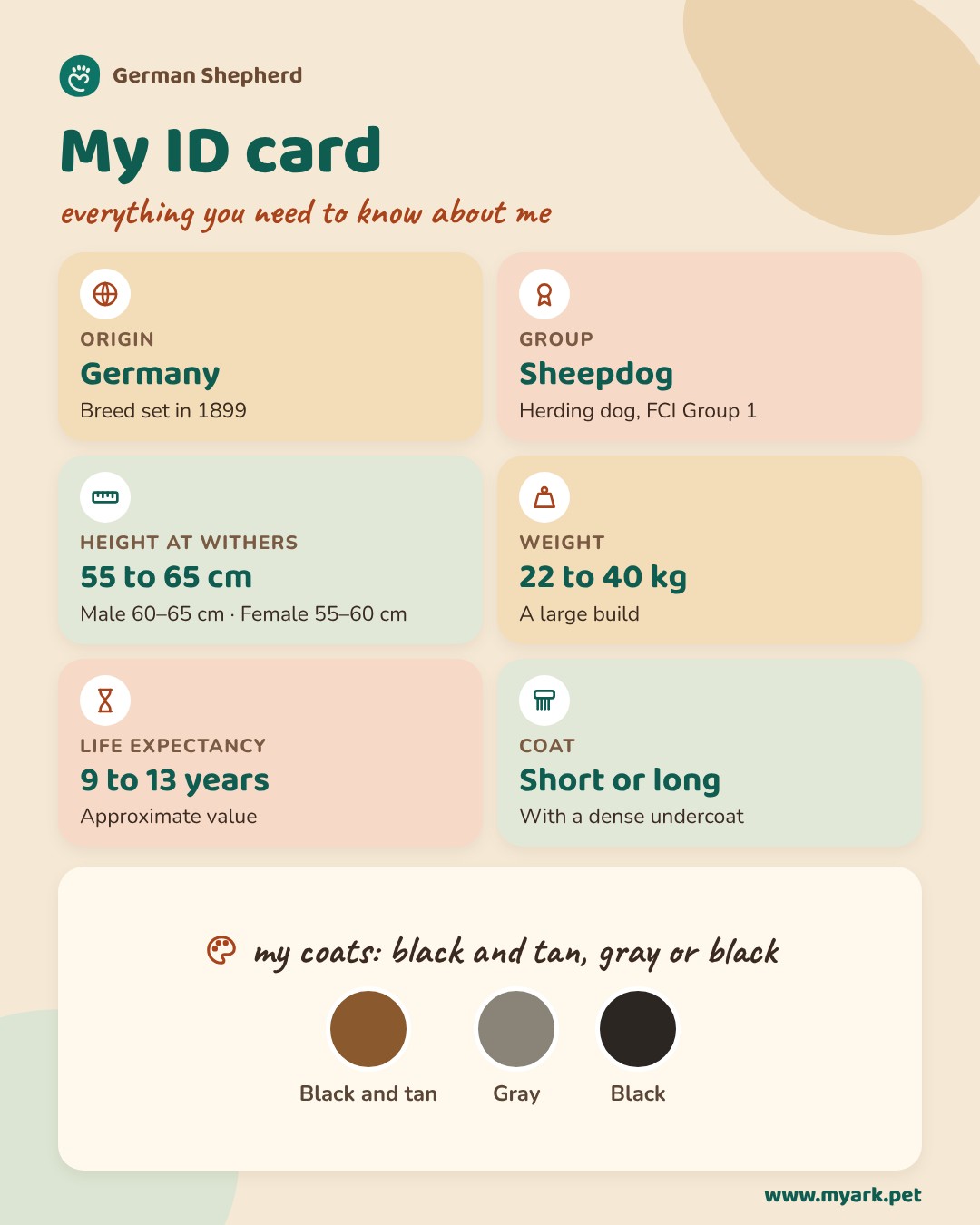
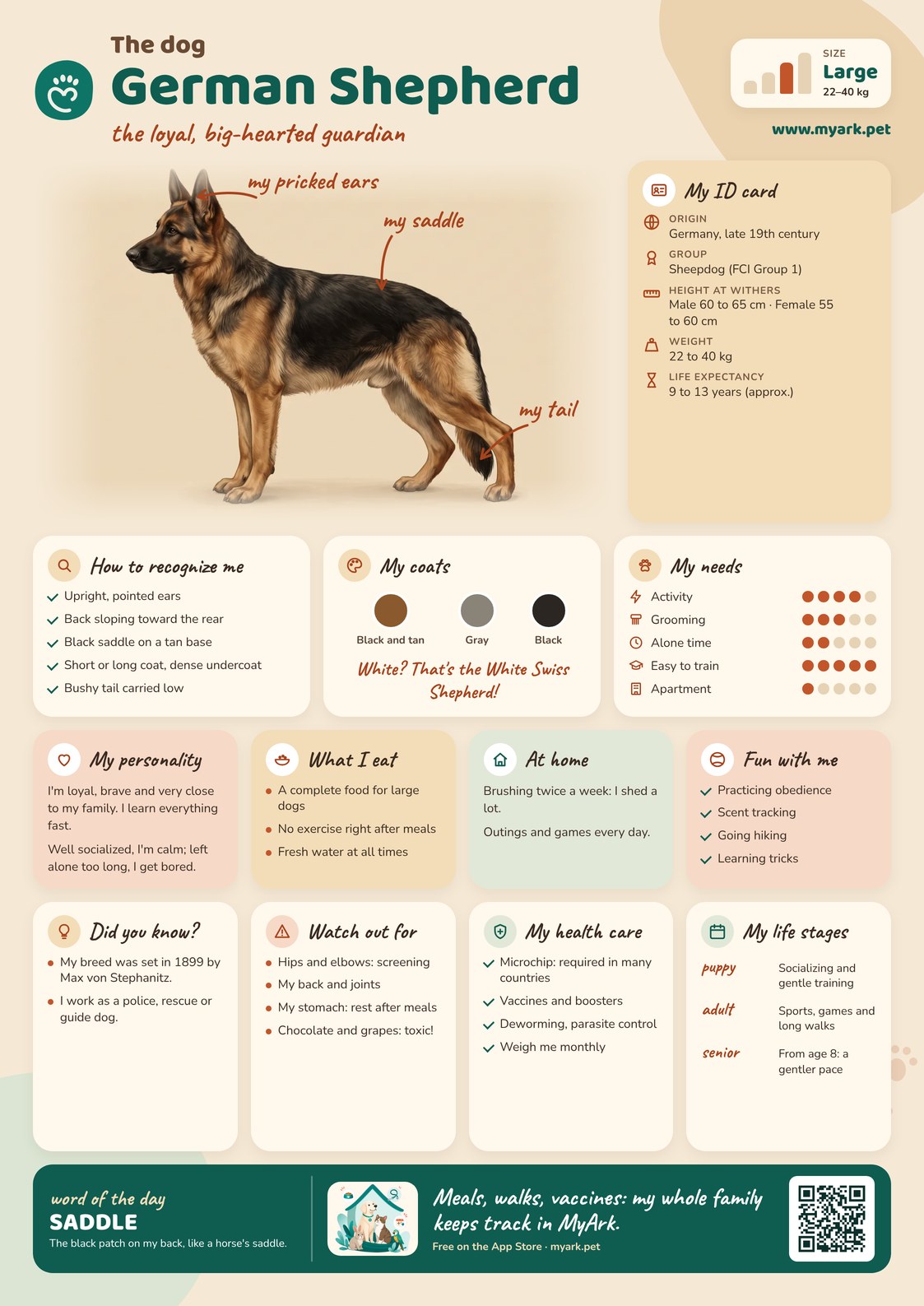
The breed was set in 1899, when the German breed club (SV) was founded on the proposals of Max von Stephanitz and A. Meyer, from the herding dogs of central and southern Germany.
It was selected as an all-round working dog — balanced, steady and willing to work — which is why it is still found in police, search and rescue and assistance roles.
Height at the shoulder (FCI standard): 60–65 cm (24–26 in) for males, 55–60 cm (22–24 in) for females.
How to recognise me
- upright, pointed ears
- back sloping gently towards the rear
- black saddle on a tan base
- short or long coat with a dense undercoat
- bushy tail carried low
My colours
- Black and tan
- Grey
- Black
What a German Shepherd Dog needs day to day
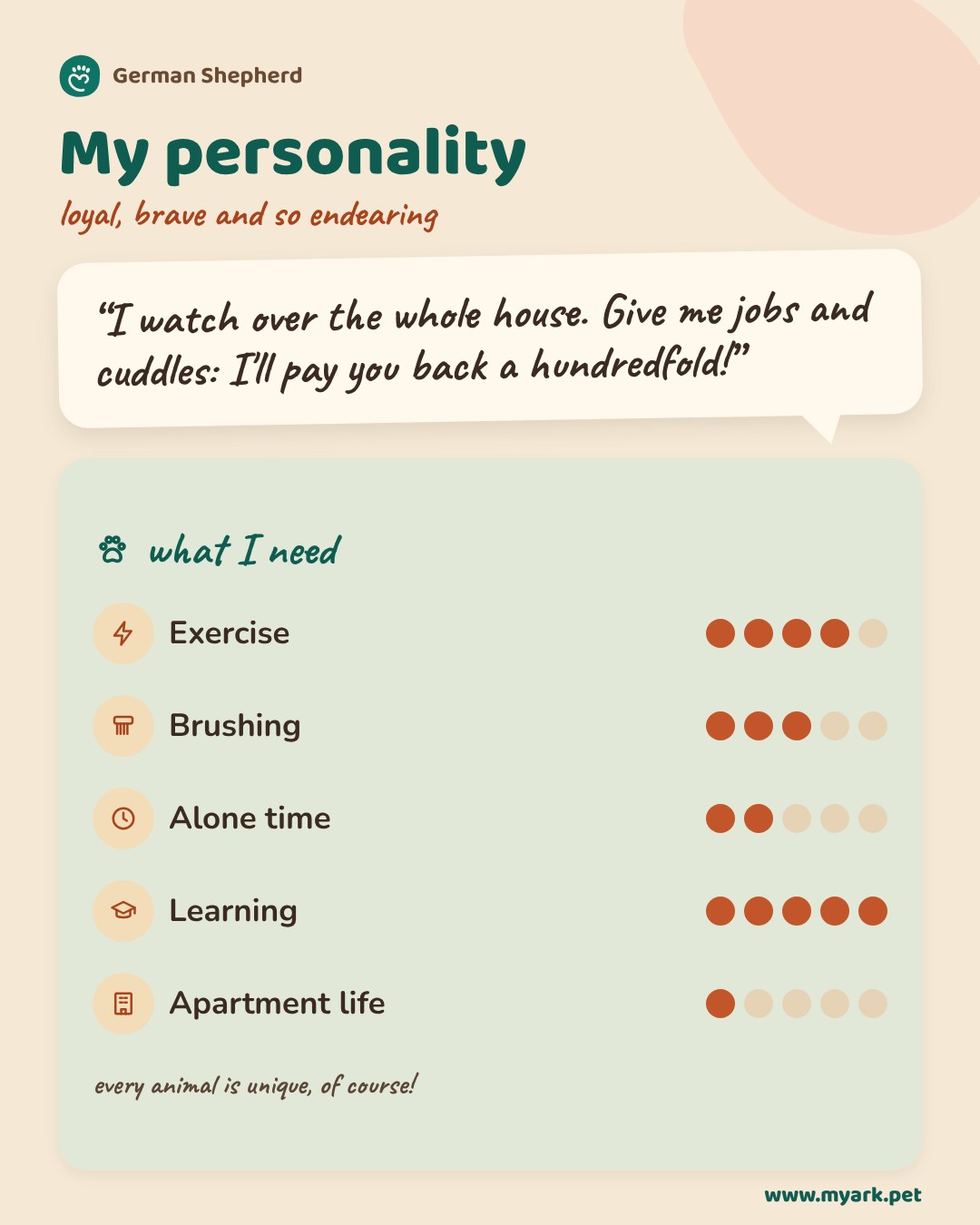
“I watch over the whole house. Give me missions and cuddles: I’ll pay you back a hundredfold!”
A German Shepherd needs daily exercise and, above all, regular brain work: obedience, scent work, problem-solving games. Without it, its alertness turns into barking, guarding or destructive habits.
At a glance
- Exercise
- 4 out of 5
- Grooming
- 3 out of 5
- Coping alone
- 2 out of 5
- Ease of training
- 5 out of 5
- Flat living
- 1 out of 5
every dog is unique, of course!
With me, we can go…
- obedience
- tracking
- hiking
- learning tricks
Living with a German Shepherd Dog: who does what
Most of a dog’s care is repeated, shared and easy to forget. Here is the German Shepherd Dog’s routine at a glance, and how a household can split it without a single “did anyone…?” message.
The routine at a glance
- every day
- two meals, with rest before and after; two or three walks, including one long outing; a short training session (10–15 minutes); a game that makes it think.
- every week
- two or three brushing sessions (daily during the moult); a new place to walk, for socialisation.
- every month
- a weigh-in; flea, tick and worming treatment on your vet’s schedule; a nail check.
- every year
- the vet check-up and vaccine boosters, with a word about joints as it ages.
Sharing it out
- Consistency is everything: write down the cues and house rules, and have every adult use them the same way.
- One person can lead training classes, but everyone practises the basics at home so it listens to the whole household.
- Meals and rest go together: whoever serves dinner also makes sure it rests afterwards, rather than heading straight out for play.
Before it arrives, agree on…
- who goes to training classes in the first year
- the cues and house rules everyone uses
- how visitors are welcomed, so guarding does not become a habit
- who covers the middle of the day
- the rule of no hard exercise straight after meals
How MyArk helps the household keep track
Dog walk log
Track walks and training outings, and see who took it.
See the featurePet feeding tracker
Log meal times so the after-meal rest rule is easy to follow.
See the featurePet health record
Keep treatments, vet visits and weight in one record — useful as joints age.
See the featureFamily pet chores
Share the daily jobs visibly between all the adults involved.
See the featureFeeding, grooming and health routine
The coat needs regular brushing, more often during the moult.
What I eat
- a complete food for large dogs
- no exercise right after a meal
- fresh water at all times
My health routine
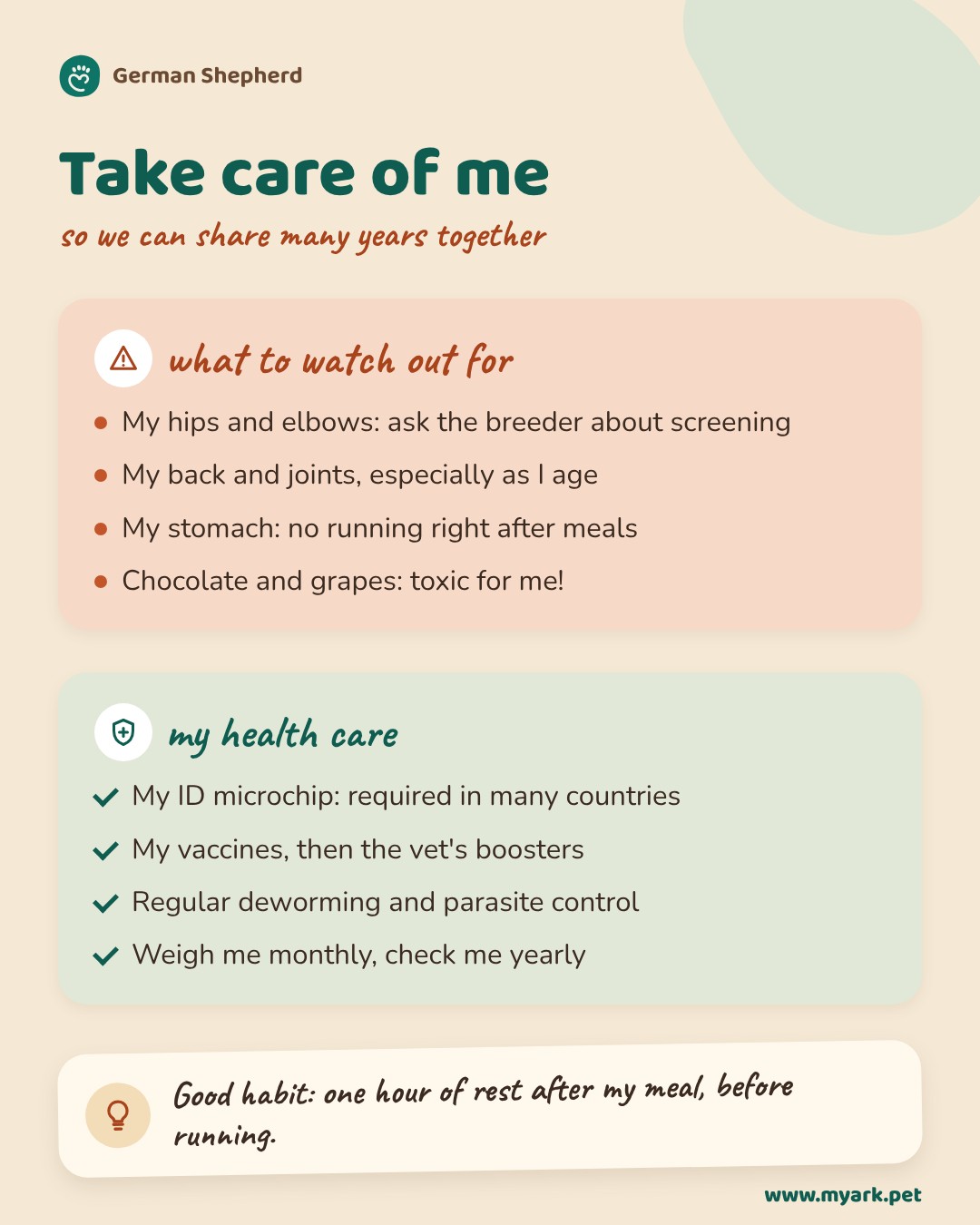
- a microchip registered with your details (a legal requirement in many countries, including the UK and France)
- core vaccinations, then boosters on the schedule your vet sets
- worming and flea and tick treatment on a regular schedule
- a weigh-in every month and a vet check-up every year
The stages of my life
- puppy
- Socialisation and gentle, reward-based training.
- adult
- Sport, games and long walks.
- senior
- From about 8 years old, a gentler pace.
What to keep an eye on
MyArk describes predispositions through visible body shape and simple checks rather than a list of diseases: it is what you can verify from the outside, and act on when choosing a breeder.
Hips and elbows
Ask the breeder for the hip and elbow screening results of both parents before you commit.
Back and joints
As it ages, tell your vet about any stiffness, limping or difficulty getting up or climbing stairs.
Stomach
Let it rest after meals, and treat it as an emergency if its belly swells while it tries to vomit without bringing anything up.
Chocolate, grapes and raisins
All are toxic to dogs: keep them out of reach and call your vet straight away if your dog eats any.
And, as for every dog:
- weight: extra kilos strain the joints, heart and breathing
- teeth, ears and nails, checked regularly
- parasite prevention and the vaccination schedule, with your vet
Is it the right dog for your household?
A dog is a social animal that copes badly with long days alone: the real question is less the breed than the time your household has. Before committing, consider rescues and rehoming charities too.
- Home
- Not made for flat life (1 out of 5): it needs space, and above all daily outings and work.
- Young children
- Possible with clear rules on both sides and supervised interactions; its size calls for care with toddlers.
- Other pets
- Can live with other animals with gradual introductions and a place for each to retreat.
- First dog
- Accessible to a well-informed first-time household ready to invest in training.
- Time alone
- Rated 2 out of 5: long days alone lead to boredom and barking.
German Shepherd Dog: straight answers
Is a German Shepherd a good family dog?
It can be a devoted family dog when it is well socialised, consistently trained and given enough exercise and mental work.
How much exercise does a German Shepherd need?
Several outings a day, including a long one, plus short daily training or scent-work sessions. Mental work matters as much as physical exercise.
Do German Shepherds shed a lot?
Yes. The dense undercoat sheds all year and heavily during the moult: brush two or three times a week, daily during a moult.
How big does a German Shepherd get?
According to the FCI standard, 60 to 65 cm at the shoulder for males and 55 to 60 cm for females, for an adult weight of roughly 22 to 40 kg.
What colours does the German Shepherd Dog come in?
The usual colours are black and tan, grey and black.