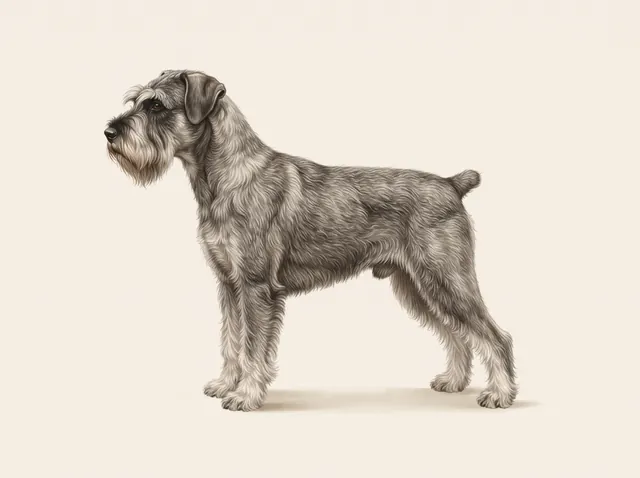
Where the Schnauzer comes from
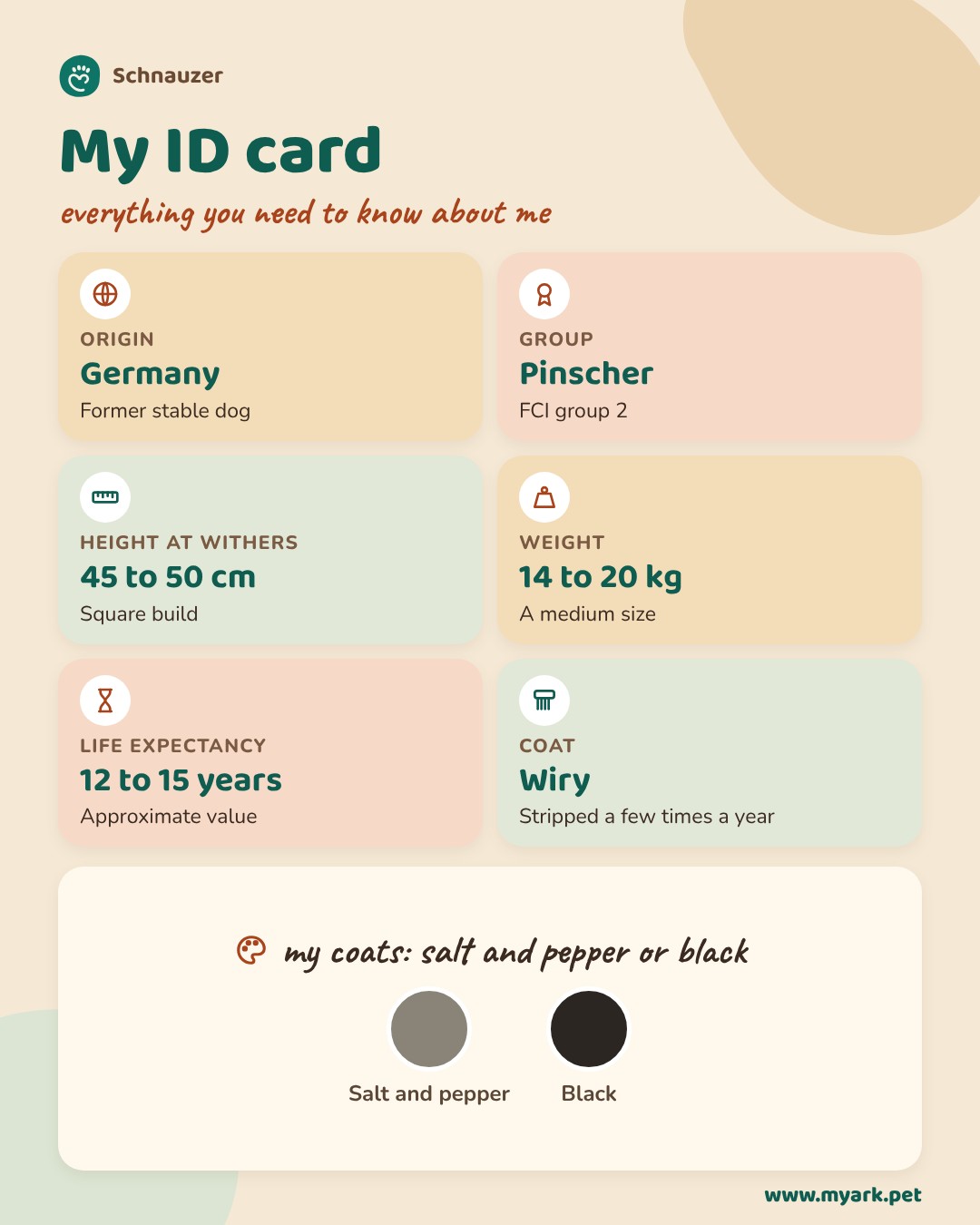
Originally a stable dog in southern Germany, at ease with horses and known for catching rodents. It was still called the “wire-haired Pinscher” when its club was founded in 1895.
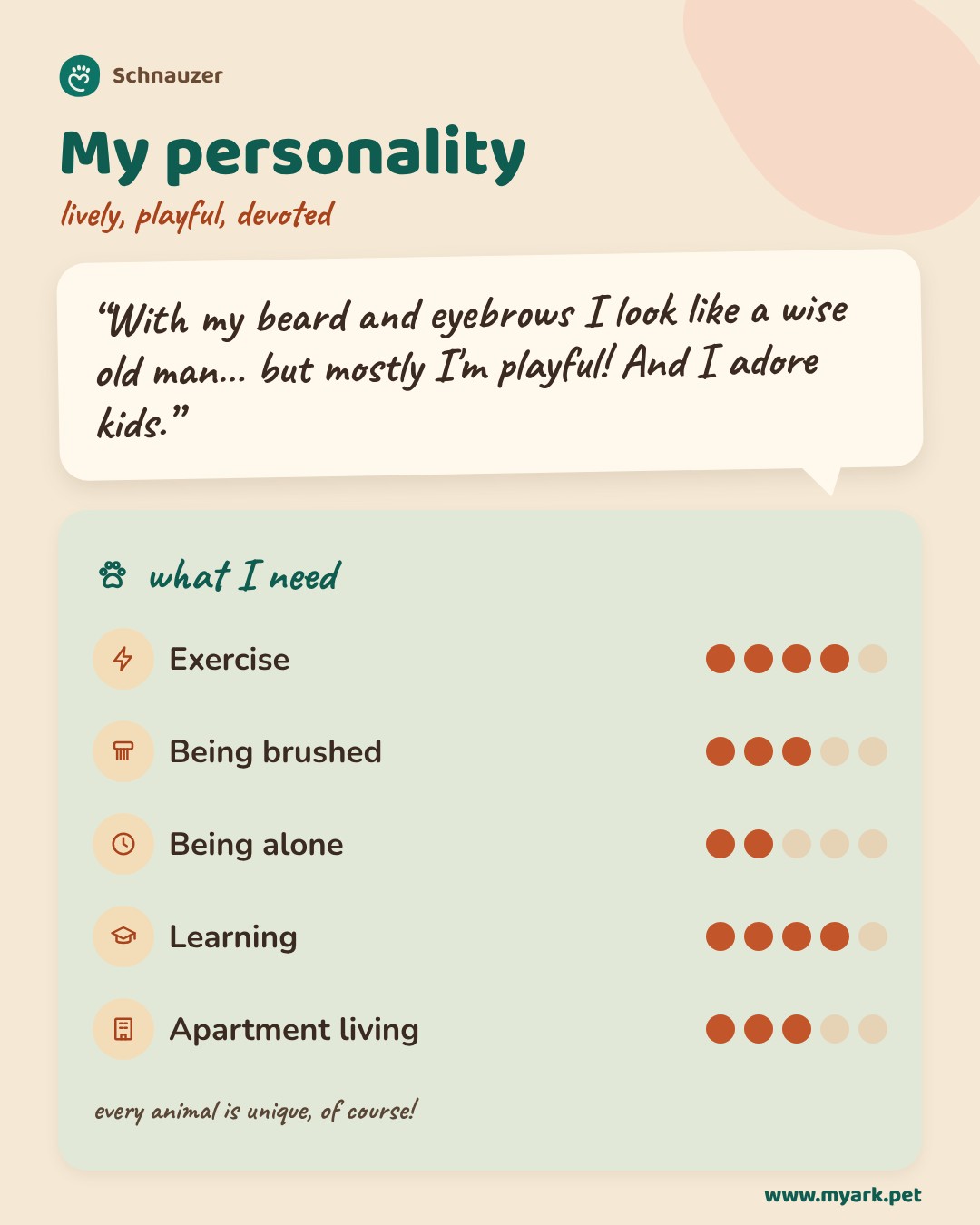
The FCI standard describes it as lively but steady, good-natured and playful, very attached to its owner and very fond of children.
Height at the shoulder (FCI standard): 45–50 cm (17.5–19.5 in) for the Standard Schnauzer.
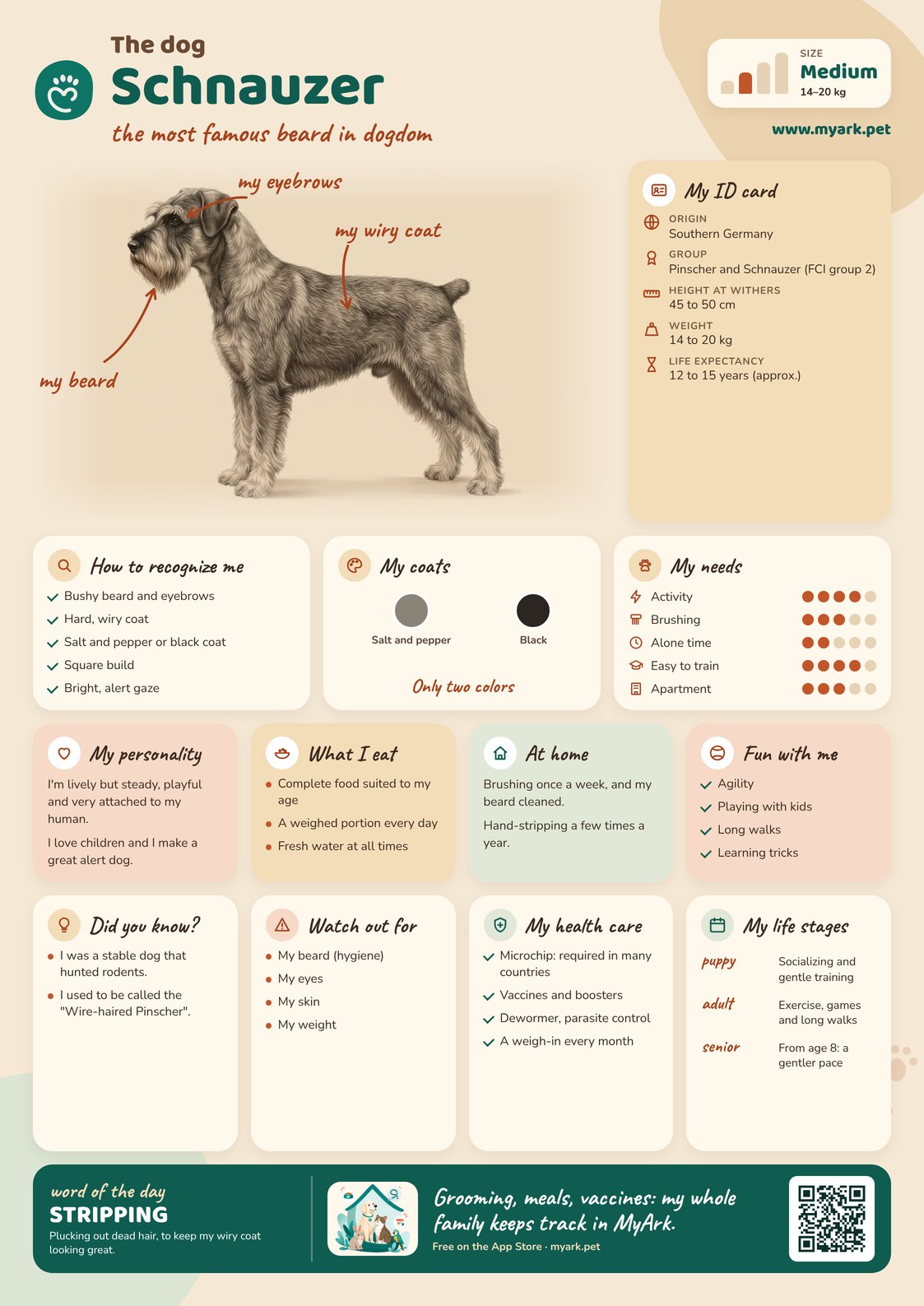
How to recognise me
- bushy beard and eyebrows
- wiry, harsh coat
- pepper and salt or black coat
- square outline
- lively expression
My colours
- Pepper and salt
- Black
What a Schnauzer needs day to day
“With my beard and eyebrows, I look like a wise old man… but mostly I’m playful! I love children.”
Its exercise needs are fairly high: brisk walks, games and training every day.
At a glance
- Exercise
- 4 out of 5
- Grooming
- 3 out of 5
- Coping alone
- 2 out of 5
- Ease of training
- 4 out of 5
- Flat living
- 3 out of 5
every dog is unique, of course!
With me, we can go…
- brisk walks
- obedience
- ball games
- playing with children
Living with a Schnauzer: who does what
Most of a dog’s care is repeated, shared and easy to forget. Here is the Schnauzer’s routine at a glance, and how a household can split it without a single “did anyone…?” message.
The routine at a glance
- every day
- a weighed ration; two walks, one brisk; a beard wipe after meals.
- every week
- a brush and comb; an ear and eye check.
- every month
- a weigh-in; flea, tick and worming treatment on your vet’s schedule; a nail check; hand-stripping or a groomer visit every two or three months.
- every year
- the vet check-up and vaccine boosters.
Sharing it out
- The beard wipe after meals is quick — give it to whoever feeds it.
- Children make great playmates and training partners.
- Book the groomer on a fixed rhythm.
Before it arrives, agree on…
- who walks it
- who brushes and wipes the beard
- the groomer rhythm
- barking rules
- who covers long days away
How MyArk helps the household keep track
Family pet chores
Walks, brushing and groomer visits on named people.
See the featurePet weight tracker
A monthly weigh-in.
See the featureDog walk log
Log the daily walks.
See the featurePet sitter instructions
Routine and contacts for a sitter.
See the featureFeeding, grooming and health routine
Coat care is a real commitment: frequent, sometimes daily brushing, and grooming appointments to budget from the start.
What I eat
- a complete food suited to its size and age
- a weighed ration every day
- fresh water at all times
My health routine
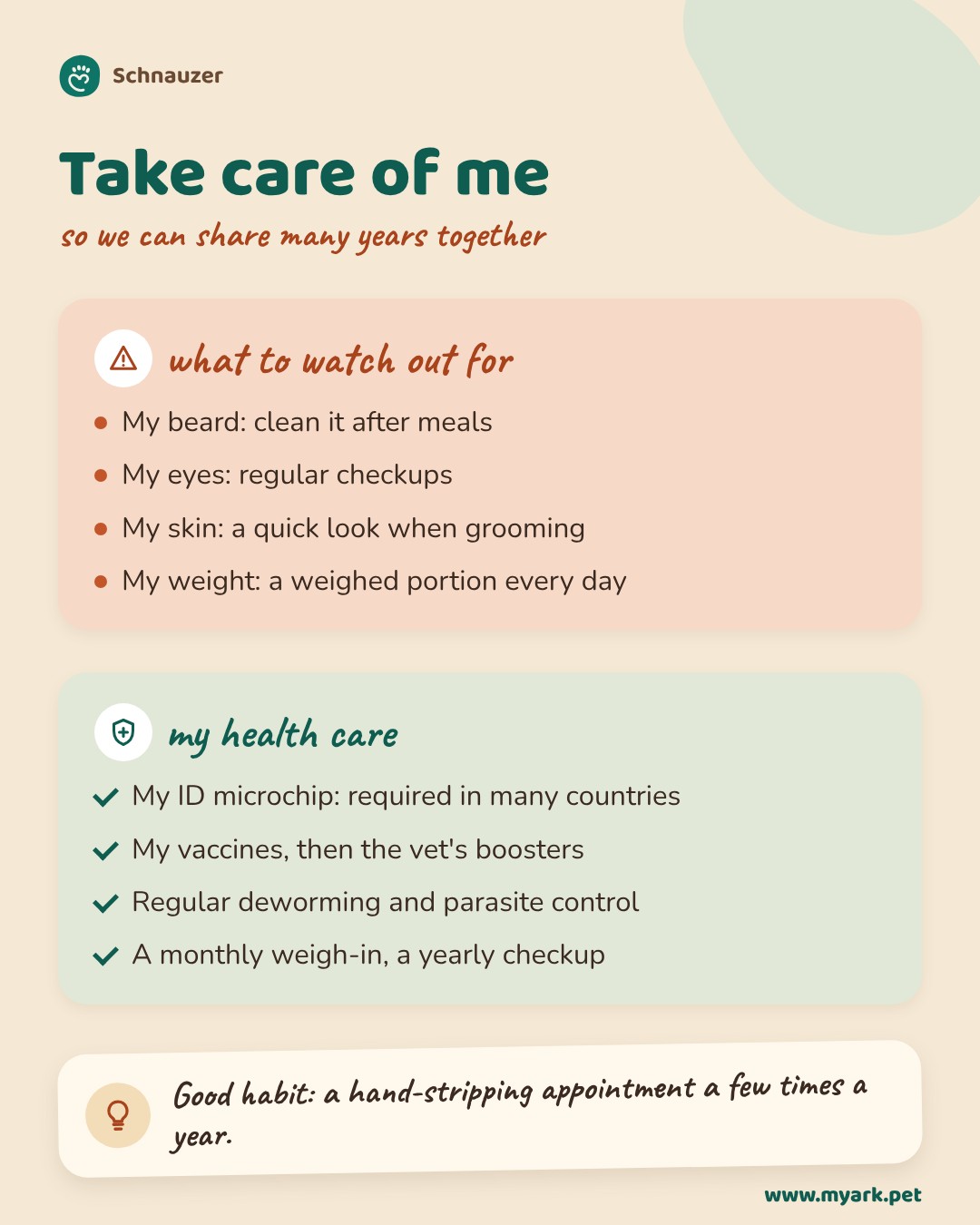
- a microchip registered with your details (a legal requirement in many countries, including the UK and France)
- core vaccinations, then boosters on the schedule your vet sets
- worming and flea and tick treatment on a regular schedule
- a weigh-in every month and a vet check-up every year
The stages of my life
- puppy
- Socialisation and gentle, reward-based training.
- adult
- Sport, games and long walks.
- senior
- From about 8 years old, a gentler pace.
What to keep an eye on
MyArk describes predispositions through visible body shape and simple checks rather than a list of diseases: it is what you can verify from the outside, and act on when choosing a breeder.
Beard
Clean it after meals.
Eyes
Some lines carry inherited eye conditions: ask the breeder for the parents’ eye test results, and have the eyes checked at every visit.
Skin
Look at it at each grooming session.
Weight
A weighed ration every day.
And, as for every dog:
- weight: extra kilos strain the joints, heart and breathing
- teeth, ears and nails, checked regularly
- parasite prevention and the vaccination schedule, with your vet
Is it the right dog for your household?
A dog is a social animal that copes badly with long days alone: the real question is less the breed than the time your household has. Before committing, consider rescues and rehoming charities too.
- Home
- Copes with a flat if exercised daily (3 out of 5).
- Young children
- Very fond of children.
- Other pets
- Usually fine; may chase small rodents.
- First dog
- A good first dog for an active household.
- Time alone
- Copes poorly with long absences (2 out of 5).
Schnauzer: straight answers
Is a Schnauzer a good family dog?
Yes: playful, steady and very fond of children.
Does a Schnauzer shed?
Little, but its wiry coat needs hand-stripping or regular grooming.
How big does a Schnauzer get?
The Standard Schnauzer measures 45 to 50 cm at the shoulder; Miniature and Giant Schnauzers are separate sizes.
What colours does the Schnauzer come in?
The usual colours are pepper and salt and black.