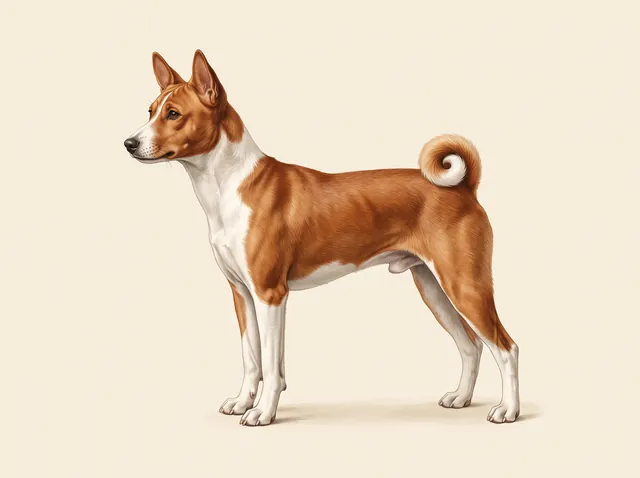
Where the Basenji comes from
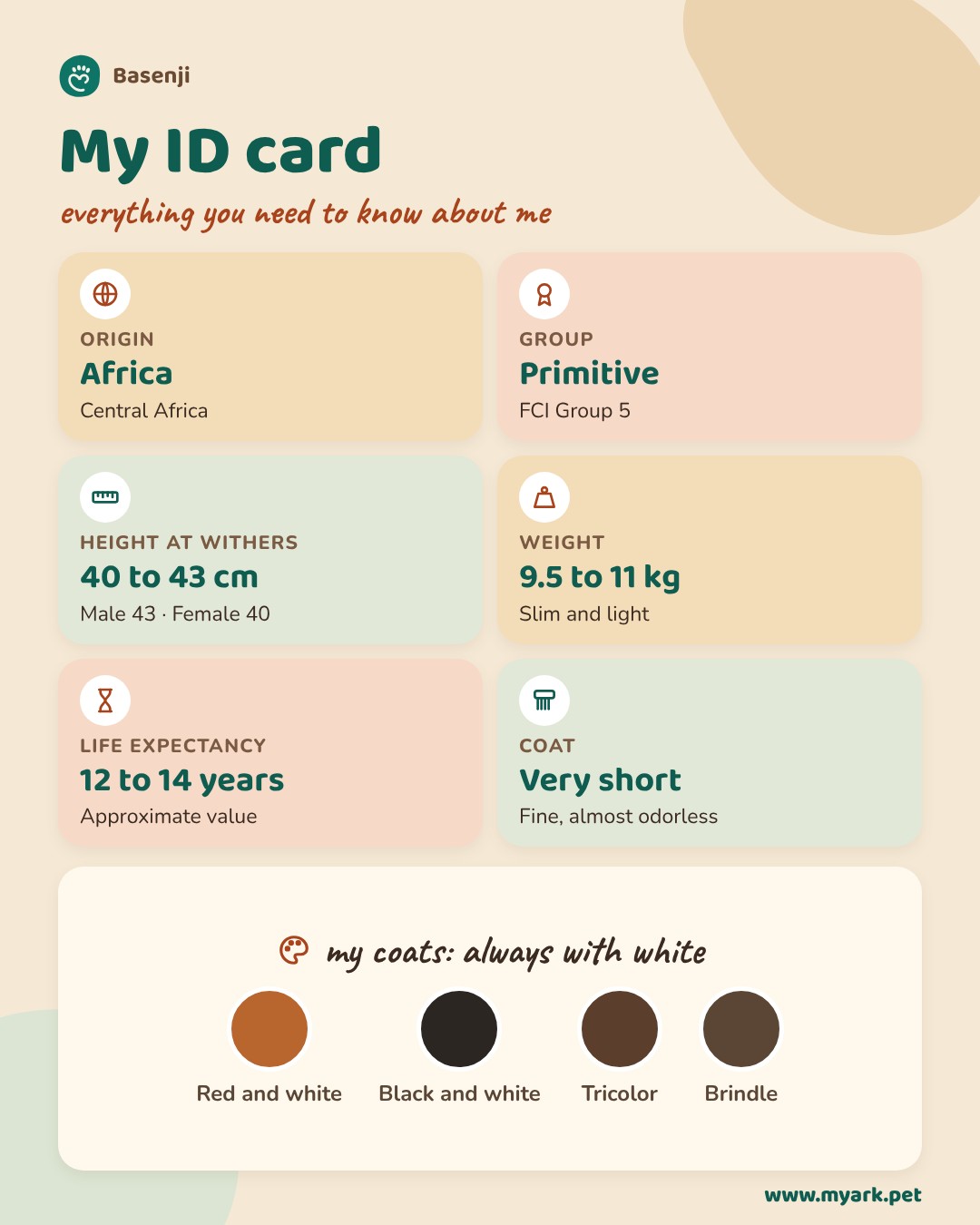
A primitive-type dog from central Africa, classed by the FCI with the spitz and primitive breeds.
The FCI standard describes it as intelligent, independent but affectionate and alert, sometimes aloof with strangers. It does not bark but is not mute: it makes a special sound between a chortle and a yodel.
Height at the shoulder (FCI standard): 43 cm (17 in) for males, 40 cm (16 in) for females.
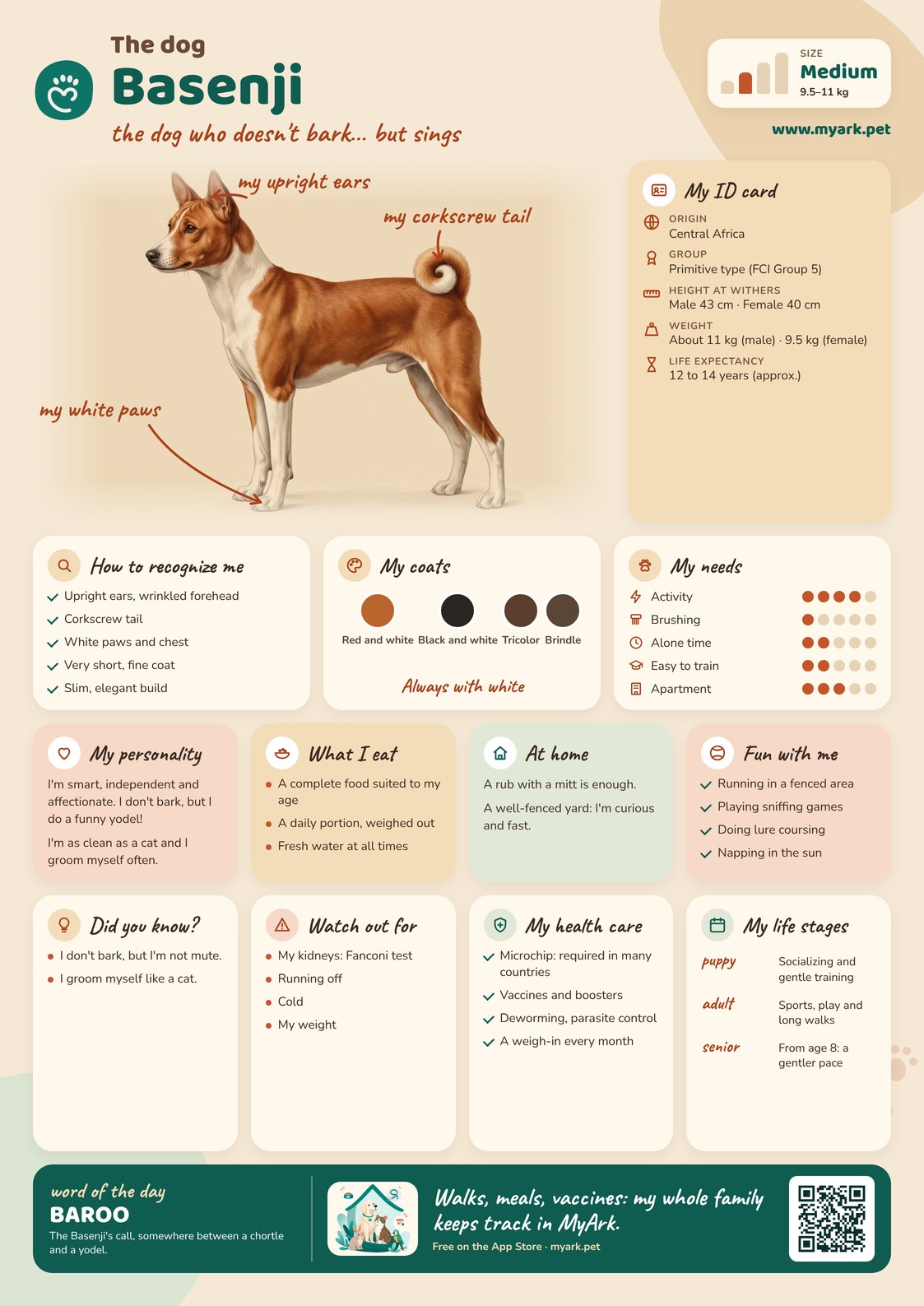
How to recognise me
- upright, pointed ears
- wrinkled forehead
- tightly curled tail
- short, fine coat
- light, elegant build
My colours
- Red and white
- Black and white
- Tricolour
- Brindle
What a Basenji needs day to day
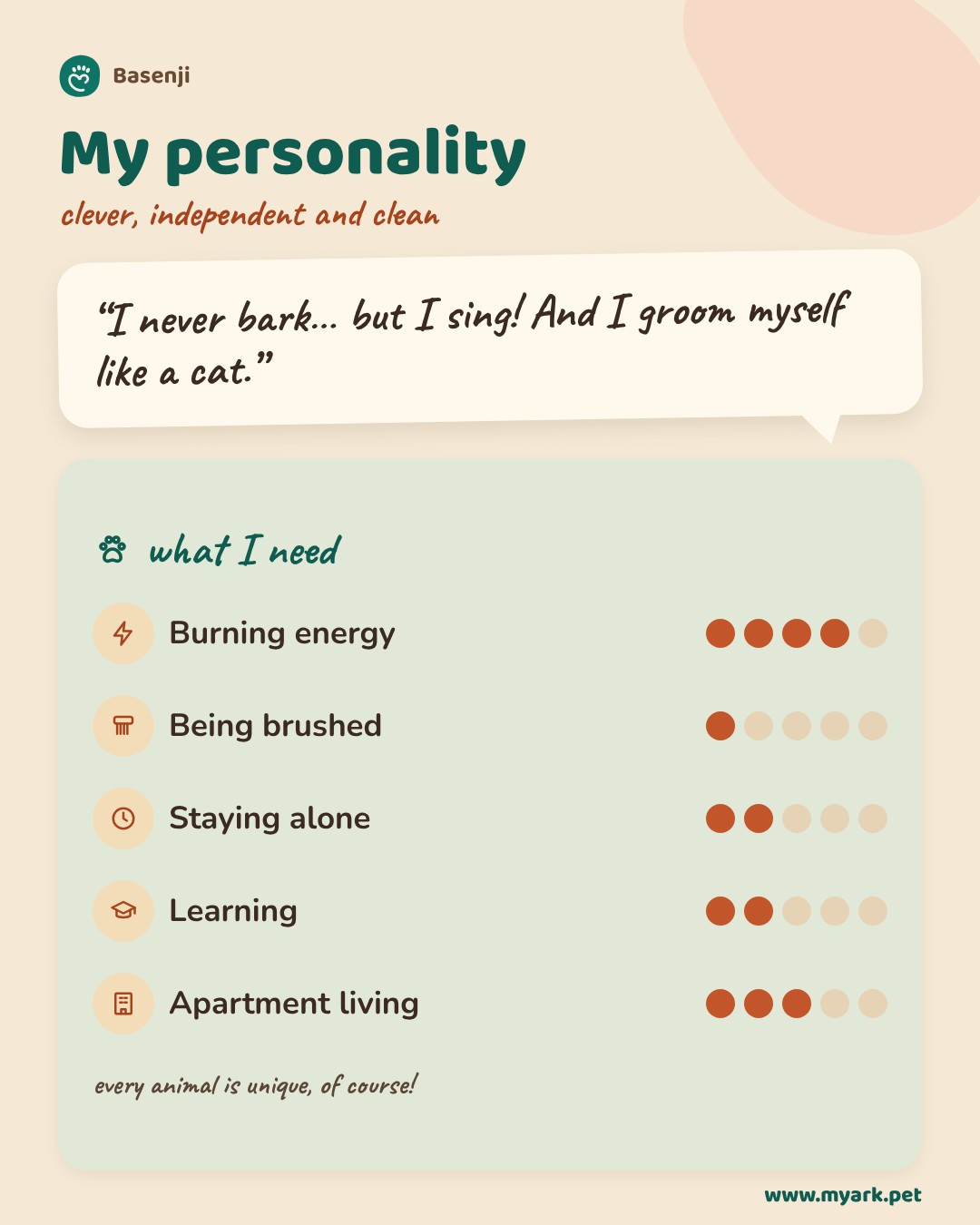
“I never bark… but I sing! And I wash myself like a cat.”
Its exercise needs are fairly high: brisk walks on a lead and runs in secure areas. Independent, it needs patient training.
At a glance
- Exercise
- 4 out of 5
- Grooming
- 1 out of 5
- Coping alone
- 2 out of 5
- Ease of training
- 2 out of 5
- Flat living
- 3 out of 5
every dog is unique, of course!
With me, we can go…
- brisk walks
- lure coursing
- running in a secure field
- puzzle games
Living with a Basenji: who does what
Most of a dog’s care is repeated, shared and easy to forget. Here is the Basenji’s routine at a glance, and how a household can split it without a single “did anyone…?” message.
The routine at a glance
- every day
- a weighed ration; two brisk walks on a lead; a puzzle or chase game.
- every week
- a quick brush; a fence check.
- every month
- a weigh-in; flea, tick and worming treatment on your vet’s schedule; a nail check.
- every year
- the vet check-up and vaccine boosters; a urine check for Fanconi syndrome.
Sharing it out
- Lead on outside: it is fast and curious.
- A warm coat for cold walks.
- Patient, short training sessions, shared fairly.
Before it arrives, agree on…
- the lead rule
- who checks the fence
- its winter coat
- what it may chew
- who covers long days away
How MyArk helps the household keep track
Pet health record
Fanconi tests and vet notes in one place.
See the featureDog walk log
Log the brisk daily walks.
See the featurePet weight tracker
A weighed ration and a monthly weigh-in.
See the featurePet sitter instructions
Escape and cold rules for a sitter.
See the featureFeeding, grooming and health routine
The coat is easy to keep: an occasional brush removes the dead hair.
What I eat
- a complete food suited to its age
- a weighed ration every day
- fresh water at all times
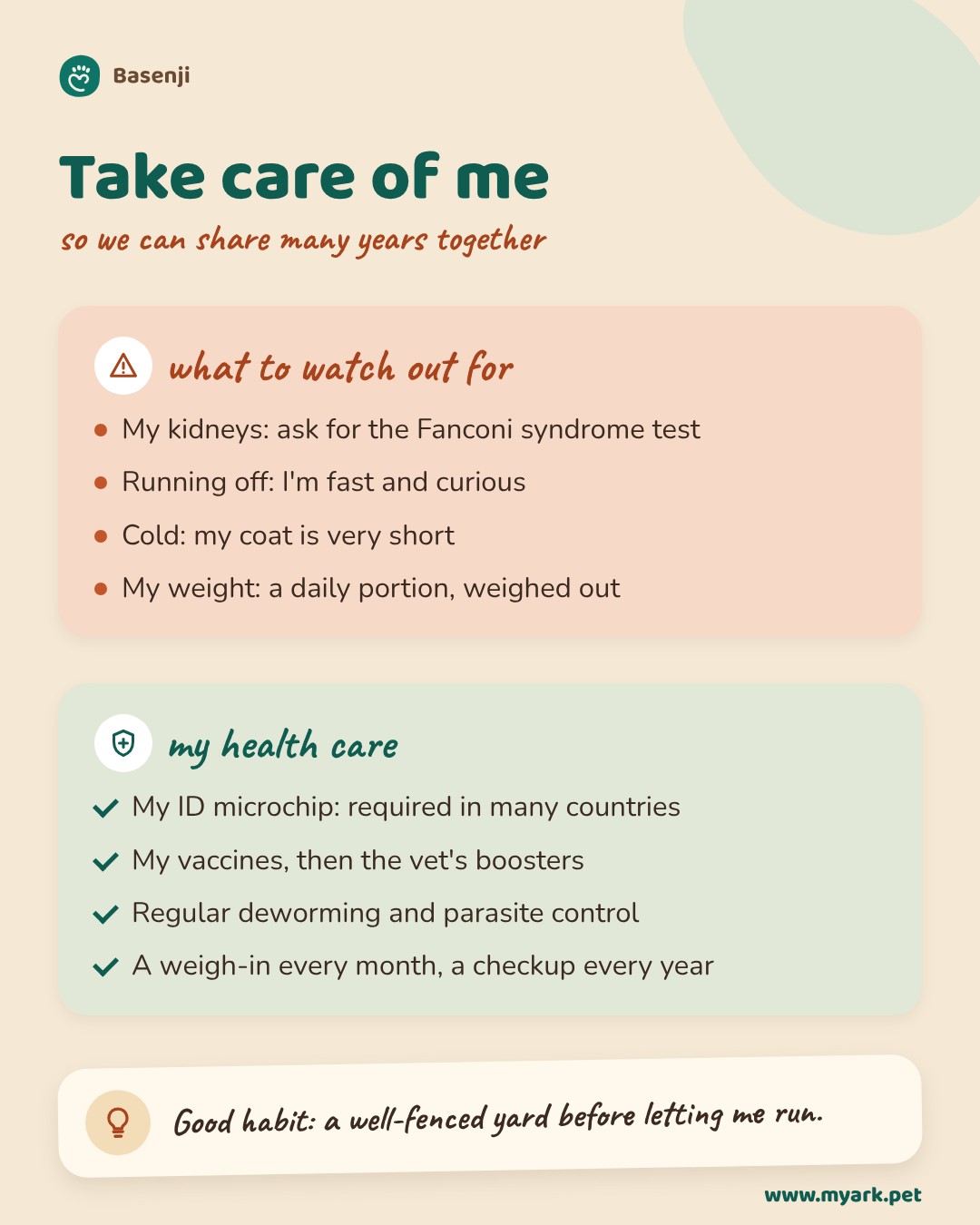
My health routine
- a microchip registered with your details (a legal requirement in many countries, including the UK and France)
- core vaccinations, then boosters on the schedule your vet sets
- worming and flea and tick treatment on a regular schedule
- a weigh-in every month and a vet check-up every year
The stages of my life
- puppy
- Socialisation and gentle, reward-based training.
- adult
- Sport, games and walks.
- senior
- From about 8 years old, a gentler pace.
What to keep an eye on
MyArk describes predispositions through visible body shape and simple checks rather than a list of diseases: it is what you can verify from the outside, and act on when choosing a breeder.
Kidneys
Ask the breeder for the Fanconi syndrome test.
Escaping
It is fast and curious: lead outside, secure fence.
The cold
A small, short-coated or slight dog loses heat quickly: a coat for winter walks and a warm, draught-free bed.
Weight
A weighed ration every day.
And, as for every dog:
- weight: extra kilos strain the joints, heart and breathing
- teeth, ears and nails, checked regularly
- parasite prevention and the vaccination schedule, with your vet
Is it the right dog for your household?
A dog is a social animal that copes badly with long days alone: the real question is less the breed than the time your household has. Before committing, consider rescues and rehoming charities too.
- Home
- Copes with a flat if exercised daily (3 out of 5) — and it is quiet.
- Young children
- Better with older children who respect its independence.
- Other pets
- A hunter: take care with cats and small pets.
- First dog
- Not easy: independent (2 out of 5 for ease of training).
- Time alone
- Copes poorly with long absences (2 out of 5).
Basenji: straight answers
Is it true that Basenjis don’t bark?
Yes: they yodel, chortle and howl instead.
Is a Basenji a good family dog?
Clean and affectionate, for a patient family with older children.
How big does a Basenji get?
The FCI standard gives about 43 cm at the shoulder for males and 40 cm for females, for an adult weight of roughly 9 to 12 kg.
What colours does the Basenji come in?
The usual colours are red and white, black and white, tricolour and brindle.