
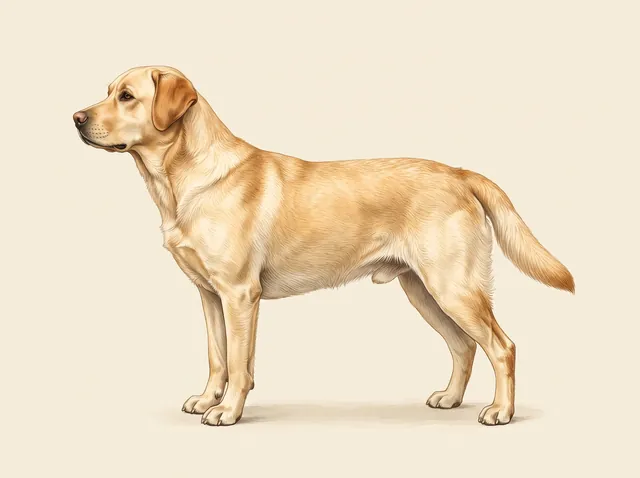
Where the Labrador Retriever comes from
The Labrador’s ancestors came from the coasts of Newfoundland, where fishermen used a similar dog to bring back fish and nets. Brought to Britain in the 19th century, it was refined there as a gundog.
It remains an excellent water dog, with a water-resistant coat and a thick “otter” tail. The FCI standard describes a good-tempered, intelligent companion, keen to please, with neither aggression nor shyness.
Height at the shoulder (FCI standard): 56–57 cm (22 in) for males, 54–56 cm (21–22 in) for females.
How to recognise me
- short, dense coat without waves
- water-resistant undercoat
- broad head and drop ears
- thick, tapering “otter” tail
- strong, well-built body
My colours
- Yellow
- Black
- Chocolate
What a Labrador Retriever needs day to day
“I love everyone, water… and food! With me, a walk often ends with a swim.”
A Labrador needs plenty of daily exercise and something to do with its brain: retrieving, scent games, training. A bored young Labrador finds its own entertainment, often in the kitchen bin.
At a glance
- Exercise
- 4 out of 5
- Grooming
- 2 out of 5
- Coping alone
- 2 out of 5
- Ease of training
- 5 out of 5
- Flat living
- 2 out of 5
every dog is unique, of course!
With me, we can go…
- swimming and retrieving
- long walks
- learning tricks
- tracking
Living with a Labrador Retriever: who does what
Most of a dog’s care is repeated, shared and easy to forget. Here is the Labrador Retriever’s routine at a glance, and how a household can split it without a single “did anyone…?” message.
The routine at a glance
- every day
- two weighed meals, treats counted in the ration; two or three walks, including one long outing; a retrieving or scent game; drying the ears after a swim.
- every week
- one or two brushing sessions (more during the moult); an ear check.
- every month
- a weigh-in, so the household sees the trend early; flea, tick and worming treatment on your vet’s schedule; a nail check.
- every year
- the vet check-up and vaccine boosters.
Sharing it out
- One person weighs out the day’s food each morning; treats come out of that amount, whoever gives them.
- Log every meal: a Labrador is a master of the “nobody fed me” act, and double dinners are the fastest route to weight gain.
- Older children can take on fetch sessions and brushing; walks on the lead stay with someone who can hold a 30 kg dog.
Before it arrives, agree on…
- the daily ration and who prepares it
- a closed-bin and food-out-of-reach rule for everyone
- who covers the middle of the day on work days
- the training words and house rules (sofa, bedrooms, kitchen)
- who takes it to the vet
How MyArk helps the household keep track
Pet feeding tracker
One tap per meal ends the double dinner — the classic Labrador trap.
See the featurePet weight tracker
A monthly weigh-in and a curve, to catch weight gain early.
See the featureDog walk log
See who walked it and when, and keep the daily rhythm steady.
See the featureShared pet care log
One shared logbook, so the whole household knows what has been done.
See the featureFeeding, grooming and health routine
The coat needs regular brushing, more often during the moult.
What I eat
- a complete food suited to its age
- a weighed ration — it is a great glutton
- fresh water at all times
My health routine
- a microchip registered with your details (a legal requirement in many countries, including the UK and France)
- core vaccinations, then boosters on the schedule your vet sets
- worming and flea and tick treatment on a regular schedule
- a weigh-in every month and a vet check-up every year
The stages of my life
- puppy
- Socialisation and gentle, reward-based training.
- adult
- Sport, games and long walks.
- senior
- From about 8 years old, a gentler pace.
What to keep an eye on
MyArk describes predispositions through visible body shape and simple checks rather than a list of diseases: it is what you can verify from the outside, and act on when choosing a breeder.
Drop ears
Ears that hang down let less air into the ear canal, which makes infections more likely. A weekly check, and drying the ears after every swim, makes a real difference.
Hips and elbows
Ask the breeder for the hip and elbow screening results of both parents before you commit.
Chocolate, grapes and raisins
All are toxic to dogs: keep them out of reach and call your vet straight away if your dog eats any.
And, as for every dog:
- weight: extra kilos strain the joints, heart and breathing
- teeth, ears and nails, checked regularly
- parasite prevention and the vaccination schedule, with your vet
Is it the right dog for your household?
A dog is a social animal that copes badly with long days alone: the real question is less the breed than the time your household has. Before committing, consider rescues and rehoming charities too.
- Home
- Best with a garden; a flat works only if the walks and daily exercise genuinely happen.
- Young children
- Usually gentle, but boisterous when young: clear rules and supervised interactions.
- Other pets
- Generally sociable; introduce it gradually and give each animal a place to retreat.
- First dog
- A very good choice for a prepared first-time household.
- Time alone
- Rated 2 out of 5: it needs company and activity, so plan for long working days.
Labrador Retriever: straight answers
Is a Labrador a good family dog?
It is one of the best-known family dogs: friendly, patient and easy to train. It needs daily exercise and a household that is strict about food.
Why do Labradors gain weight so easily?
They are extremely food-motivated, and extra treats from several people add up. Weigh the daily ration, count treats in it and check its weight every month.
Do Labradors shed?
Yes. The short coat sheds all year, more heavily during the moult. Weekly brushing keeps it under control.
How big does a Labrador get?
According to the FCI standard, ideally 56 to 57 cm at the shoulder for males and 54 to 56 cm for females, for an adult weight of roughly 25 to 36 kg.
What colours does the Labrador Retriever come in?
The usual colours are yellow, black and chocolate.