
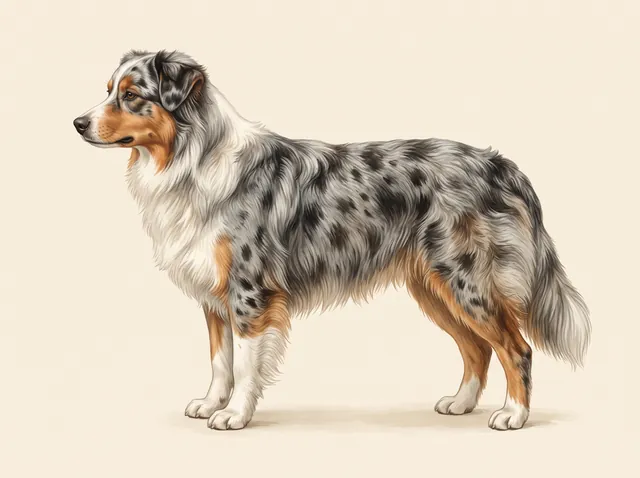
Where the Australian Shepherd comes from
Despite its name, the breed developed in the United States, on the ranches of the American West. The name is thought to come from Basque shepherds who arrived from Australia in the 19th century with their flocks.
Its popularity grew with western riding after the Second World War. The FCI standard describes an intelligent working dog with strong herding and guarding instincts, able to work all day.
Height at the shoulder (FCI standard): 51–58 cm (20–23 in) for males, 46–53 cm (18–21 in) for females.
How to recognise me
- medium-length coat, straight or slightly wavy
- a full ruff and well-feathered legs
- triangular, semi-erect ears
- merle or solid coat, often with tan points
- brown, blue, amber… or odd eyes
My colours
- Blue merle
- Red merle
- Black
- Red
What a Australian Shepherd needs day to day
“Give me a job, a ball or a flock: I’m happy! But without activity, I get bored fast.”
Its exercise needs are very high, and they are the first thing to weigh up honestly — before the question of space. Long outings, a dog sport and daily training keep it balanced; a quiet life does not.
At a glance
- Exercise
- 5 out of 5
- Grooming
- 3 out of 5
- Coping alone
- 1 out of 5
- Ease of training
- 4 out of 5
- Flat living
- 1 out of 5
every dog is unique, of course!
With me, we can go…
- agility
- herding work
- canicross
- hiking
Living with a Australian Shepherd: who does what
Most of a dog’s care is repeated, shared and easy to forget. Here is the Australian Shepherd’s routine at a glance, and how a household can split it without a single “did anyone…?” message.
The routine at a glance
- every day
- two regular meals, never just before sport; at least one long, active outing plus shorter walks; a training or brain-game session; calm time, so it learns to switch off.
- every week
- two or three brushing sessions (more during the moult); a dog sport or a new walking route.
- every month
- a weigh-in; flea, tick and worming treatment on your vet’s schedule; a nail check.
- every year
- the vet check-up, an eye check and vaccine boosters.
Sharing it out
- Plan the week as a household: who does the long run, who the sport, who the training — an Aussie notices a missed day.
- Teach calm as a shared job: everyone rewards it for settling, not just for being busy.
- Write “MDR1” on its records and tell anyone who takes it to a vet, including dog sitters.
Before it arrives, agree on…
- a realistic weekly activity plan, with names against each slot
- who takes on a dog sport or training club
- how herding behaviour around children and bikes will be redirected
- who covers the middle of the day
- that every vet visit starts with “Australian Shepherd — MDR1?”
How MyArk helps the household keep track
Dog walk log
Check at a glance that today’s long outing has happened, and who took it.
See the featurePet health record
Keep its MDR1 status, eye checks and treatments in one record anyone can open.
See the featurePet sitter instructions
Hand over routines, medication warnings and contacts in a ready-made sheet.
See the featureFamily pet chores
Share the activity load visibly across the household.
See the featureFeeding, grooming and health routine
The coat needs regular brushing, more often during the moult.
What I eat
- a complete food suited to its activity
- regular meals, never right before sport
- fresh water at all times
My health routine
- a microchip registered with your details (a legal requirement in many countries, including the UK and France)
- core vaccinations, then boosters on the schedule your vet sets
- worming and flea and tick treatment on a regular schedule
- a weigh-in every month and a vet check-up every year
The stages of my life
- puppy
- Socialisation and gentle, reward-based training.
- adult
- Sport, games and long walks.
- senior
- From about 8 years old, a gentler pace.
What to keep an eye on
MyArk describes predispositions through visible body shape and simple checks rather than a list of diseases: it is what you can verify from the outside, and act on when choosing a breeder.
Merle coat
Breeding two merle dogs together produces “double merle” puppies at risk of deafness and eye defects. A serious breeder never does this, and can explain why.
MDR1 gene
Some medicines can be dangerous for dogs carrying this gene: always tell the vet its breed before any treatment.
Eyes
Have its eyes checked regularly by the vet.
Hips
Ask the breeder for the hip screening results of both parents.
And, as for every dog:
- weight: extra kilos strain the joints, heart and breathing
- teeth, ears and nails, checked regularly
- parasite prevention and the vaccination schedule, with your vet
Is it the right dog for your household?
A dog is a social animal that copes badly with long days alone: the real question is less the breed than the time your household has. Before committing, consider rescues and rehoming charities too.
- Home
- Not made for flat life (1 out of 5); even with a garden, it needs outings and work every day.
- Young children
- Possible with clear rules and supervision; its herding instinct may lead it to nip at running children’s heels.
- Other pets
- Can live with other animals with gradual introductions and a place for each to retreat.
- First dog
- Not recommended as a very first dog: it needs experience, time or professional support.
- Time alone
- Its weakest point (1 out of 5): long days alone quickly lead to anxiety and restlessness.
Australian Shepherd: straight answers
Is an Australian Shepherd a good family dog?
For an active household with time for daily exercise, sport and training, yes. For a quieter household, its needs are usually too high.
How much exercise does an Australian Shepherd need?
A lot: at least one long, active outing a day plus training or a dog sport. Its needs are very high, and they come before the question of space.
What is MDR1 in Australian Shepherds?
A gene variant found in the breed that makes some medicines dangerous. Ask the breeder about the parents, and always mention the breed to your vet before a treatment.
How big does an Australian Shepherd get?
According to the FCI standard, 51 to 58 cm at the shoulder for males and 46 to 53 cm for females, for an adult weight of roughly 16 to 32 kg.
What colours does the Australian Shepherd come in?
The usual colours are blue merle, red merle, black and red.