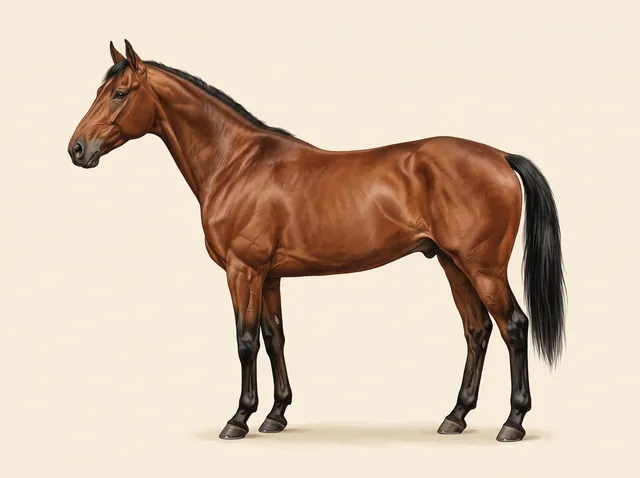
Where the French Trotter comes from
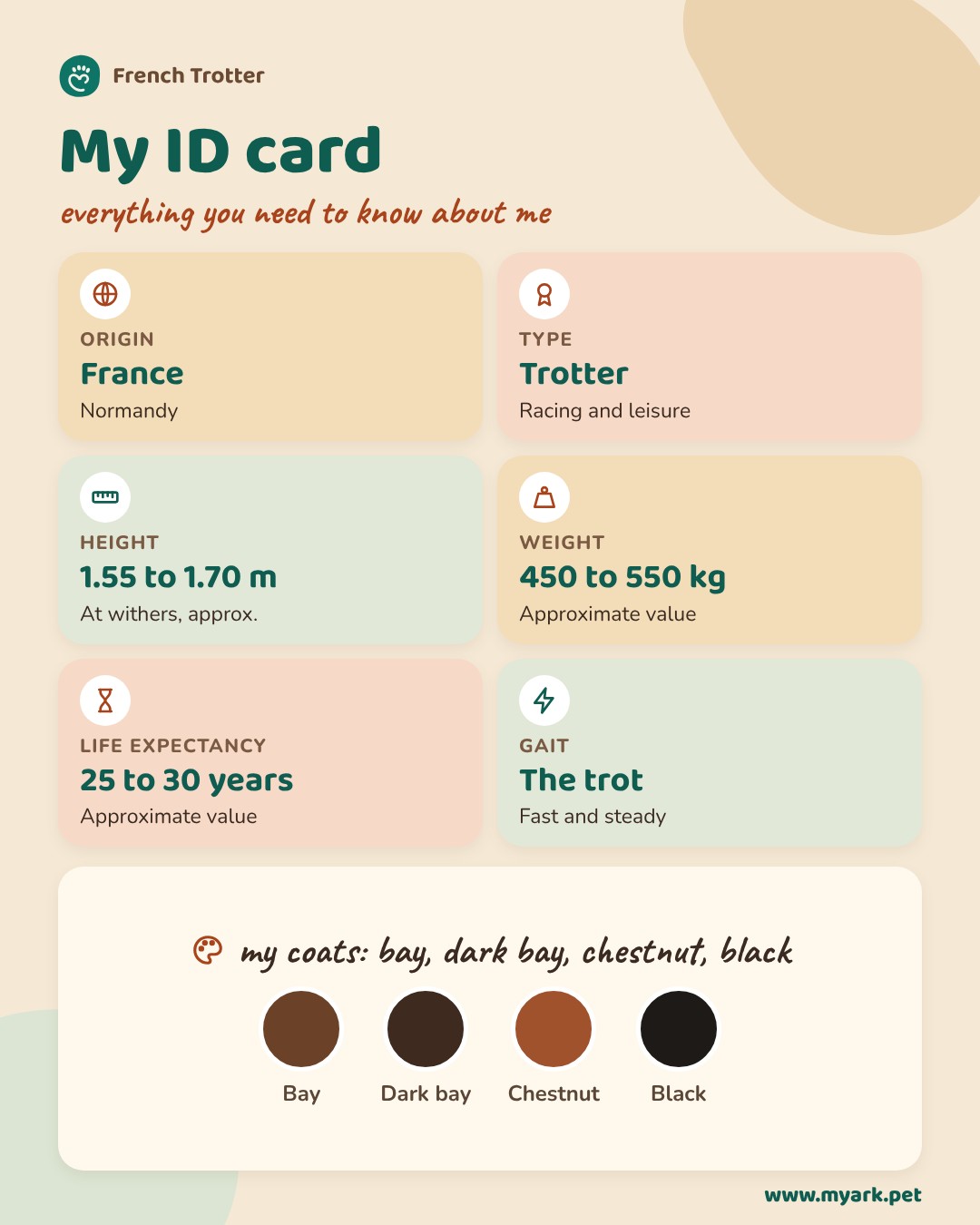
Selected in Normandy since the early 19th century for harness and ridden trotting races, from the Norfolk Trotter, the Thoroughbred and the Orlov Trotter. It has had its current name since 1922.
Its most famous race is the Prix d’Amérique, at Vincennes.
Height at the withers: 1.60–1.70 m (15.3–16.3 hh).
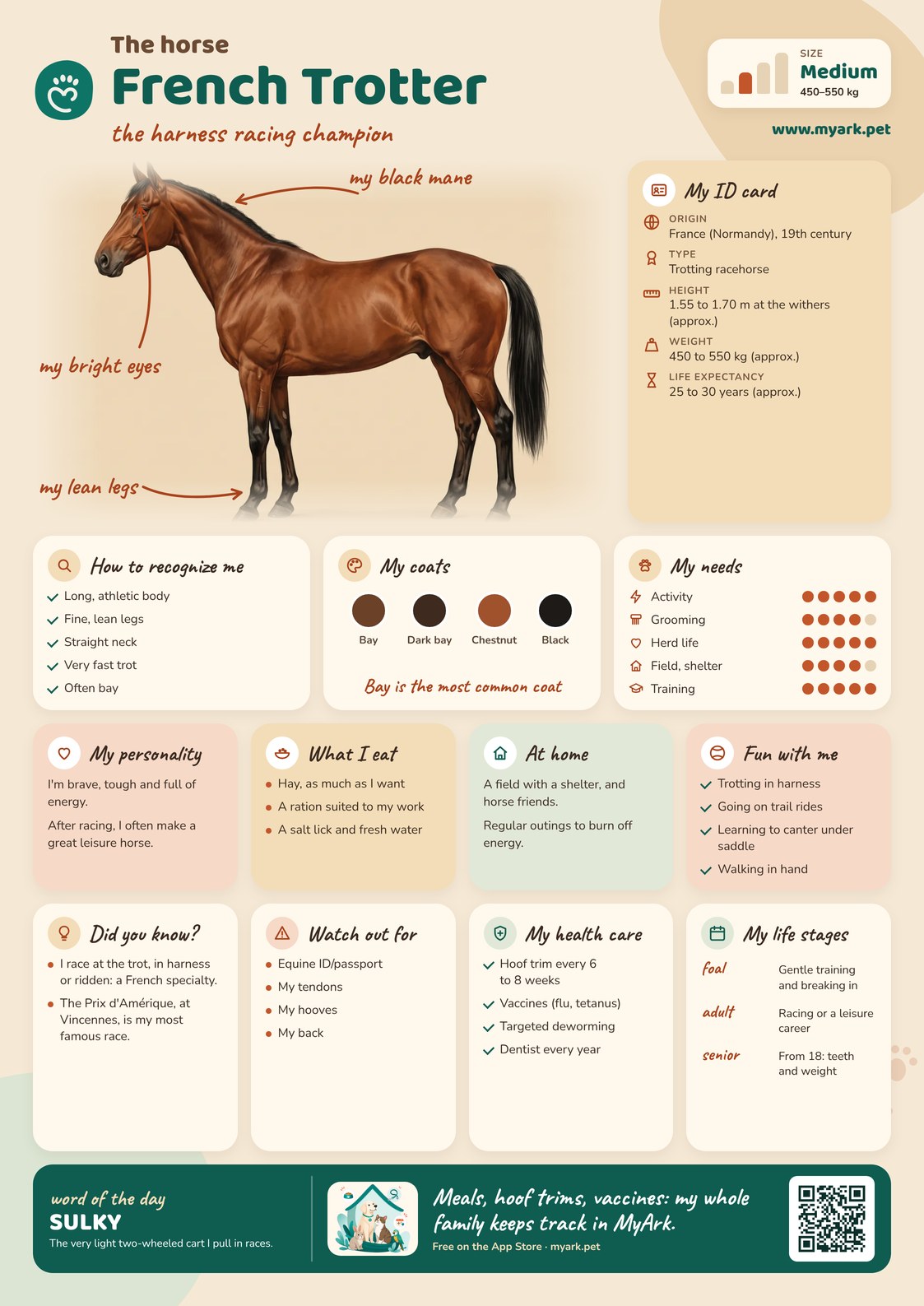
How to recognise me
- long, athletic body
- strong legs
- powerful hindquarters
- bay or brown coat
- an extended trot
My colours
- Bay
- Brown bay
- Chestnut
- Black
What a French Trotter needs day to day
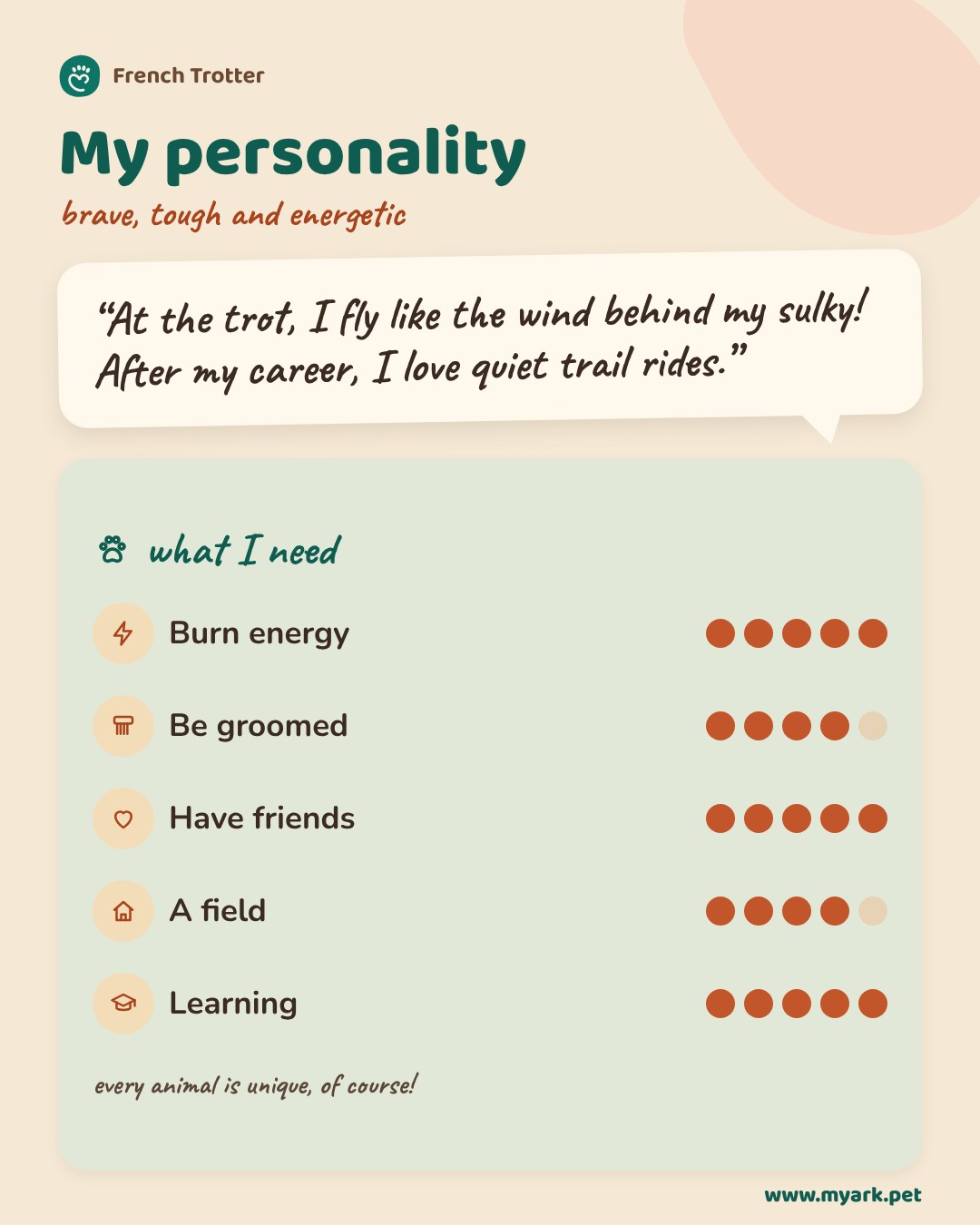
“I trot fast and far! After racing, I can learn to canter and become a great hacking partner.”
Its exercise needs are moderate to high: driving, hacking and retraining under saddle.
At a glance
- Exercise
- 5 out of 5
- Grooming
- 4 out of 5
- Company
- 5 out of 5
- A field
- 4 out of 5
- Learning
- 5 out of 5
every horse is unique, of course!
With me, we can go…
- harness trotting
- hacking
- learning to canter under saddle
- walks in hand
Living with a French Trotter: who does what
A horse’s care is daily, often split between home and the yard — hay, water, turnout, mucking out, hooves — and easy to lose track of. Here is the French Trotter’s routine at a glance, and how a household can split it without a single “did anyone…?” message.
The routine at a glance
- every day
- hay and water; turnout; picking out the hooves.
- every week
- grooming; a leg check after work; a saddle fit check.
- every month
- a weight-tape check; a check of the field, fences and water; the farrier visit, every 6 to 8 weeks.
- every year
- vaccinations and the vet check-up; the equine dentist.
Sharing it out
- Legs checked after every effort.
- Patient retraining with consistent aids.
- Saddle fit checked regularly.
Before it arrives, agree on…
- who rides, drives or works it, and when
- who feeds the hay and how much
- who mucks out and checks the field
- who books the farrier and dentist
- who covers holidays
How MyArk helps the household keep track
Pet feeding tracker
Log hay, hard feed and supplements so no one feeds twice.
See the featureFamily pet chores
Mucking out, turnout and checks on named people.
See the featurePet health record
Farrier, dentist, vaccinations and worming in one place.
See the featureRecurring pet care reminders
Never miss the vaccination and worming dates.
See the featureFeeding, grooming and health routine
Coat care is a real commitment: frequent, sometimes daily brushing, and grooming appointments to budget from the start.
What I eat
- hay all year round
- a ration adapted to its work
- a salt lick and fresh water
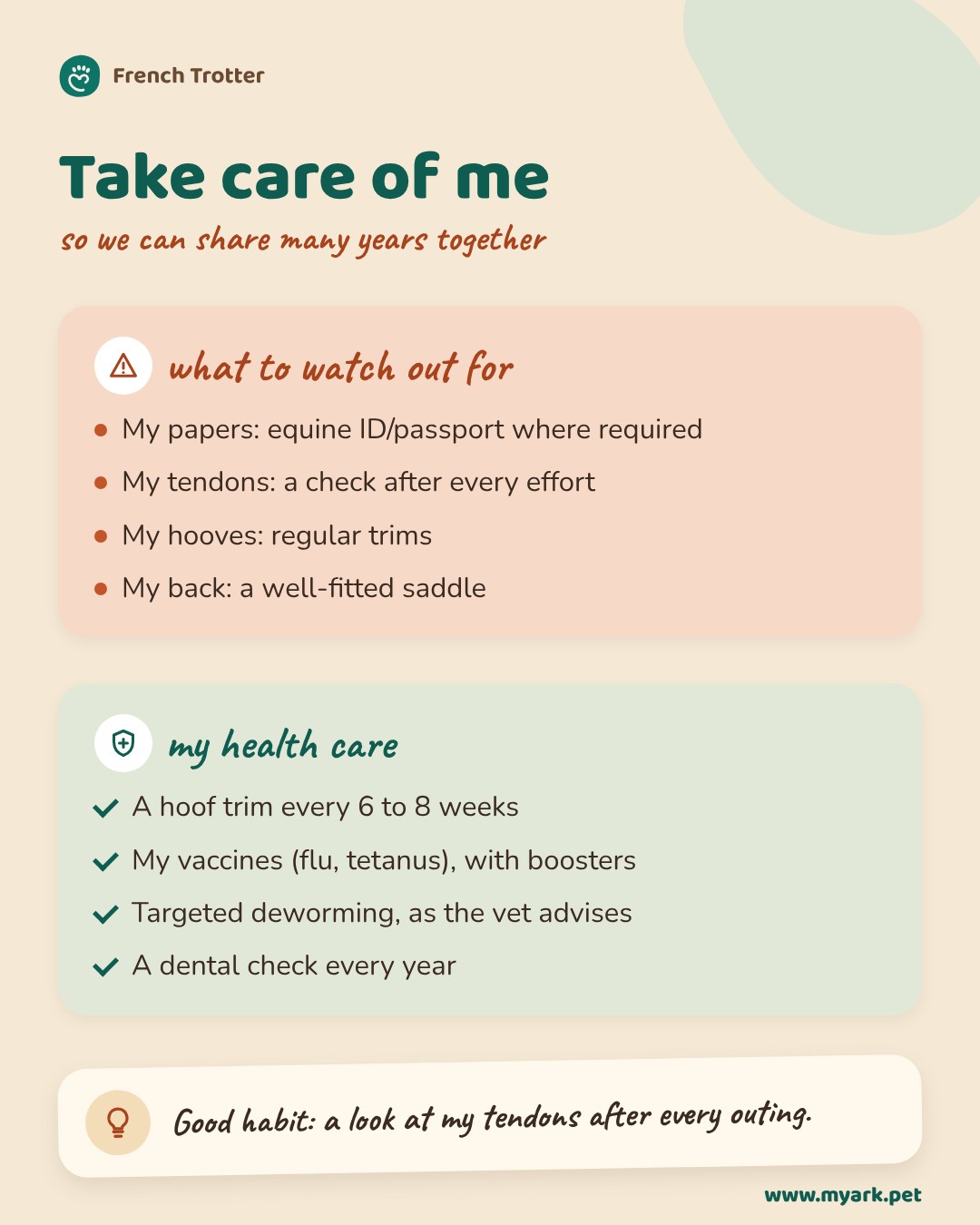
My health routine
- a passport and a microchip (a legal requirement for horses in the UK and in France)
- vaccinations (equine flu, tetanus) on the schedule your vet sets
- targeted worming, guided by faecal egg counts
- the farrier every 6 to 8 weeks and an equine dentist every year
The stages of my life
- foal
- Handling, gentle education and a herd to grow up in.
- adult
- Regular work, turnout and a steady routine.
- senior
- From about 20 years old, adapted feeding and closer check-ups.
What to keep an eye on
MyArk describes predispositions through visible body shape and simple checks rather than a list of diseases: it is what you can verify from the outside, and act on when choosing a breeder.
Tendons
Check them after each effort.
Hooves
A trim or shoeing every 6 to 8 weeks, and a daily pick-out.
Back
A well-fitted saddle.
And, as for every horse:
- weight and grass: rich spring grass and extra weight are the main causes of laminitis
- hooves trimmed or shod every 6 to 8 weeks, teeth checked every year
- vaccinations and worming, planned with your vet
- company: a horse lives badly alone, it needs at least one equine companion
Is it the right horse for your household?
A horse is a herd animal that needs a field, company and daily care for decades: the real question is less the breed than the time, the space and the budget your household has. Before buying, consider loaning, sharing or a rescue horse too.
- Space
- A field with shelter.
- Children
- Docile; retrained ex-racers suit confident riders.
- Other animals
- Needs equine company.
- First horse
- Possible with experienced support for retraining.
- Time
- Daily care and regular work.
French Trotter: straight answers
Can an ex-racing trotter become a riding horse?
Yes: many do, with patient retraining, especially for the canter.
Is a French Trotter calm?
Generally docile and energetic.
How big does a French Trotter get?
About 1.60 to 1.70 m at the withers.
What colours does the French Trotter come in?
The usual colours are bay, brown bay, chestnut and black.