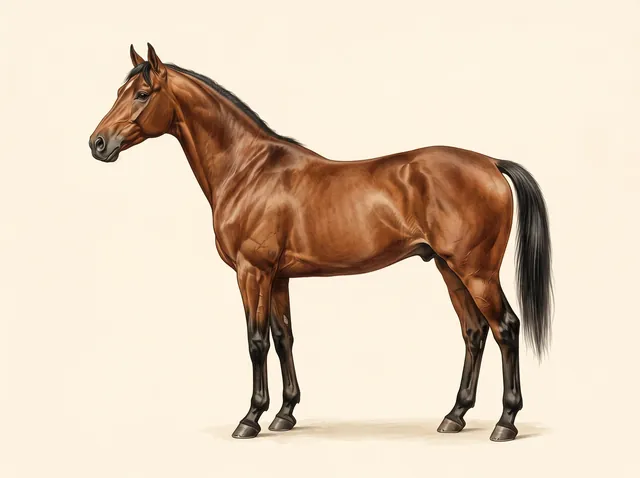
Where the Anglo-Arab comes from
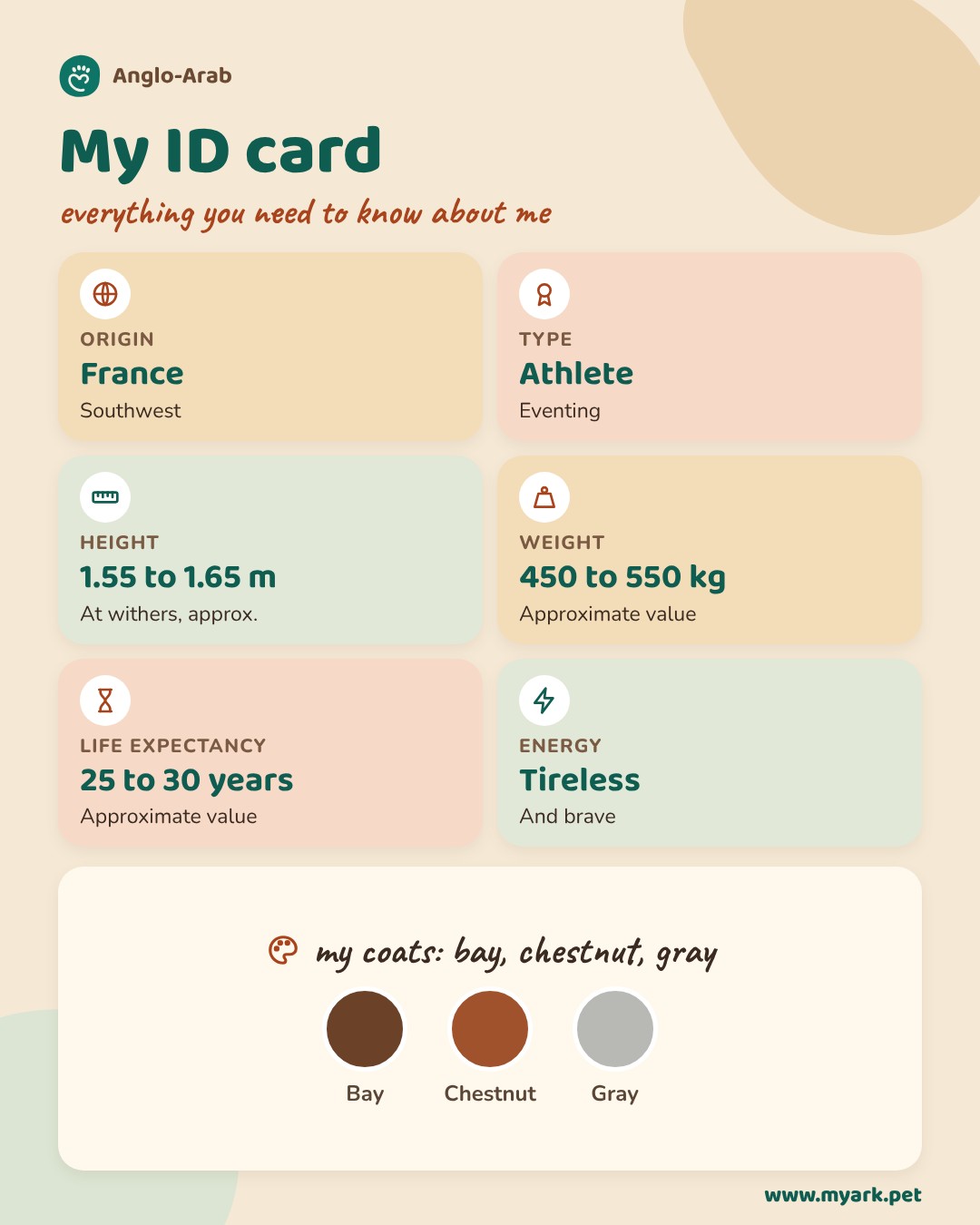
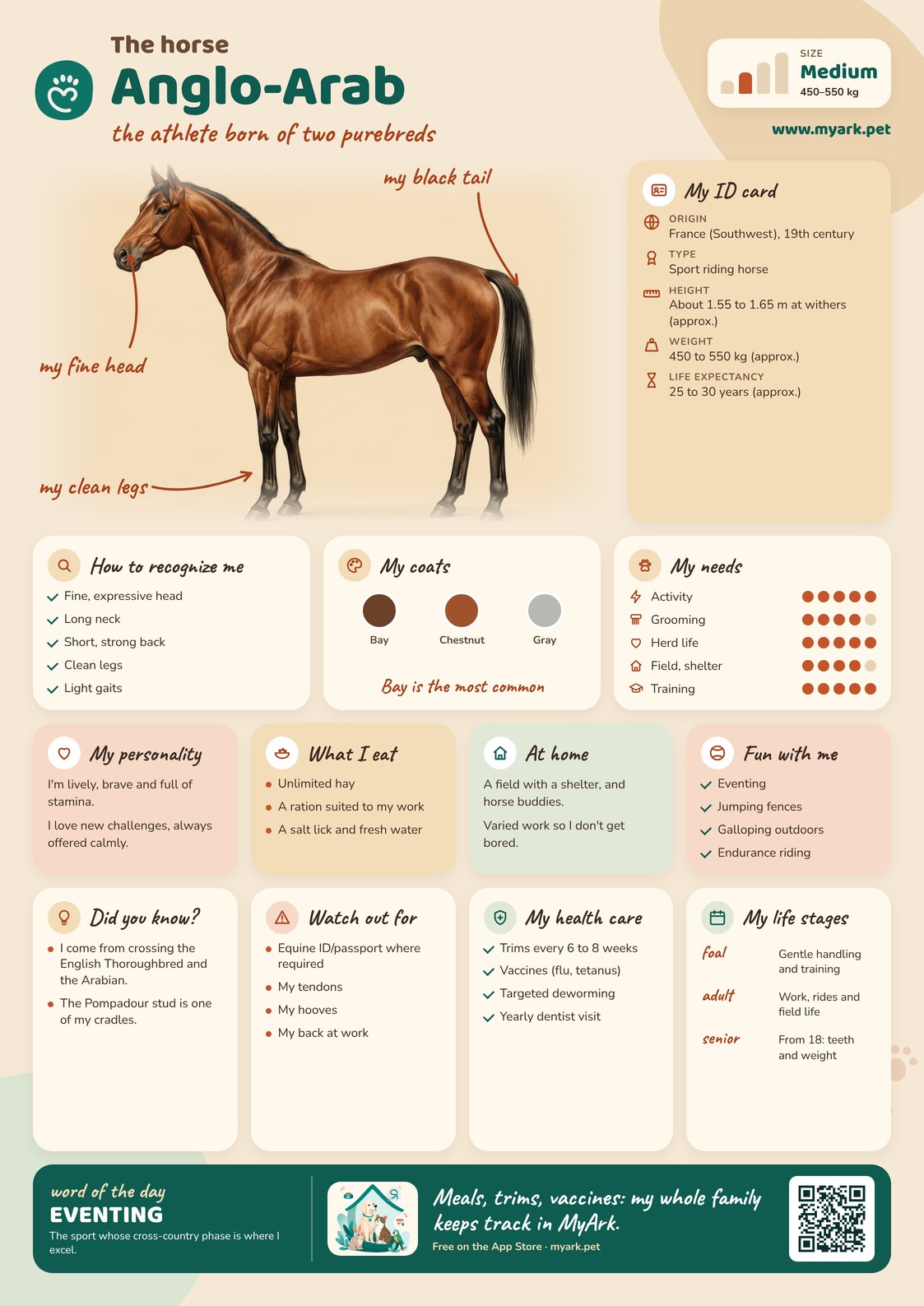
A sport horse from crosses between the Arabian and the Thoroughbred, developed from the end of the 18th century in England, Russia and France; the French Anglo-Arab long remained the best known.
It excels at eventing. The Pompadour stud is one of its cradles.
Height at the withers: 1.55–1.70 m (15.1–16.3 hh).
How to recognise me
- athletic, refined body
- expressive head
- strong legs
- good hooves
- bay, chestnut or grey coat
My colours
- Bay
- Chestnut
- Grey
What a Anglo-Arab needs day to day
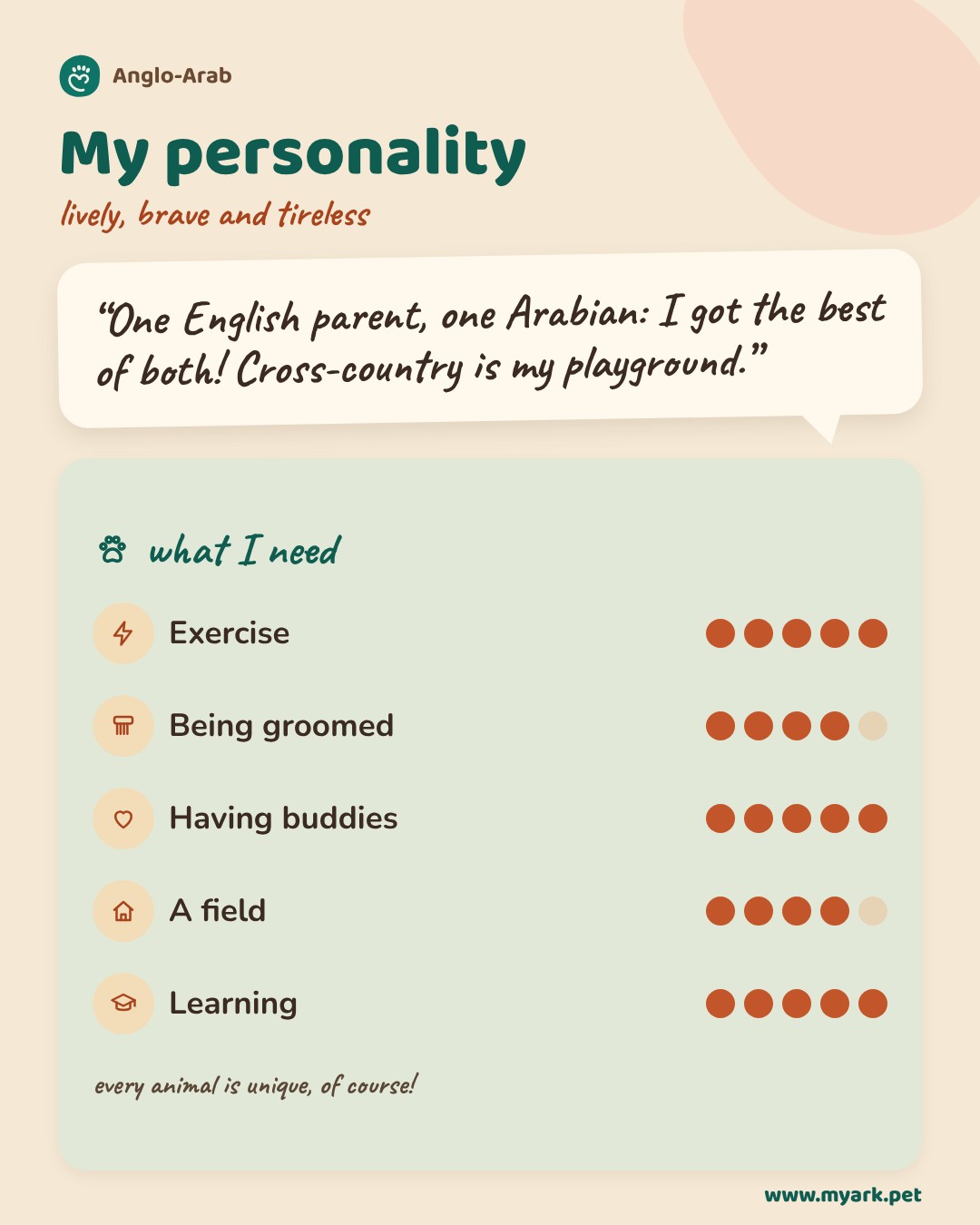
“I’m bold and balanced, and I love eventing! Warm me up and cool me down well.”
Its exercise needs are high: eventing, show jumping, galloping out and endurance.
At a glance
- Exercise
- 5 out of 5
- Grooming
- 4 out of 5
- Company
- 5 out of 5
- A field
- 4 out of 5
- Learning
- 5 out of 5
every horse is unique, of course!
With me, we can go…
- eventing
- show jumping
- galloping out
- endurance riding
Living with a Anglo-Arab: who does what
A horse’s care is daily, often split between home and the yard — hay, water, turnout, mucking out, hooves — and easy to lose track of. Here is the Anglo-Arab’s routine at a glance, and how a household can split it without a single “did anyone…?” message.
The routine at a glance
- every day
- hay and a ration adapted to its work; turnout; picking out the hooves; a warm-up and cool-down.
- every week
- grooming; a weight-tape check; a fence and water check.
- every month
- a weight-tape check; a check of the field, fences and water; the farrier visit, every 6 to 8 weeks.
- every year
- vaccinations and the vet check-up; the equine dentist.
Sharing it out
- Warm-ups and cool-downs on every ride.
- Legs checked after hard work.
- Farrier and dentist on the calendar.
Before it arrives, agree on…
- who rides, drives or works it, and when
- who feeds the hay and how much
- who mucks out and checks the field
- who books the farrier and dentist
- who covers holidays
How MyArk helps the household keep track
Pet feeding tracker
Log hay, hard feed and supplements so no one feeds twice.
See the featureFamily pet chores
Mucking out, turnout and checks on named people.
See the featurePet health record
Farrier, dentist, vaccinations and worming in one place.
See the featureRecurring pet care reminders
Never miss the vaccination and worming dates.
See the featureFeeding, grooming and health routine
Coat care is a real commitment: frequent, sometimes daily brushing, and grooming appointments to budget from the start.
What I eat
- hay all year round
- a ration adapted to its work
- a salt lick and fresh water
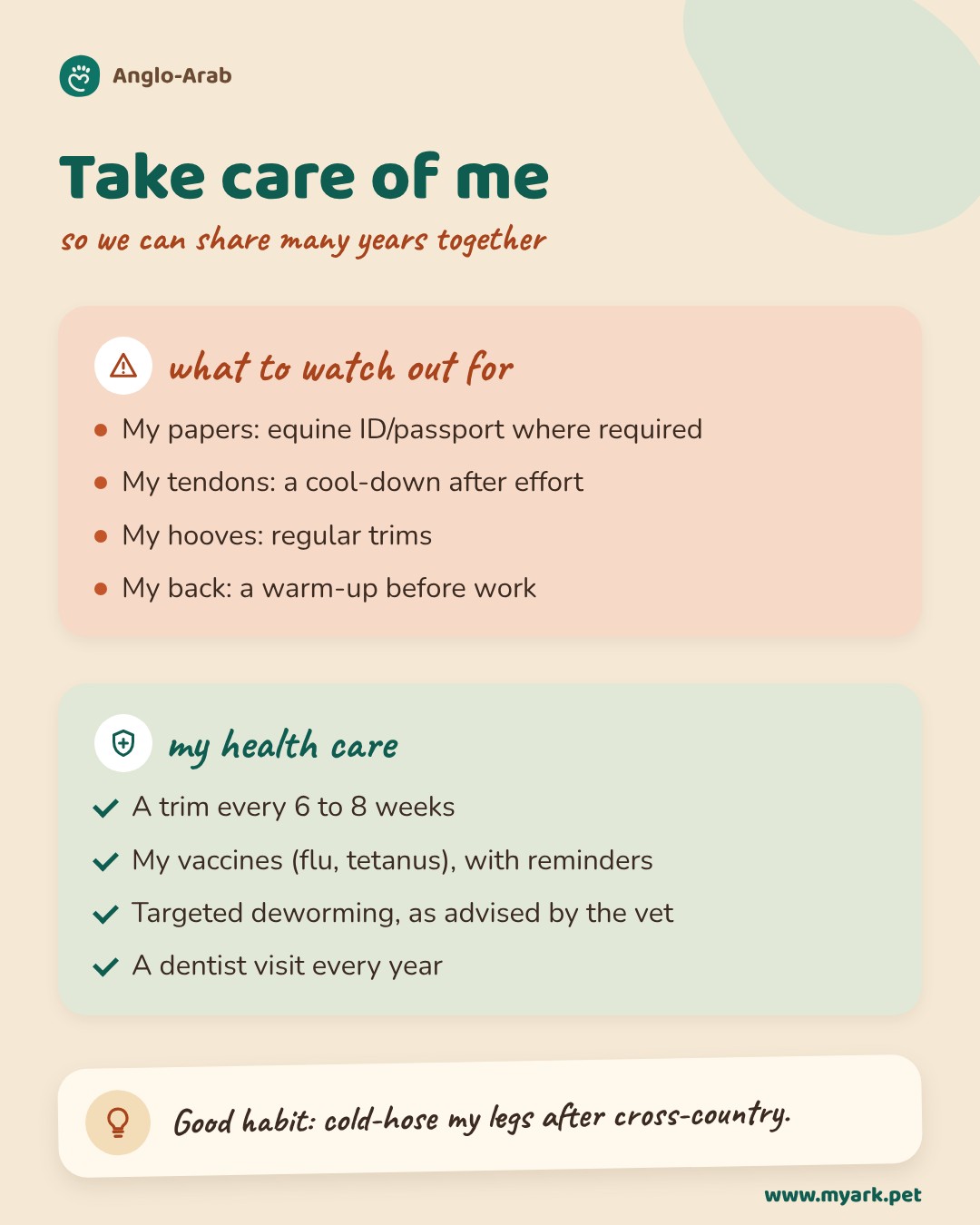
My health routine
- a passport and a microchip (a legal requirement for horses in the UK and in France)
- vaccinations (equine flu, tetanus) on the schedule your vet sets
- targeted worming, guided by faecal egg counts
- the farrier every 6 to 8 weeks and an equine dentist every year
The stages of my life
- foal
- Handling, gentle education and a herd to grow up in.
- adult
- Regular work, turnout and a steady routine.
- senior
- From about 20 years old, adapted feeding and closer check-ups.
What to keep an eye on
MyArk describes predispositions through visible body shape and simple checks rather than a list of diseases: it is what you can verify from the outside, and act on when choosing a breeder.
Tendons
A cool-down after effort.
Hooves
A trim or shoeing every 6 to 8 weeks, and a daily pick-out.
Back
A warm-up before work.
And, as for every horse:
- weight and grass: rich spring grass and extra weight are the main causes of laminitis
- hooves trimmed or shod every 6 to 8 weeks, teeth checked every year
- vaccinations and worming, planned with your vet
- company: a horse lives badly alone, it needs at least one equine companion
Is it the right horse for your household?
A horse is a herd animal that needs a field, company and daily care for decades: the real question is less the breed than the time, the space and the budget your household has. Before buying, consider loaning, sharing or a rescue horse too.
- Space
- A field with shelter, and an arena.
- Children
- Lively: better for confident teens and adults.
- Other animals
- Needs equine company.
- First horse
- Best for an experienced rider.
- Time
- Daily care and regular work.
Anglo-Arab: straight answers
What is an Anglo-Arab?
A cross between the Arabian and the Thoroughbred, bred as a sport horse.
Is an Anglo-Arab good for eventing?
It is one of its specialities.
How big does an Anglo-Arab get?
About 1.55 to 1.70 m at the withers.
What colours does the Anglo-Arab come in?
The usual colours are bay, chestnut and grey.