
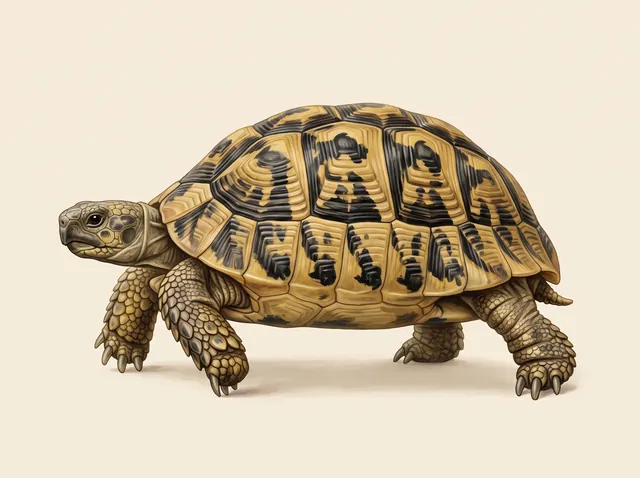
The status of each species
- Hermann’s tortoise
- CITES Appendix II, Annex A of the wildlife trade regulations that apply in Great Britain. Since 23 June 2026, also listed in Annex X (captive-bred specimens).
- Spur-thighed and marginated tortoises
- CITES Appendix II, Annex A. Since 23 June 2026, also listed in Annex X.
- Horsfield (Russian) tortoise
- CITES Appendix II, Annex B: no Article 10 certificate is needed to sell one, but you must be able to show that it was acquired legally.
Statuses checked on the official Species+ database (CITES and UNEP) and on legislation.gov.uk. They can change: check them before buying.
What an Article 10 certificate is, and when it is needed
An Article 10 certificate is a commercial use certificate issued by APHA for one individual animal. According to GOV.UK, you need one for an Annex A specimen you plan to sell, keep or transport for sale, display to the public for commercial purposes, or breed from in order to sell the young. Using an Annex A specimen commercially without a valid certificate is a criminal offence.
- You do not need one to own an Annex A tortoise, give one away, or display it for non-commercial purposes.
- A gift that involves any exchange or benefit, even a charitable donation, counts as commercial and needs a certificate.
- A specimen-specific certificate stays with the tortoise for life and passes to each new owner; a transaction-specific certificate covers only a named holder and use, and the new owner must apply for their own.
- You apply through the GOV.UK “apply for a CITES permit” service; APHA aims to process applications within 30 days.
The June 2026 change for captive-bred tortoises
The Control of Trade in Endangered Species (Amendment and Revocation) Regulations 2026, in force since 23 June 2026, added Hermann’s, spur-thighed and marginated tortoises to Annex X. Captive-born and bred animals of species in Annex X are exempt from the Article 10 certificate requirement. In its response to the consultation, the government said the aim was to remove the need for Article 10 certificates for “appropriately marked captive bred specimens” of these three species.
- The exemption covers tortoises born and bred in captivity, not wild-caught animals.
- Other Annex A tortoises, and any specimen that does not qualify, still need an Article 10 certificate for sale or commercial use.
- Certificates issued in Great Britain are valid only in Great Britain; Northern Ireland follows different rules, so check with APHA if you are there.
- Moving a tortoise in or out of the country is separate: import and export permits still apply.
Microchips and marking
Under the GOV.UK guidance, a live animal covered by an Article 10 certificate must be uniquely and permanently marked, usually with an ISO-standard, uniquely numbered microchip, and a specimen-specific certificate is only issued for a marked animal. A microchip is fitted by a vet, who can tell you whether your tortoise is big enough.
- A microchip is not required simply to keep a pet tortoise, but it lets a lost or stolen tortoise be identified.
- When an Article 10 certificate exists, the microchip number on it must match the tortoise: ask your vet to scan it.
- Keep the microchip number, the vet’s record and any certificate with your tortoise’s papers, for its whole life.
Buying or taking on a tortoise
According to GOV.UK, a seller of an Annex A specimen that still needs a certificate must show the buyer the certificate and its reference number, or give a photocopy marked “copy for information only”. Someone who receives a tortoise as a non-commercial gift should fill in APHA form WLRS02, and the giver should pass on its origin, how they acquired it and any previous paperwork.
- Ask where and when the tortoise was bred, and for any breeder’s records or receipts showing it was bred in captivity.
- If there is an Article 10 certificate, check that the seller is named on it and that the microchip number matches.
- Keep every document you are given: without them, you may not be able to sell the tortoise later.
- Never buy a tortoise you suspect was taken from the wild.
If you find a tortoise, or lose yours
Its papers and microchip number always to hand
In the MyArk health record, note each tortoise’s microchip number, the date it was chipped, the references of its documents and its yearly vet check. Everyone in the household can see them.
- The microchip number and identity of each tortoise
- Document dates and references, in the notes
- The yearly check-up and weigh-ins in the same place
- The pet sitter sheet with this information, for when someone else looks after it
Common questions
Do I need an Article 10 certificate to keep a tortoise?
No. According to GOV.UK, you do not need one to own an Annex A tortoise or give one away with nothing in return. It is needed for commercial use, such as selling one, unless an exemption applies.
Do I still need an Article 10 to sell a captive-bred Hermann’s tortoise?
Since 23 June 2026, captive-born and bred Hermann’s, spur-thighed and marginated tortoises are listed in Annex X and are exempt from the certificate requirement in Great Britain. You must still be able to show that the tortoise was bred in captivity. If in doubt, ask APHA.
Does my tortoise have to be microchipped?
Not simply to keep it as a pet. An animal covered by an Article 10 certificate must be uniquely and permanently marked, usually with a microchip fitted by a vet. A microchip also helps identify a lost or stolen tortoise.
What is the difference between a specimen-specific and a transaction-specific certificate?
A specimen-specific certificate belongs to the tortoise: it stays with it for life and is handed to each new owner. A transaction-specific certificate is valid only for the named holder and use, and the new owner must apply for their own.
Does a Horsfield tortoise need paperwork?
The Horsfield tortoise is in Annex B, so no Article 10 certificate is needed to sell one. The seller must still be able to show it was acquired legally: ask for its history and keep the documents.
Can I give my tortoise away?
Yes. A gift with nothing in return needs no Article 10 certificate. GOV.UK asks the new keeper to fill in form WLRS02, and the giver to pass on the tortoise’s origin, how it was acquired and any previous paperwork.
Sources
Benchmarks checked on 25 October 2026 in the documents below, then rewritten in plain English. They do not replace an examination and advice from your vet, who adapts care to your pet and to where you live.
- GOV.UK (APHA and Defra), Commercial use of endangered species: check if you need a CITES certificate (updated 23 June 2026)
- GOV.UK, Endangered species: apply for a commercial use certificate
- GOV.UK (Defra), Reforming domestic CITES implementation: summary of responses and government response (2026)
- legislation.gov.uk, The Control of Trade in Endangered Species (Amendment and Revocation) Regulations 2026 (SI 2026/627)
- legislation.gov.uk, Commission Regulation (EC) No 865/2006, Annex X (as it applies in Great Britain)
- Species+ (UNEP-WCMC and CITES Secretariat), CITES status of species of the genus Testudo