
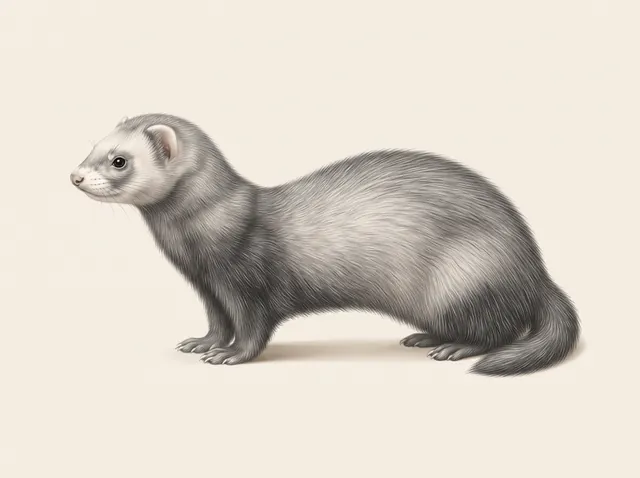
A strict carnivore
Ferrets need to eat meat to stay healthy. According to the MSD Veterinary Manual, their diet should be high in animal protein, around 35 to 40%, with little carbohydrate and little fibre. They digest large amounts of fibre and starchy foods such as bread or cereals poorly.
The MSD manual recommends a complete food made for ferrets rather than cat or kitten food; according to the Royal Veterinary College (RVC), most dog and cat foods don’t provide what a ferret needs.
Little and often: a very short gut
Ferrets turn their food into energy very quickly, and food passes through their gut fast. So they need to eat every few hours, not twice a day like a dog.
- Leave food available at all times, or weigh out the day’s ration and let your ferret graze from the bowl.
- A heavy or fixed bowl stops it being tipped over during play.
- Check your ferret is actually eating: a ferret that stops touching its food needs close watching.
Water, always available
Fresh water must be available at all times and changed every day. A bottle with a metal spout is often preferred, because ferrets play with bowls and tip them over; a heavy bowl that can’t be turned over works too. The RSPCA advises checking the water twice a day.
Foods to avoid
- Sugar, fruit, honey, raisins
- Ferrets are prone to a tumour of the pancreas (insulinoma); the MSD manual advises avoiding sugary, high-carbohydrate foods.
- Milk and dairy products
- Ferrets digest lactose poorly.
- Bread, cereals, rice, potato
- Starchy foods are poorly digested by this carnivore.
- Only soft food, long term
- According to the MSD manual, a diet of soft food alone over the long term encourages gum and dental disease; dry food helps limit plaque.
Treats should make up no more than about 5% of what your ferret eats in a day, according to the MSD manual: a small piece of meat or cooked egg is fine.
Dry food or a raw diet?
- Ferret kibble
- The simplest choice, recommended by the MSD manual and the RVC, as long as it is high in animal protein.
- Raw diet
- Possible according to the PDSA, in the form of whole prey; the RVC advises against it (risk of an unbalanced diet, salmonella and gut blockage). Decide with your vet.
To change food, mix the new one gradually into the old over several days.
When to ask for advice
One shared picture for the whole household
With a pet that eats often, everyone takes a turn filling the bowl. In MyArk, the household logs meals and treats in a shared care log: everyone knows what has been given, and a ferret that is eating less is spotted sooner.
- Meals and treats logged by everyone in the household
- The shared care log, visible to everyone
- Weights on a chart, to follow your ferret’s weight
- Feeding instructions on the pet sitter sheet
Common questions
How often does a ferret eat?
Often: its gut is short and it digests quickly. Vets advise leaving food and water available at all times, or weighing out the day’s ration and leaving it in the bowl.
Can ferrets eat cat food?
It isn’t ideal: the MSD Veterinary Manual recommends a food made for ferrets, and most cat foods don’t provide enough animal protein. Ask your vet for advice.
Can ferrets eat fruit?
Best avoided: fruit is sugary, and ferrets are prone to insulinoma, a tumour of the pancreas. The MSD manual advises against fruit, honey, raisins and sugary treats.
Can I give my ferret milk?
No: ferrets digest lactose poorly. Milk and dairy products are best avoided.
What treats can I give a ferret?
Small pieces of meat or cooked egg, in small amounts: no more than about 5% of what your ferret eats in a day, according to the MSD manual.
My ferret has stopped eating: is it serious?
Yes, if it hasn’t eaten or drunk for 24 hours, or has stopped passing droppings: it is an emergency. Ferrets readily swallow rubber or plastic objects that can block their gut.
Sources
Benchmarks checked on 21 October 2026 in the documents below, then rewritten in plain English. They do not replace an examination and advice from your vet, who adapts care to your pet and to where you live.
- MSD Veterinary Manual, Providing a Home for a Ferret (2024)
- MSD Veterinary Manual, Veterinary edition, Management of Ferrets (2026)
- PDSA, Your ferret’s diet
- RSPCA, Ferret diet
- Royal Veterinary College, Beaumont Sainsbury Animal Hospital, Caring for your ferret
- MSD Veterinary Manual, Emergencies of Ferrets (2026)
- MSD Veterinary Manual, Other Noninfectious Diseases of Ferrets (2024)