
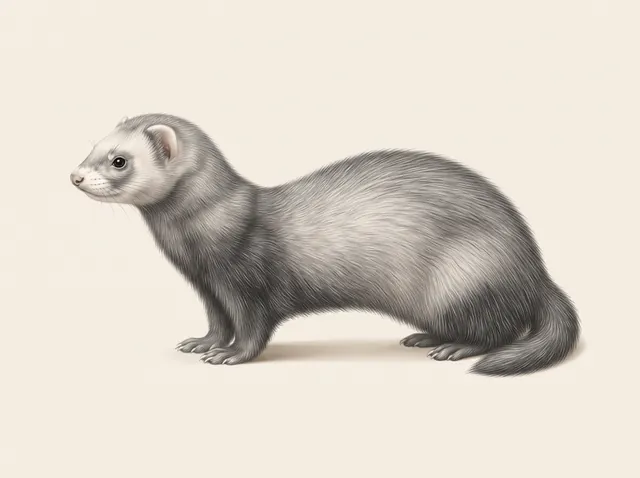
Puberty and seasons in ferrets
Ferrets reach puberty between 4 and 8 months, in the first spring after their birth. According to the Royal Veterinary College (RVC), females come into season as the days lengthen, from March to September, and stay in season until they are mated or the days shorten. A swollen vulva is the most visible sign.
Entire males have a strong musky smell during the breeding season and mark their territory with urine.
Why seasons are dangerous for females
During a prolonged season, oestrogen levels stay high. According to the RVC and the British Small Animal Veterinary Association (BSAVA), these hormones can stop the bone marrow making blood cells: this is hyperoestrogenism, which can lead to severe anaemia and death.
The options for females
- Surgical spaying
- Removal of the ovaries and uterus. It ends seasons and the risk of anaemia, and clearly reduces the smell. According to the BSAVA, it is best done outside a season, when the risk of bleeding is higher.
- Hormone implant
- A small implant, barely bigger than a microchip, placed under the skin. According to the BSAVA, it stops seasons for about a year and a half to two years, sometimes longer depending on the implant. Placed in a female that has already been in season for a long time, it can prolong the season at first: your vet will take this into account.
- Vasectomised male
- Mating with a sterile male ends the season, but it has to be repeated every season; it can cause injuries, stress and false pregnancy.
There are also one-off hormone treatments to end a current season: these are for your vet to decide, who will then suggest a long-term solution.
The options for males
- Castration
- Removal of the testicles. It reduces the smell and can reduce aggression; a castrated male no longer tries to mate.
- Hormone implant
- According to the RVC, it reduces the smell 5 to 14 weeks after it is placed, and its effects last up to about 16 months. Keep the male away from females in season for the first few weeks.
- Vasectomy
- The male can no longer father kits, but keeps his smell, behaviour and aggression. It is mainly used to end females’ seasons.
Neutering and adrenal gland disease: what is known
Adrenal gland disease is common in adult ferrets. Its most common signs are hair loss that starts at the tail and lower back, itching, a swollen vulva in a spayed female and, in males, a return of sexual behaviour or difficulty passing urine.
Several veterinary sources link this disease with surgical neutering: after the ovaries or testicles are removed, other hormones keep stimulating the adrenal glands. According to the MSD Veterinary Manual, the age at neutering no longer seems to play a major role, and still-preliminary data suggest that a hormone implant might reduce this risk. For this reason, the PDSA recommends an implant rather than surgery, while other sources present both options.
When to ask for advice
Don’t let the implant date slip by
Record the neutering or the implant, with its date, in your ferret’s MyArk health record: a reminder alerts everyone in the household before it is time to talk to the vet about it again.
- The date of the neutering or implant in the health record
- A reminder before the renewal date your vet suggests
- Dated observations: seasons, hair loss, swollen vulva
- Weights on a chart, to show your vet
Common questions
Should I neuter my female ferret?
At the very least, prolonged seasons must be prevented: an unmated female stays in season, and the excess oestrogen can cause fatal anaemia. Surgical spaying and a hormone implant are the two main options, to be chosen with your vet.
What is hyperoestrogenism?
It is excess oestrogen in a female that stays in season. These hormones slow down blood cell production by the bone marrow, which can lead to severe anaemia.
How long does an implant last in a ferret?
According to the BSAVA, about a year and a half to two years in females, sometimes longer depending on the implant. Your vet decides on renewal when hormonal signs return.
Does neutering cause adrenal gland disease?
Several veterinary sources link the two, but the link isn’t fully understood, and the disease also occurs in ferrets that haven’t been neutered. Talk to a vet who is experienced with ferrets.
Why castrate a male ferret?
To reduce his smell, often his aggression, and to prevent litters. A hormone implant is an alternative; a vasectomy changes neither the smell nor the behaviour.
My ferret was already neutered when I got it: what should I record?
Note it in the health record, with the date if you know it. Many ferrets are neutered before they are sold; it is useful information for your vet, especially if signs of adrenal gland disease appear later.
Sources
Benchmarks checked on 21 October 2026 in the documents below, then rewritten in plain English. They do not replace an examination and advice from your vet, who adapts care to your pet and to where you live.
- MSD Veterinary Manual, Breeding and Reproduction of Ferrets (2024)
- MSD Veterinary Manual, Hormonal Disorders of Ferrets (2024)
- MSD Veterinary Manual, Veterinary edition, Management of Ferrets (2026)
- MSD Veterinary Manual, Veterinary edition, Endocrine Disorders of Ferrets (2026)
- Royal Veterinary College, Beaumont Sainsbury Animal Hospital, Caring for your ferret
- BSAVA, Treatments to prevent prolonged oestrus in female ferrets (2024)
- PDSA, Ferret health