
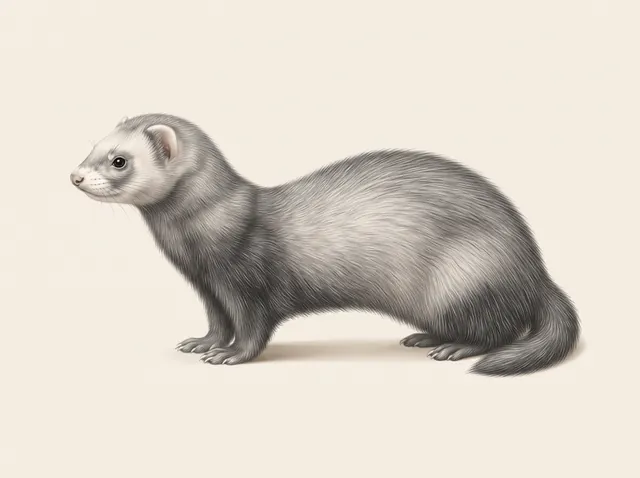
How much an adult ferret weighs
The MSD Veterinary Manual gives these benchmarks. Build varies from one ferret to another: your vet can tell you whether yours is at a healthy weight.
- Entire male
- Up to about 2 kg.
- Neutered male
- 1.2 kg on average.
- Entire female
- Up to about 1.2 kg.
- Spayed female
- 0.8 kg on average.
Ferrets reach adult size at around 5 to 6 months and are considered adult at one year.
A weight that follows the seasons
According to the PDSA, it is normal for a ferret to gain weight before winter, to build up reserves, and to lose it in spring. Their coat changes too: thicker and darker in winter, it moults in spring and autumn.
What should concern you is weight that climbs in the middle of summer, or winter weight that doesn’t come off in spring: cut back on treats and talk to your vet.
Weighing your ferret and tracking the trend
- Kitchen scales accurate to the gram work well: put a basket or box on them, reset to zero, then place your ferret inside.
- Weigh at the same time of day, for example once a month, and note each result.
- Compare with the same season the year before, rather than with the previous month.
- Weight is also used to dose treatments: a recent weight helps avoid a dosing error.
Avoiding excess weight
Obesity is one of the common health problems in ferrets, according to the Royal Veterinary College (RVC). A ferret that eats too much and doesn’t burn enough energy gains weight.
- Limit treats, and avoid sugary ones.
- Let your ferret out of the cage for at least 2 to 4 hours a day, supervised or in a ferret-proofed space, as the MSD manual recommends.
- Offer toys, tunnels and hiding places that encourage exploring.
When weight loss should worry you
Outside the spring weight loss, a ferret that is getting thinner should be examined. Weight loss is among the signs of two common diseases in adult ferrets: adrenal gland disease, often with hair loss that starts at the tail, and insulinoma, a tumour of the pancreas that can also cause weakness and dragging back legs.
When to ask for advice
Follow your ferret’s weight on a chart
Log each weigh-in in MyArk: the weight tracker shows everyone in the household whether changes from one season to the next stay normal, and the latest weight is to hand for dosing a treatment.
- A weight chart for each pet, over several years
- A weighing reminder, for example every month
- Treats logged by everyone in the household
- An up-to-date weight for dosing treatments
Common questions
What is a normal weight for a ferret?
According to the MSD Veterinary Manual, a neutered male weighs 1.2 kg on average and a spayed female 0.8 kg; an entire male can reach 2 kg. Your vet can tell you whether your ferret is at a healthy weight.
Why does my ferret put on weight in autumn?
It is normal: ferrets build up reserves before winter and lose that weight in spring. If the weight goes up in summer or doesn’t come down in spring, cut back on treats and talk to your vet.
How do I weigh a ferret?
With kitchen scales accurate to the gram and a basket or box: reset to zero, then put your ferret inside. Weigh at the same time of day and note each result.
How often should I weigh my ferret?
Once a month is a good benchmark for a healthy adult; more often if your ferret is ill, elderly or if your vet asks.
My ferret is losing weight: is it serious?
Outside the spring weight loss, weight loss should be shown to your vet: it can be a sign of adrenal gland disease, insulinoma or another problem.
Is my ferret getting enough exercise?
The MSD manual recommends at least 2 to 4 hours a day out of the cage, supervised or in a ferret-proofed space.
Sources
Benchmarks checked on 21 October 2026 in the documents below, then rewritten in plain English. They do not replace an examination and advice from your vet, who adapts care to your pet and to where you live.
- MSD Veterinary Manual, Veterinary edition, Overview of Ferrets (2026)
- PDSA, Your ferret’s diet
- PDSA, Ferret health
- Royal Veterinary College, Beaumont Sainsbury Animal Hospital, Caring for your ferret
- MSD Veterinary Manual, Providing a Home for a Ferret (2024)
- MSD Veterinary Manual, Routine Health Care for Ferrets (2024)
- MSD Veterinary Manual, Hormonal Disorders of Ferrets (2024)
- MSD Veterinary Manual, Emergencies of Ferrets (2026)