
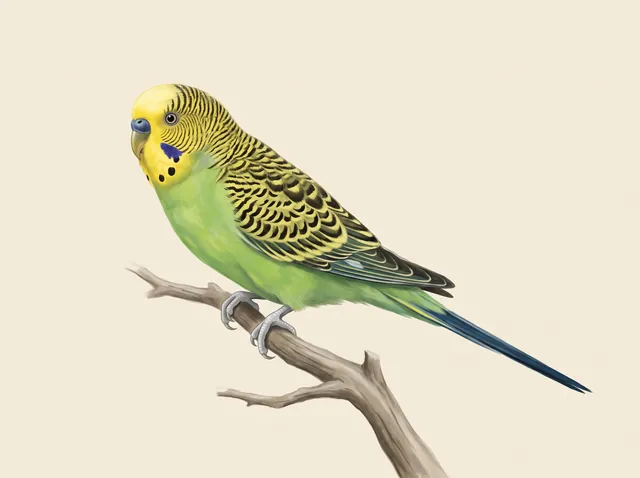
Reading your budgies
- Chattering and singing
- Content and relaxed.
- Preening each other
- A strong social bond.
- Head bobbing
- Excitement or courtship.
- Fluffed up for long periods
- Possibly ill.
- Hissing or biting
- Fear or territorial defence.
Keeping budgies busy
- Daily flight.
- Toys to chew and shred, rotated.
- Foraging: food hidden in paper or toys.
- Branches to climb and gnaw.
Taming
Sit quietly by the cage, talk softly, offer millet through the bars, then on your hand. Teach the budgie to step onto a finger in short sessions. Grabbing a budgie breaks trust.
When behaviour changes
Feather plucking can be caused by illness, parasites, poor diet, boredom or stress. A budgie that goes quiet or stops playing may be ill.
Detailed guides
Note what you notice
A budgie that goes quiet or plucks feathers: in MyArk, everyone can note it with the date, to show your vet.
- Observations dated and shared
- Food and weights on the same timeline
- Notes per bird
- A history for the vet
Common questions
Can budgies learn to talk?
Some do, especially males, but it varies a lot.
How do I tame a budgie?
Patiently, with millet from your hand and short, calm sessions.
Why is my budgie plucking its feathers?
Illness, parasites, diet, boredom or stress: see an avian vet.
Do budgies need toys?
Yes, to chew, climb and forage, rotated regularly.
Will two budgies still bond with me?
Yes, with time and patience; their wellbeing comes first.
Sources
Benchmarks checked on 12 November 2026 in the documents below, then rewritten in plain English. They do not replace an examination and advice from your vet, who adapts care to your budgies and to where you live.