
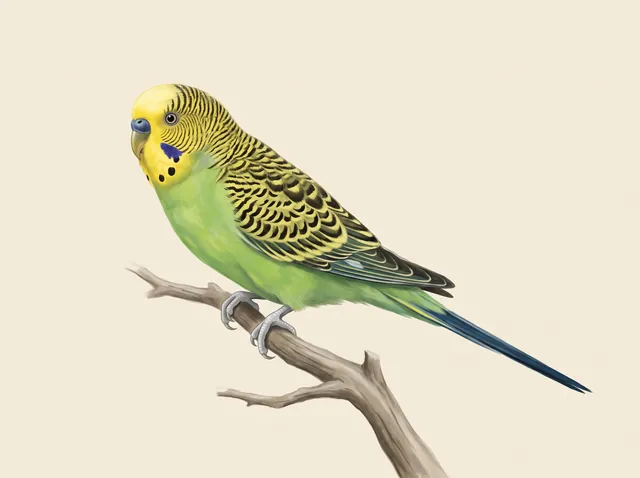
Why weigh a budgie
Budgies hide their symptoms, and their feathers can mask serious weight loss, the veterinary edition of the MSD Veterinary Manual points out. For this manual, an accurate weight is essential for monitoring a bird’s health and recovery.
VCA Animal Hospitals counts a significant change in weight, up or down, among the signs of illness. On a 35-gram bird, losing 3 or 4 grams can’t be seen: only the scales reveal it.
Weight benchmarks
- Budgerigar
- It measures around 18 to 20 cm and usually weighs between 30 and 40 g, according to a veterinary study published in 2024.
- Cockatiel
- Larger, it weighs 80 to 95 g on average, according to VCA Animal Hospitals.
These figures are averages: size and bloodline vary from bird to bird. What matters is your budgie’s usual healthy weight, and how it changes.
How to weigh it
- The scalesKitchen or postal scales that show single grams; an avian vet recommends them in a World Parrot Trust publication.
- The containerA perch set on the scales, or a small cardboard box whose weight you subtract (the “tare” button).
- The timingThe same day of the week, at the same time.
- Record itWrite down every weigh-in: comparing one week with the next is what tells you something.
Rewarding your bird when it steps onto the scales makes weighing easier over time.
Reading the chart
- Stable weight
- A good sign in a healthy adult.
- Weight loss
- Check that it is really eating and look at its droppings. A loss that is confirmed should be reported to your vet.
- A loss of 10% or more
- During a change of diet, the veterinary edition of the MSD Manual says to call the vet beyond a 10% loss: that is 3.5 g for a 35 g budgie.
- Weight gain
- Often linked to a diet that is too fatty (seed, table scraps) and lack of exercise, according to the MSD Manual.
Back up the scales with touch
Vets assess a bird’s body condition by feeling the breast muscles on either side of the keel, on a scale from 1 (very thin) to 5 (obese); for the veterinary edition of the MSD Manual, 3 is right for most birds. Ask your vet to show you how at a visit.
Keeping a healthy weight
- Limit fatty seed and millet spray, and give vegetables every day.
- Let your budgie fly every day in a safe room with the windows shut: the Royal Veterinary College (RVC) in London recommends daily flying exercise.
- Avoid table scraps, which are often fatty or salty.
- For a budgie that is overweight or underweight, your vet decides on the plan.
When to ask for advice
A weight chart accurate to the gram
Log every weigh-in in MyArk: the weight tracker shows the trend at a glance, for everyone in the household, and a drop of a few grams shows up before other signs.
- A weight chart for each bird, over time
- A weekly weigh-in reminder, shared with the household
- Observations noted in the health record
- The latest weigh-in to hand for your vet
Common questions
How much does a budgie weigh?
Usually between 30 and 40 grams as an adult, according to a 2024 veterinary study. Weight varies with size and bloodline: what matters is that your budgie’s weight stays stable.
How much does a cockatiel weigh?
80 to 95 grams on average, according to VCA Animal Hospitals, more than twice as much as a budgie.
How do I weigh a budgie?
On kitchen scales accurate to the gram, with a perch or a small box whose weight you subtract. Always the same scales, on the same day and at the same time.
How often should I weigh my budgie?
About once a week, as an avian vet advises in a World Parrot Trust publication. Your vet may ask for more during an illness or a change of diet.
My budgie has lost 3 grams: is it serious?
For a 35-gram bird, that is almost 10% of its weight. Check that it is eating and look at its droppings, then call your vet, especially if the loss is confirmed or comes with other signs.
Is my budgie overweight?
Weight gain often comes from a diet too rich in seed and too little flying. Your vet can assess its body condition by feeling its breast, and advise you.
Sources
Benchmarks checked on 25 October 2026 in the documents below, then rewritten in plain English. They do not replace an examination and advice from your vet, who adapts care to your pet and to where you live.
- Yilmaz et al., Sex determination in budgerigars using radiographic pelvimetry, Veterinary Medicine and Science (2024)
- VCA Animal Hospitals (Drs Rich, Hess and Axelson, vets), Cockatiels – General Information (2023)
- World Parrot Trust, PsittaScene (Dr Brenna Fitzgerald, avian vet), Signs of illness (2009)
- MSD Veterinary Manual, veterinary edition, Management of Pet Birds (2024)
- VCA Animal Hospitals (Drs Rich, Hess and Axelson, vets), Recognizing the Signs of Illness in Pet Birds (2023)
- MSD Veterinary Manual, Nutritional Disorders of Pet Birds (2026)
- Royal Veterinary College, Beaumont Sainsbury Animal Hospital, Caring for your budgie