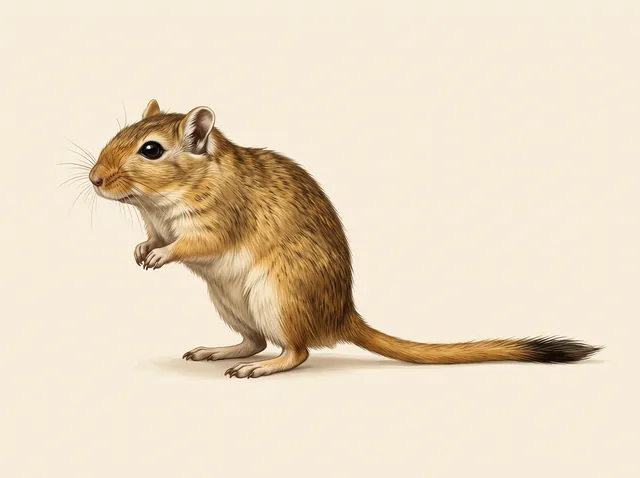
Where the Mongolian gerbil comes from
The Mongolian gerbil lives in the semi-desert regions of Mongolia and north-eastern China; Father Armand David first reported it in 1866.
First used in laboratories, it only became a pet after 1954.
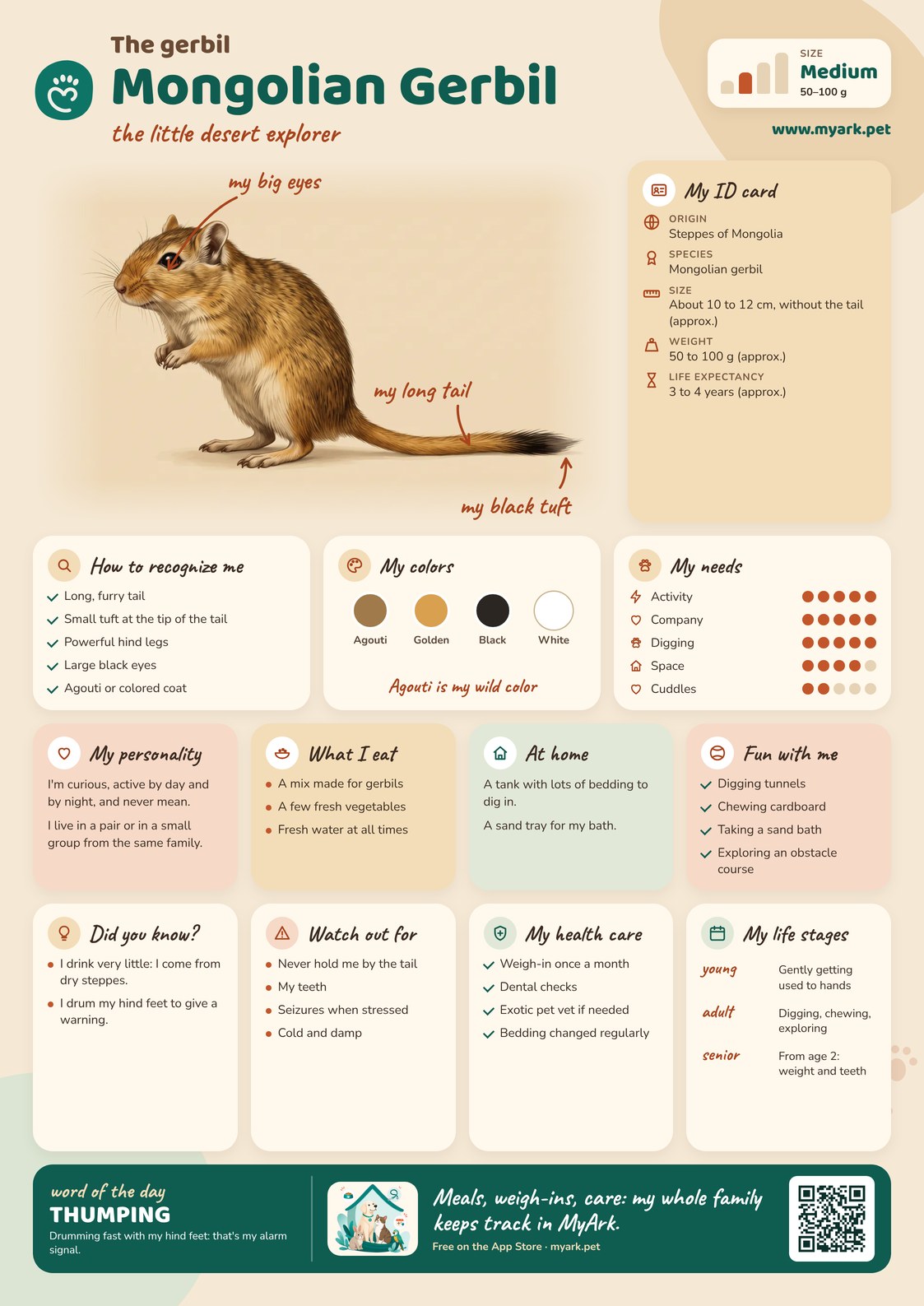
How to recognise me
- long, furry tail
- small tuft at the tail tip
- powerful hind legs
- large black eyes
- agouti or coloured coat
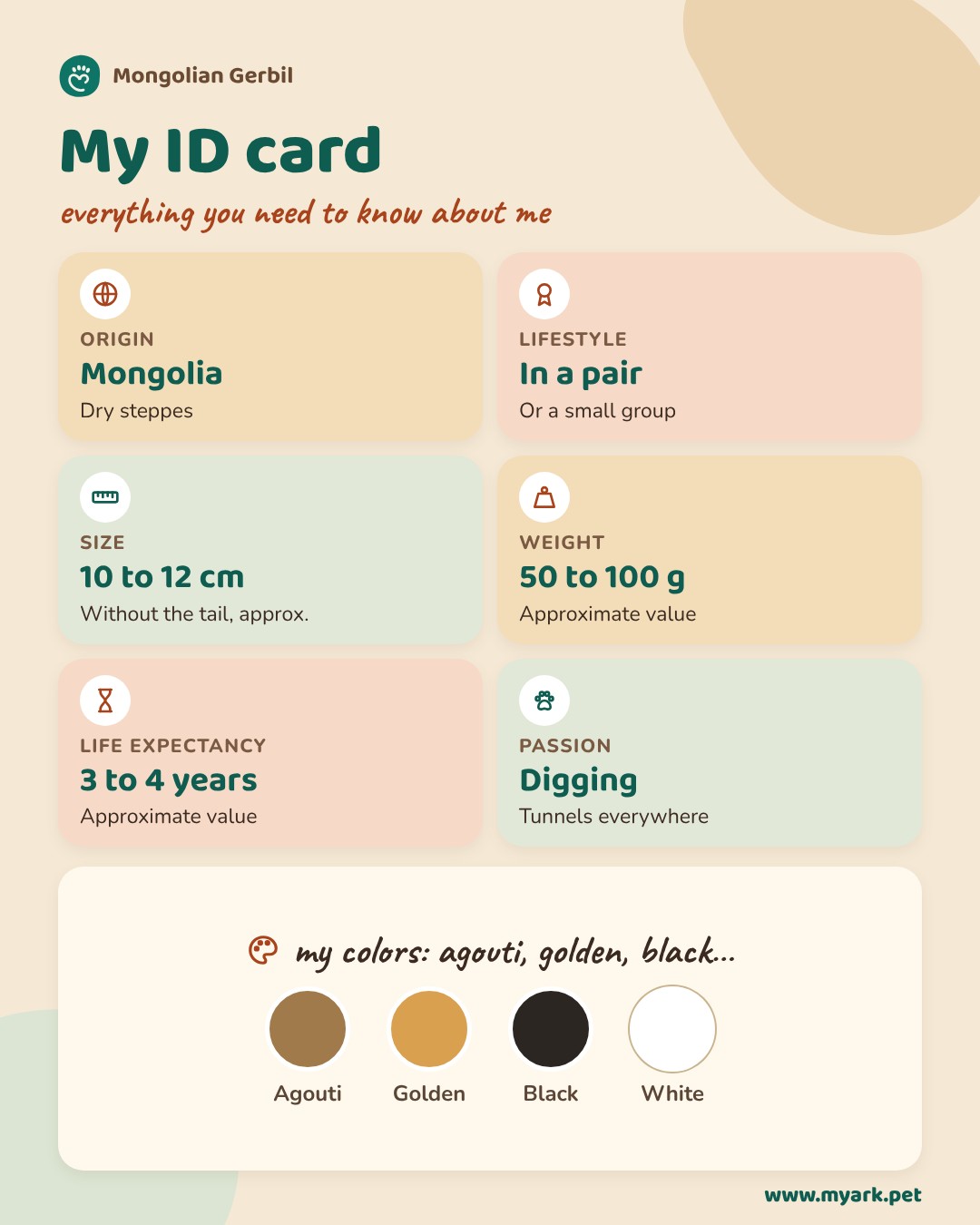
My colours
- Agouti
- Golden
- Black
- White
What a Mongolian gerbil needs day to day
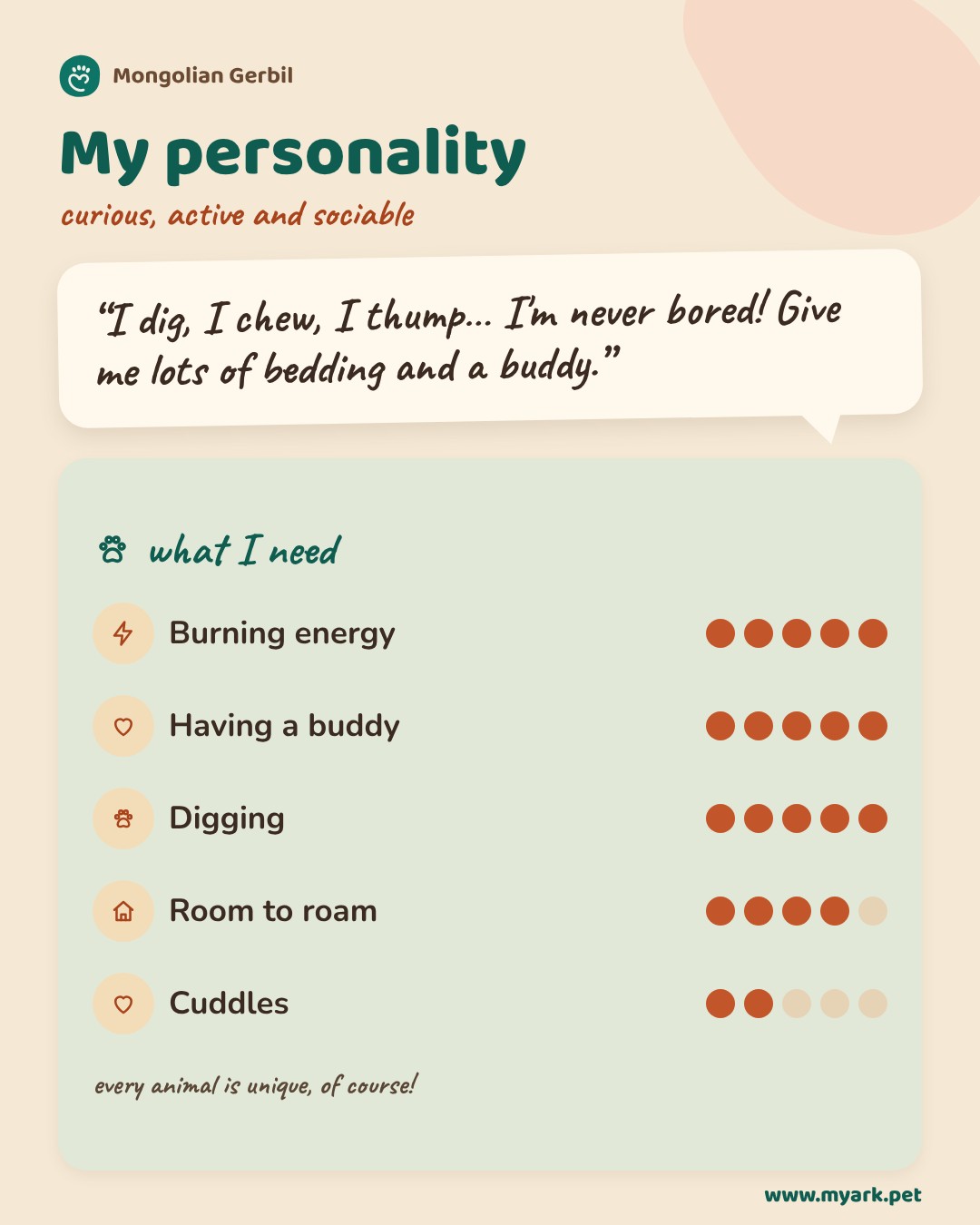
“I dig, I gnaw, I drum… I’m never bored! Give me lots of bedding and a friend.”
Its needs are real: a companion, a deep tank to dig in, a sand bath and things to gnaw.
At a glance
- Exercise
- 5 out of 5
- A companion
- 5 out of 5
- Digging
- 5 out of 5
- Space
- 4 out of 5
- Cuddles
- 2 out of 5
every gerbil is unique, of course!
With me, we can go…
- digging tunnels
- gnawing cardboard and wood
- a sand bath
- standing guard on its hind legs
Living with a Mongolian gerbil: who does what
A gerbil needs a deep tank rather than an ordinary cage — that is what lets it behave normally. Its care is light but regular: food, water, deep bedding, things to gnaw. Here is the Mongolian gerbil’s routine at a glance, and how a household can split it without a single “did anyone…?” message.
The routine at a glance
- every day
- food and fresh water; a little fresh vegetable; a look at each gerbil.
- every week
- soiled corners removed, deep bedding topped up; the sand bath sieved; a weigh-in.
- every month
- a partial clean, keeping some old bedding for familiar smells; gnawing wood and cardboard renewed; teeth checked.
- every year
- a check-up with a vet used to small mammals.
Sharing it out
- Food and water go on one person each day.
- Children hold them close to the floor, with an adult.
- The bedding top-up and weigh-in on a name.
Before it arrives, agree on…
- who does food and water every day
- who tops up the bedding and the sand
- who does the weekly weigh-in
- how children handle them — close to the floor, never by the tail
- who looks after them during holidays
How MyArk helps the household keep track
Family pet chores
Food, bedding and sand on named people.
See the featurePet weight tracker
A weekly weigh-in: weight loss is an early warning sign.
See the featurePet feeding tracker
Log food and fresh vegetables.
See the featurePet sitter instructions
Holiday instructions: food, water and never by the tail.
See the featureFeeding, grooming and health routine
The coat needs regular brushing, more often during the moult.
What I eat
- a gerbil seed mix
- a little fresh vegetable
- fresh water at will
My health routine
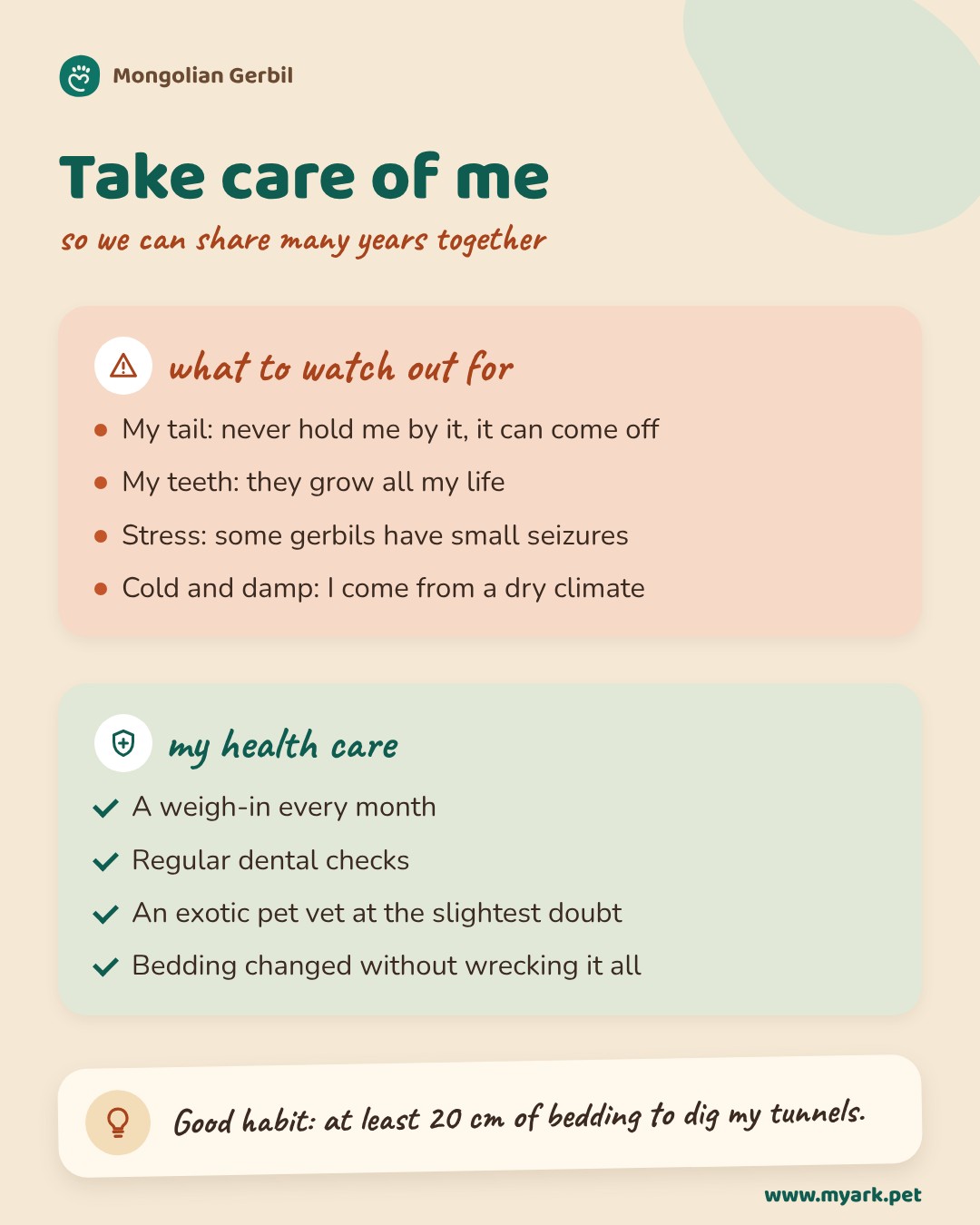
- never lift a gerbil by its tail: the skin can come away
- teeth checked regularly: they grow all its life
- a weekly weigh-in
- a vet used to small mammals, found before there is a problem
The stages of my life
- young
- Gentle taming, close to the floor.
- adult
- A companion, deep bedding and things to gnaw.
- older
- From about 2 years old, closer watch on weight and teeth.
What to keep an eye on
MyArk describes predispositions through visible body shape and simple checks rather than a list of diseases: it is what you can verify from the outside, and act on when choosing a breeder.
Tail
Never hold me by it: it can come away.
Teeth
They grow all its life: cardboard and wood to gnaw.
Stress
Some gerbils have brief seizures.
Cold and damp
I come from a dry climate.
And, as for every gerbil:
- very deep bedding: gerbils dig deep
- life in a pair or same-sex siblings
- a sand bath for coat care
- wood to gnaw at all times
Is it the right gerbil for your household?
Gerbils need a deep tank, a companion, sand and things to gnaw; they are lively and curious, and live only a few years. They are better watched than carried by young children — and never picked up by the tail.
- Home
- A deep tank with thick bedding, in a calm room.
- Children
- Lively: better watched than carried by young children.
- Other pets
- Keep cats and dogs away; never mix with other rodents.
- First pet
- A good first pet.
- Time
- A few minutes a day, and a weekly top-up.
Mongolian gerbil: straight answers
Can a gerbil live alone?
No: keep a pair or same-sex siblings.
Why does my gerbil drum its feet?
It is an alarm signal to its companions.
Does a gerbil need a cage or a tank?
A deep tank, so it can dig.
What colours does the Mongolian gerbil come in?
The usual colours are agouti, golden, black and white.