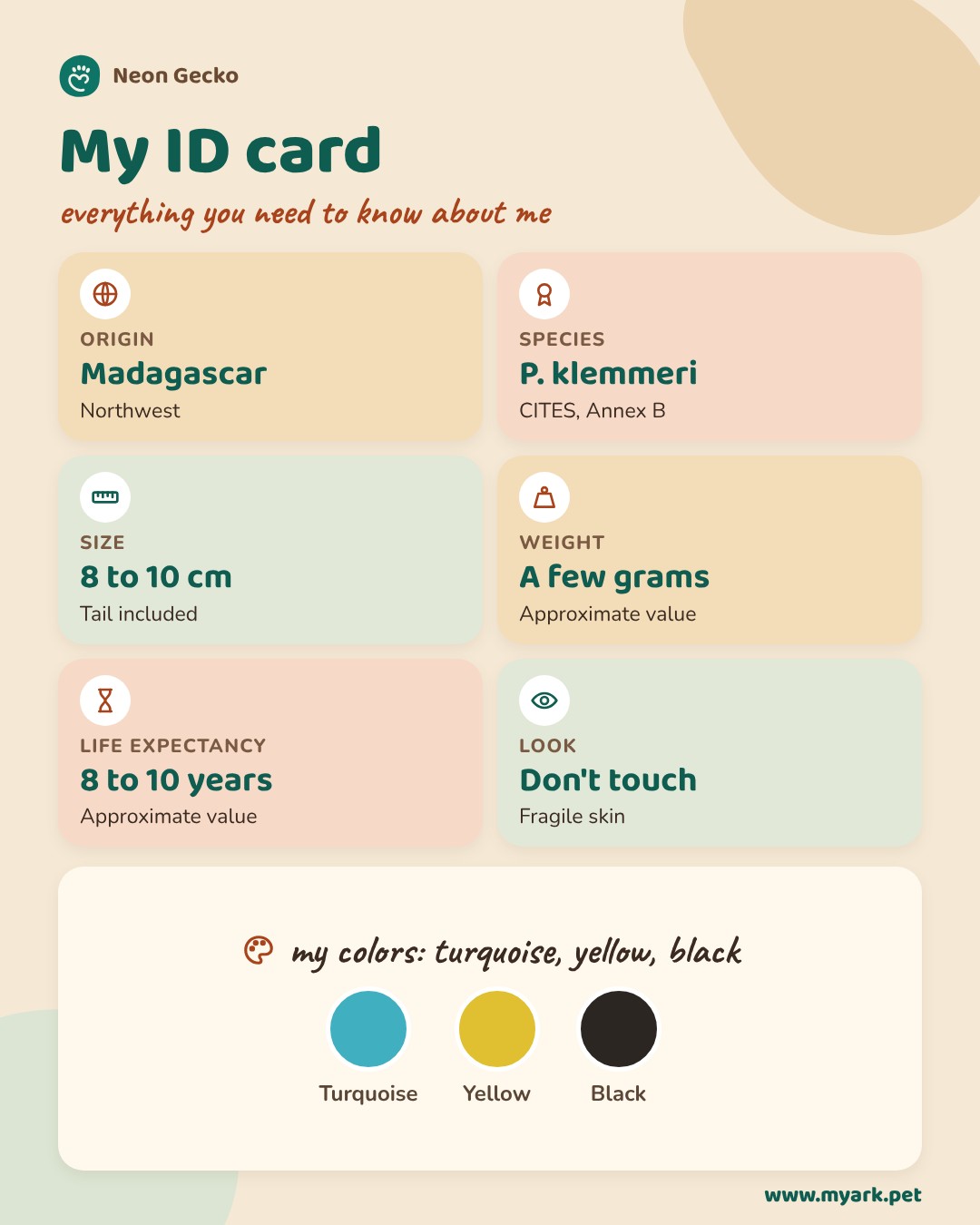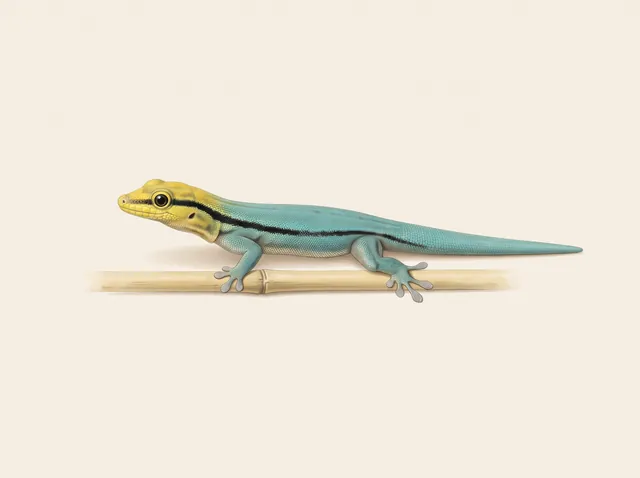
Where the Neon day gecko (Phelsuma klemmeri) comes from
The neon day gecko lives in the bamboo forests of north-western Madagascar.
Its flattened body lets it slip into cracks and hollow bamboo.
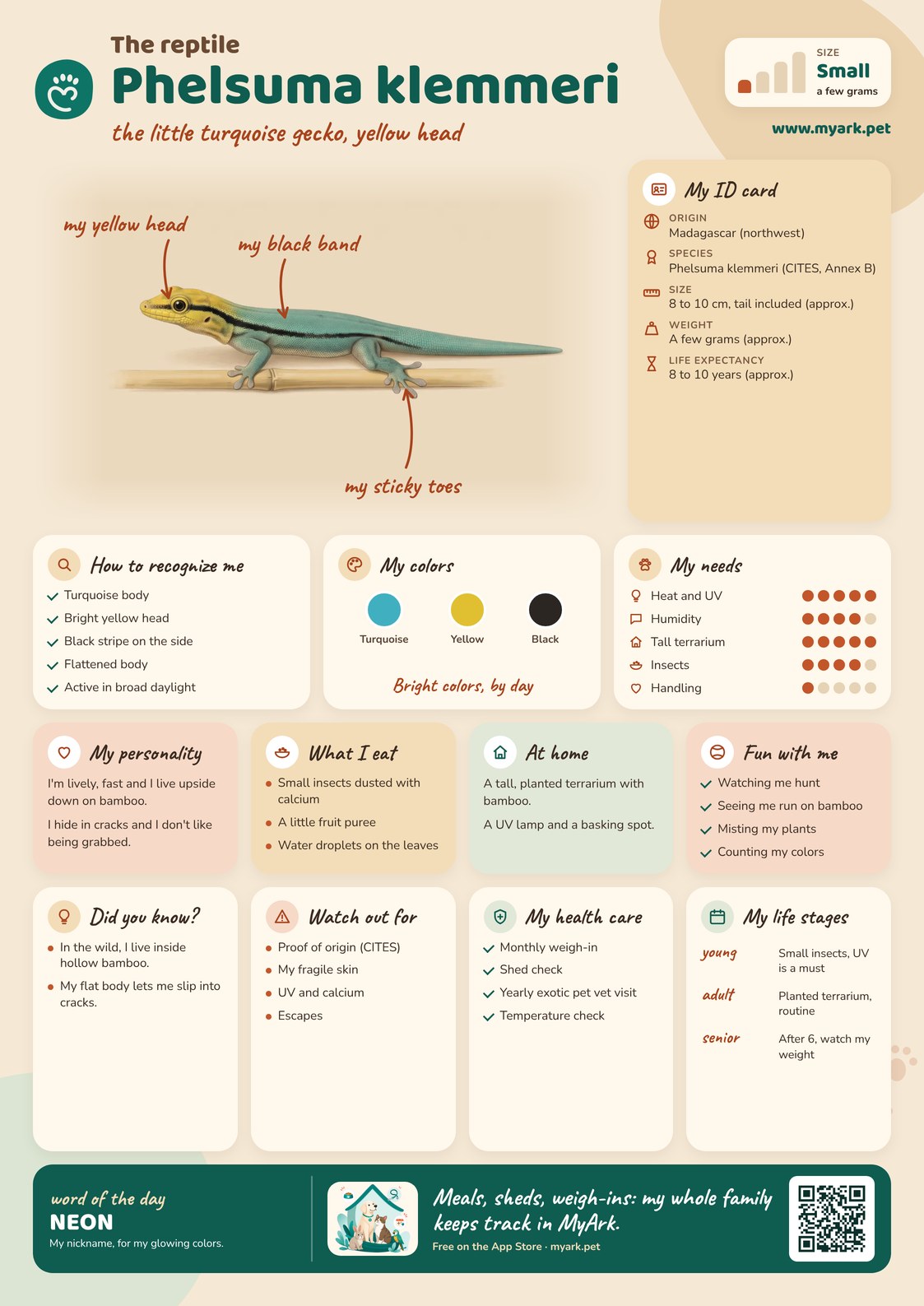
How to recognise me
- turquoise body
- bright yellow head
- black band on the flank
- flattened body
- active in broad daylight
My colours
- Turquoise
- Yellow
- Black
What a Neon day gecko (Phelsuma klemmeri) needs day to day
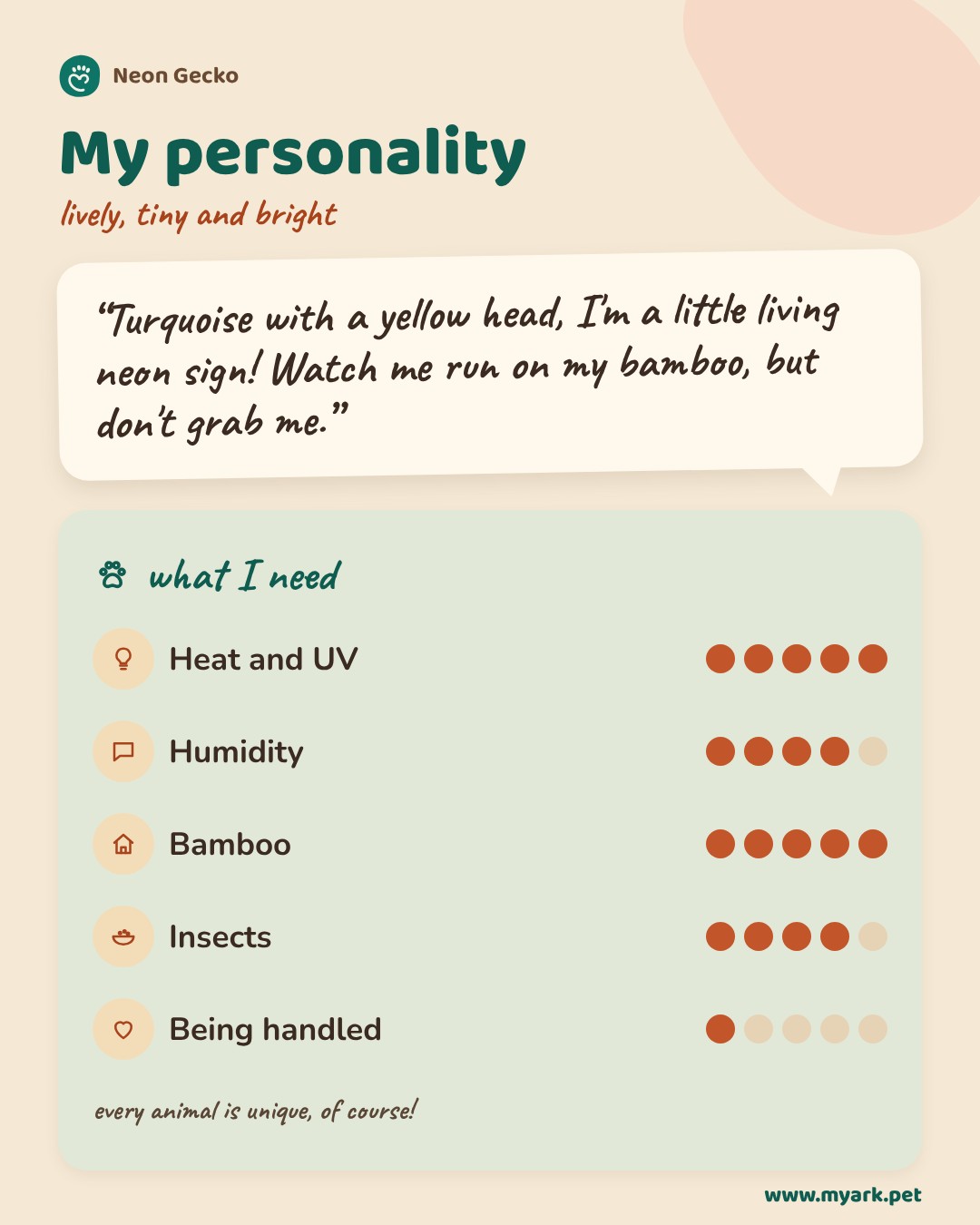
“Turquoise with a yellow head, I’m a little living neon! Watch me run on my bamboo, but don’t catch me.”
Its needs are real: a planted vivarium with bamboo, warmth and UVB, humidity and small insects dusted with calcium.
At a glance
- Warmth and UV
- 5 out of 5
- Humidity
- 4 out of 5
- Bamboo
- 5 out of 5
- Insects
- 4 out of 5
- Being handled
- 1 out of 5
every gecko is unique, of course!
With me, we can go…
- basking under its lamp
- hunting insects by day
- running along bamboo and leaves
- licking drops from the leaves
Living with a Neon day gecko (Phelsuma klemmeri): who does what
A gecko suits a calm home: it is an animal to watch, which copes badly with repeated handling. The routine is short — temperatures, misting, insects — but it must never slip. Here is the Neon day gecko (Phelsuma klemmeri)’s routine at a glance, and how a household can split it without a single “did anyone…?” message.
The routine at a glance
- every day
- temperatures checked at the warm and cool ends; fresh water or misting, depending on the species; a look at the gecko, without disturbing it; the lid checked.
- every week
- insects dusted with calcium, at the right interval; droppings removed; the humid hide refreshed.
- every month
- a weigh-in; a look at toes and tail tip after the shed; thermostat, lamps and UVB checked.
- every year
- a check-up with a reptile vet; UVB tubes replaced as the maker advises; a full clean of the vivarium.
Sharing it out
- Daily temperature checks and misting on a rota.
- Feeding on one named person, logged.
- Children watch; handling only with an adult.
Before it arrives, agree on…
- who checks temperatures and humidity every day
- who feeds and dusts the insects, and on which days
- who buys and keeps the live insects
- the house rule: watch, don’t grab
- who looks after it during holidays
How MyArk helps the household keep track
Pet feeding tracker
Log each meal and the calcium dusting, so nobody doubles up.
See the featurePet weight tracker
A monthly weigh-in: weight loss is an early warning sign.
See the featureFamily pet chores
Temperature checks, misting and insects on named people.
See the featurePet sitter instructions
Holiday instructions: temperatures, misting and feeding.
See the featureFeeding, vivarium and health routine
Care is regular rather than time-consuming: temperatures and humidity checked, insects dusted with calcium, a clean vivarium.
What I eat
- small insects dusted with calcium
- a little fruit diet
- water drops on the leaves
My health routine
- a thermostat on every heat source, checked with a thermometer
- calcium and vitamin D3 dusted on the insects, and UVB lighting where the species needs it
- a regular weigh-in and a look at toes and tail tip after each shed
- a reptile vet found before there is a problem
The stages of my life
- young
- Small insects more often, dusted with calcium.
- adult
- A steady set-up, meals at the right interval and calcium.
- older
- Fewer meals and a closer watch on weight.
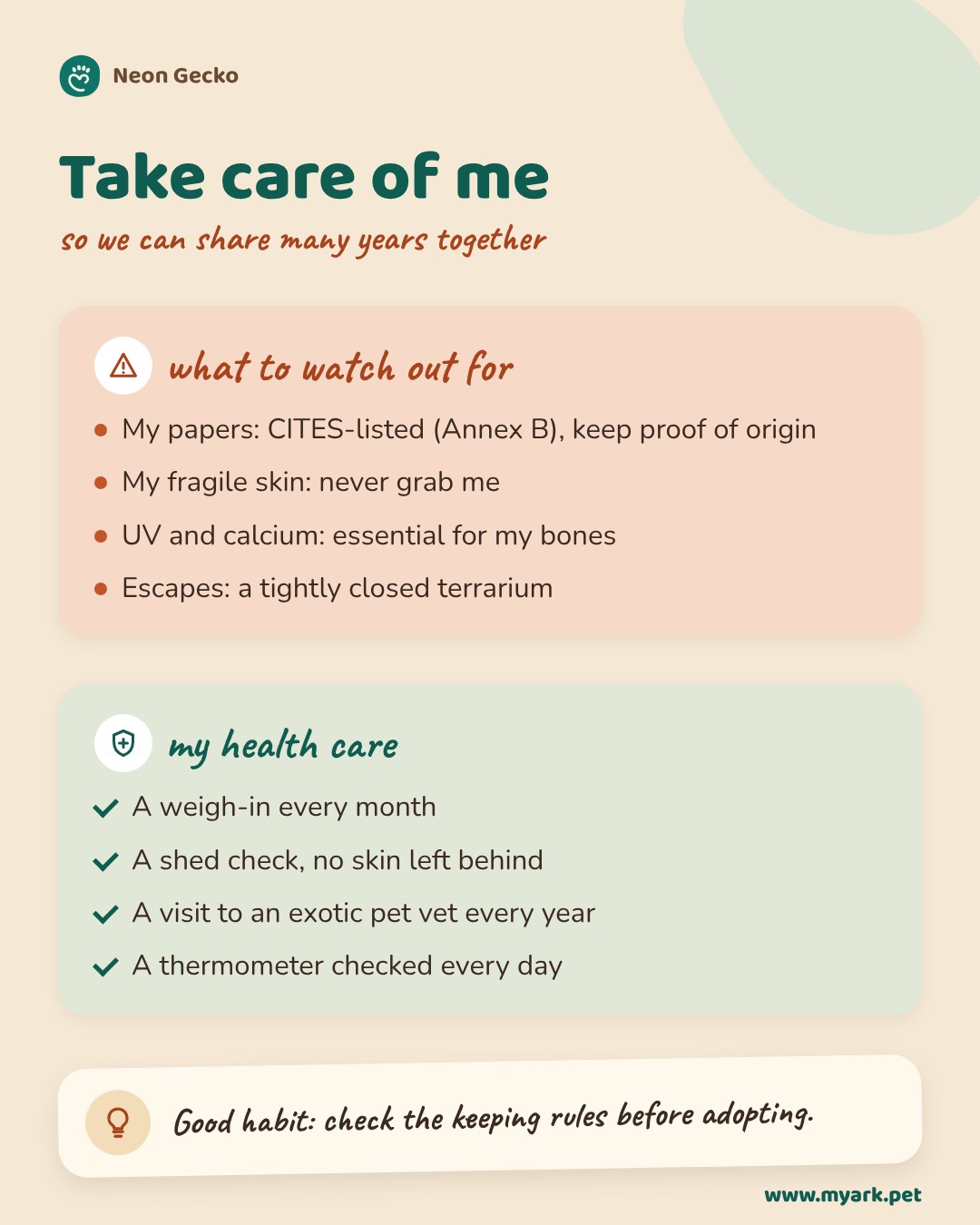
What to keep an eye on
MyArk describes the points to watch through the set-up, the shed and simple checks rather than a list of diseases: most gecko health problems start with heat, humidity or calcium.
Papers
A CITES species: keep its proof of origin and check your country’s rules.
Fragile skin
Never grab it: its skin can tear.
UV and calcium
Essential for its bones.
Escapes
A well-closed vivarium.
And, as for every gecko:
- a temperature gradient and, depending on the species, suitable UVB lighting
- controlled humidity, adjusted by misting
- calcium and vitamin D3 dusted on the prey
- hides, including a humid one for shedding
Is it the right gecko for your household?
A gecko needs a secure vivarium with a thermostat, controlled humidity, live insects dusted with calcium and a reptile vet — and many live for well over a decade. Check the rules and any CITES papers required in your country, and choose captive-bred animals.
- Home
- A tall, planted vivarium with a thermostat, in a calm room. Bamboo and UVB lighting.
- Children
- To watch only.
- Other pets
- Keep cats and dogs away from the vivarium.
- First reptile
- Better with some reptile experience.
- Time
- A few minutes a day, without fail.
Neon day gecko (Phelsuma klemmeri): straight answers
How big is a neon day gecko?
Tiny: one of the smallest day geckos.
Can I handle it?
No: its skin is fragile.
Does it need bamboo?
Yes: it lives in hollow bamboo.
What colours does the Neon day gecko (Phelsuma klemmeri) come in?
The usual colours are turquoise, yellow and black.