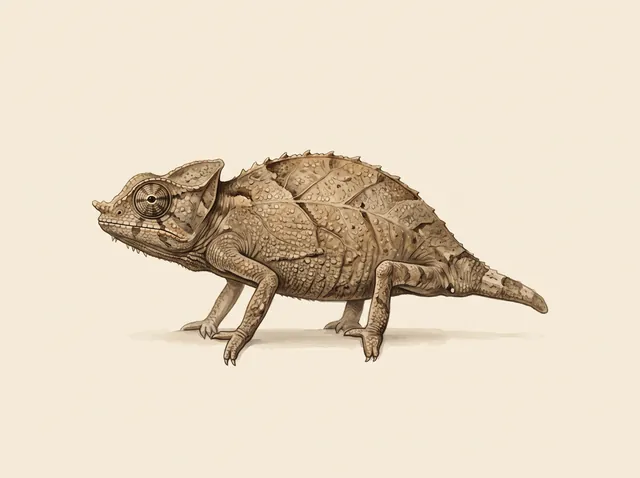
Where the Pygmy (leaf) chameleon comes from
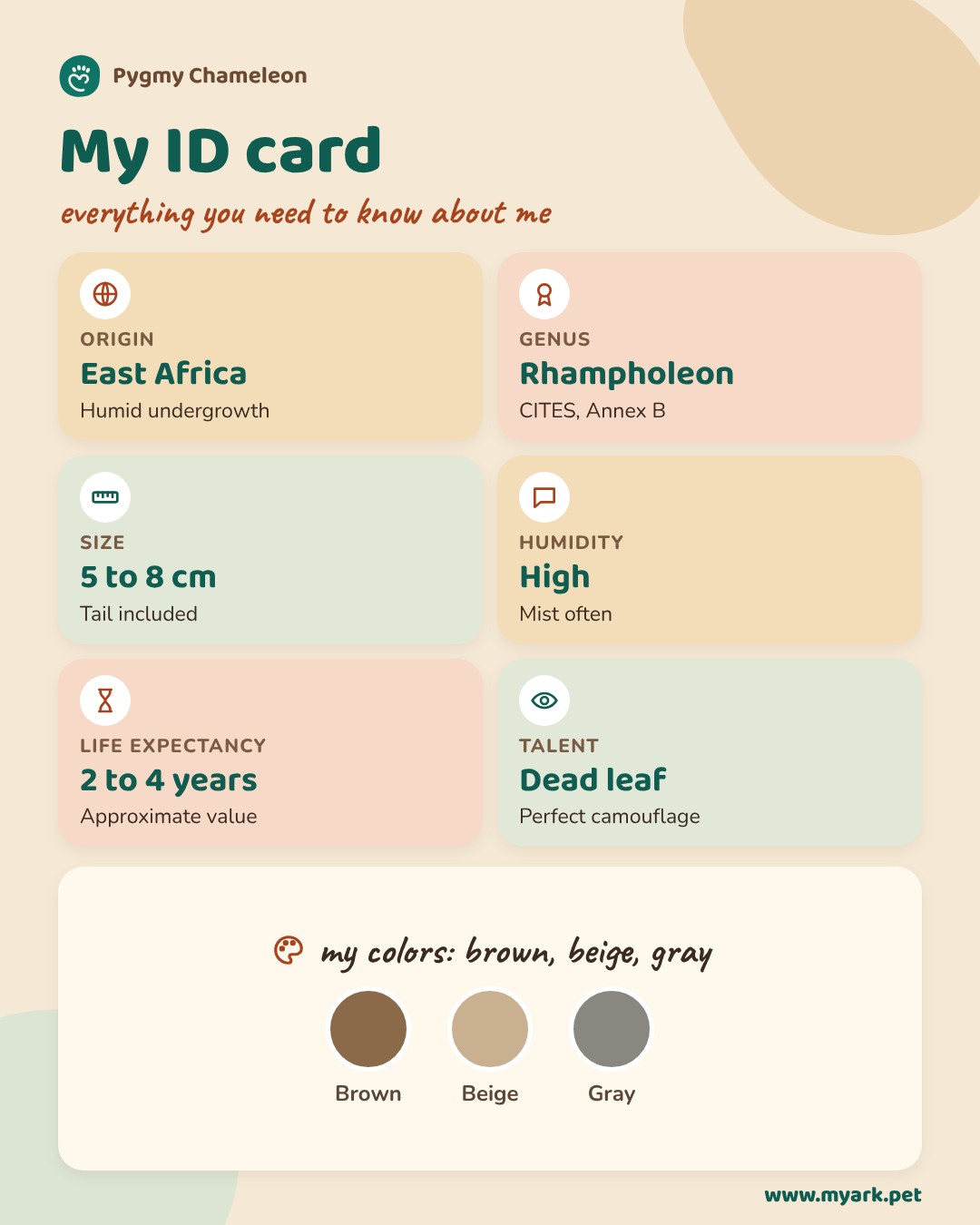
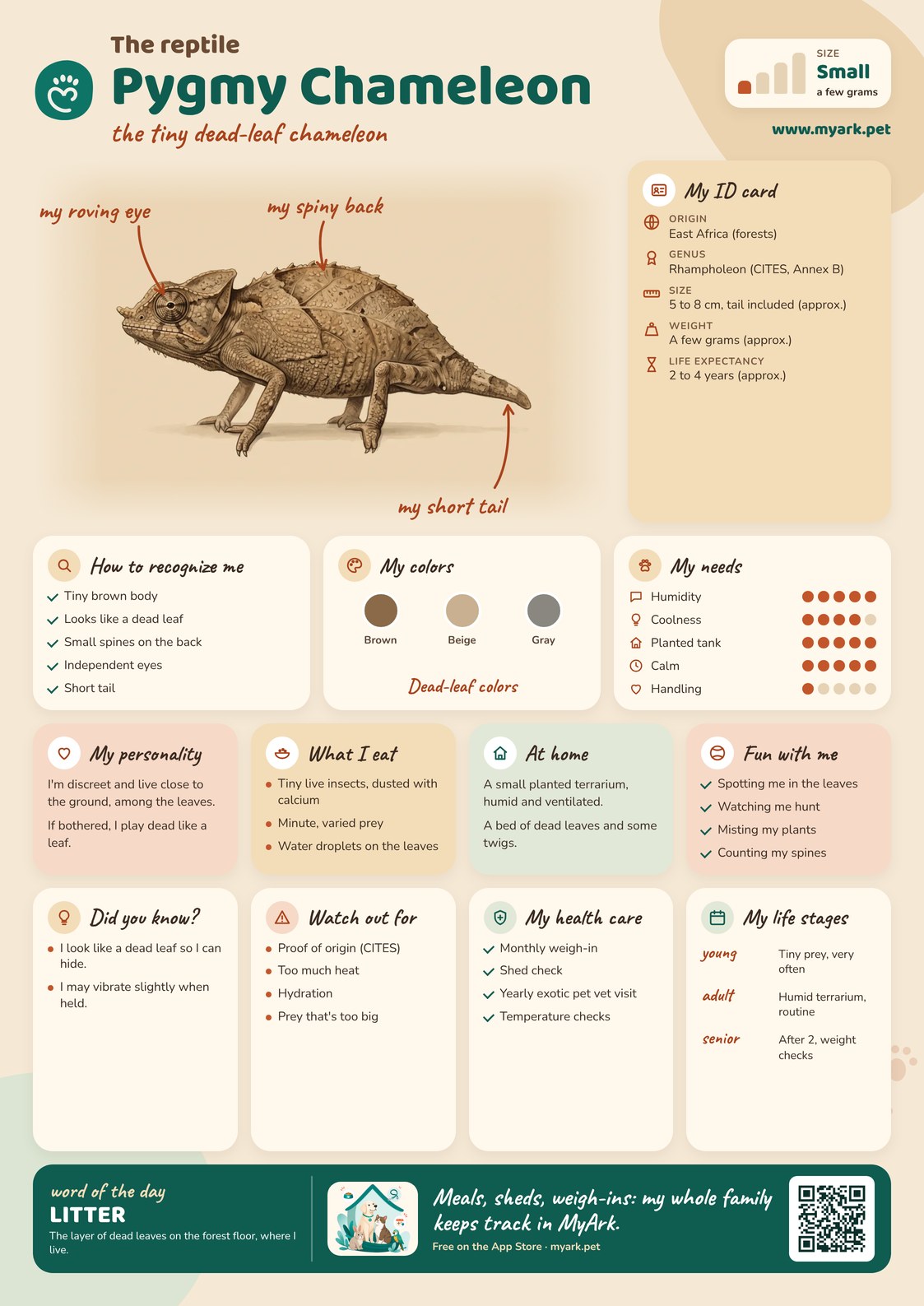
Pygmy chameleons live in the leaf litter of East African forests.
They look like a dead leaf and can vibrate slightly when held.
How to recognise me
- tiny brown body
- dead-leaf look
- small spines on the back
- independent eyes
- short tail
My colours
- Brown
- Beige
- Grey
What a Pygmy (leaf) chameleon needs day to day
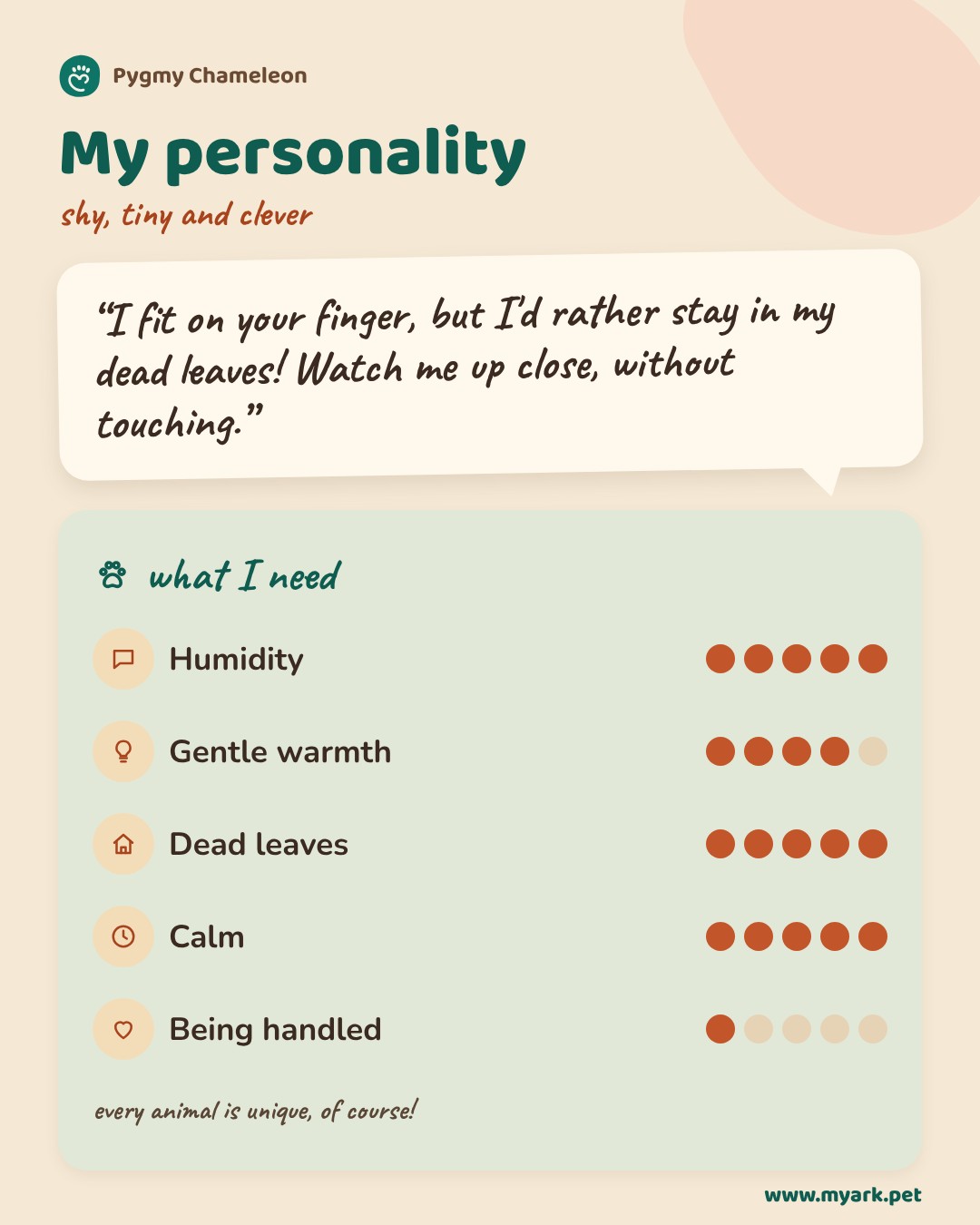
“I fit on your finger, but I’d rather stay in my dead leaves! Watch me up close, without touching.”
Its needs are demanding: a screened enclosure, misting, UVB, live insects and calm.
At a glance
- Humidity
- 5 out of 5
- Gentle warmth
- 4 out of 5
- Leaf litter
- 5 out of 5
- Calm
- 5 out of 5
- Being handled
- 1 out of 5
every chameleon is unique, of course!
With me, we can go…
- catching insects with its tongue
- climbing branches
- basking under the lamp
- changing colour
Living with a Pygmy (leaf) chameleon: who does what
A chameleon is not a first reptile: it forgives very few technical mistakes. It is an animal to watch, not handle — and the misting, UVB and insects must never slip. Here is the Pygmy (leaf) chameleon’s routine at a glance, and how a household can split it without a single “did anyone…?” message.
The routine at a glance
- every day
- misting or drip running, morning and evening; live insects, dusted as planned; temperatures and humidity checked; a look at the chameleon, from a distance.
- every week
- uneaten insects removed; plants and branches cleaned; the insect colony fed and cleaned.
- every month
- a weigh-in; UVB and heat lamp checked; plants refreshed.
- every year
- a check-up with a reptile vet; UVB tube replaced as the maker advises.
Sharing it out
- Morning and evening misting on a rota.
- Feeding on one named person, logged.
- Children watch; nobody handles it.
Before it arrives, agree on…
- who mists, morning and evening
- who feeds and dusts the insects
- who keeps the insect colony
- the house rule: watch, don’t handle
- who looks after it during holidays — an experienced person
How MyArk helps the household keep track
Family pet chores
Misting, feeding and insect care on named people.
See the featurePet feeding tracker
Log each meal and dusting.
See the featurePet weight tracker
A monthly weigh-in: weight loss is an early warning sign.
See the featurePet sitter instructions
Holiday instructions: misting, UVB and feeding.
See the featureFeeding, enclosure and health routine
The set-up is demanding: a screened, ventilated enclosure, misting or a drip system, UVB, dense plants and gut-loaded insects.
What I eat
- tiny live insects dusted with calcium
- minute, varied prey
- water droplets on the leaves
My health routine
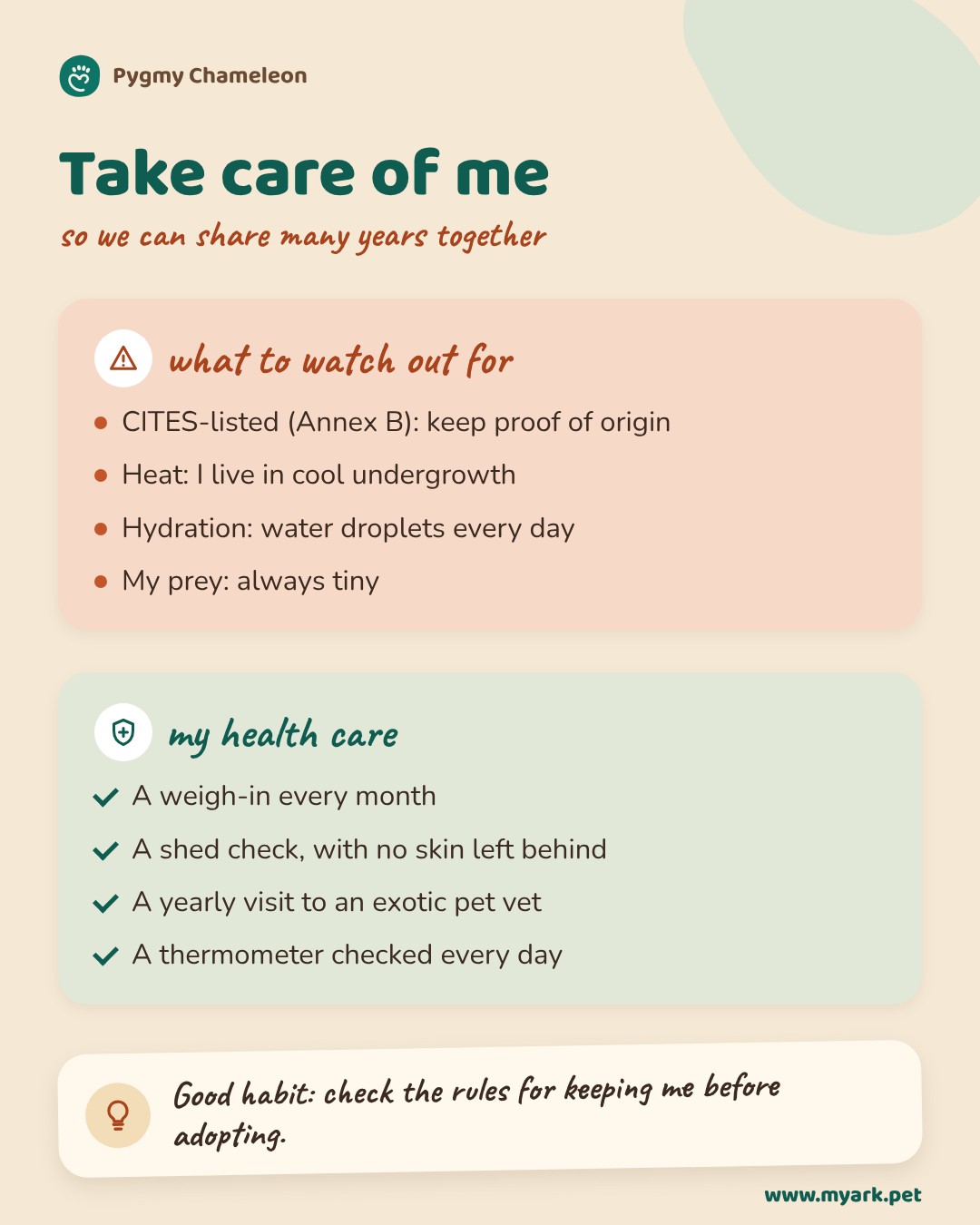
- misting or a drip every day: dehydration is a major cause of death
- calcium and vitamins dusted on insects, as advised by your vet
- UVB replaced on schedule and a regular weigh-in
- a reptile vet found before there is a problem
The stages of my life
- young
- Small insects every day, frequent misting.
- adult
- A steady set-up, varied insects, calm.
- older
- Fewer meals and a closer watch on weight and hydration.
What to keep an eye on
MyArk describes the points to watch through the set-up, hydration and simple checks rather than a list of diseases: chameleons forgive very few technical mistakes.
Papers
A CITES species: keep its proof of origin and check your country’s rules.
Heat
I live in the cool undergrowth.
Hydration
Water droplets every day.
Prey
Always tiny.
And, as for every chameleon:
- a screened, ventilated enclosure — never a closed glass box
- a drip or misting system: chameleons don’t drink from a bowl
- UVB lighting, replaced as the maker advises
- dense plants offering places to hide from view
Is it the right chameleon for your household?
Chameleons need a screened enclosure, misting, UVB, live gut-loaded insects and a calm room with no other chameleon in view. They are for experienced keepers; check the rules and any CITES papers required in your country.
- Home
- A small, humid, planted enclosure with leaf litter, in a cool, calm room.
- Children
- To watch only.
- Other pets
- Keep cats and dogs away.
- First reptile
- Not a first reptile.
- Time
- Daily misting, without fail.
Pygmy (leaf) chameleon: straight answers
How big is a pygmy chameleon?
Tiny: it fits on a finger.
What does it eat?
Minute live insects.
Does it need papers?
Yes: keep its CITES proof of origin.
What colours does the Pygmy (leaf) chameleon come in?
The usual colours are brown, beige and grey.