Where the Jackson’s chameleon comes from
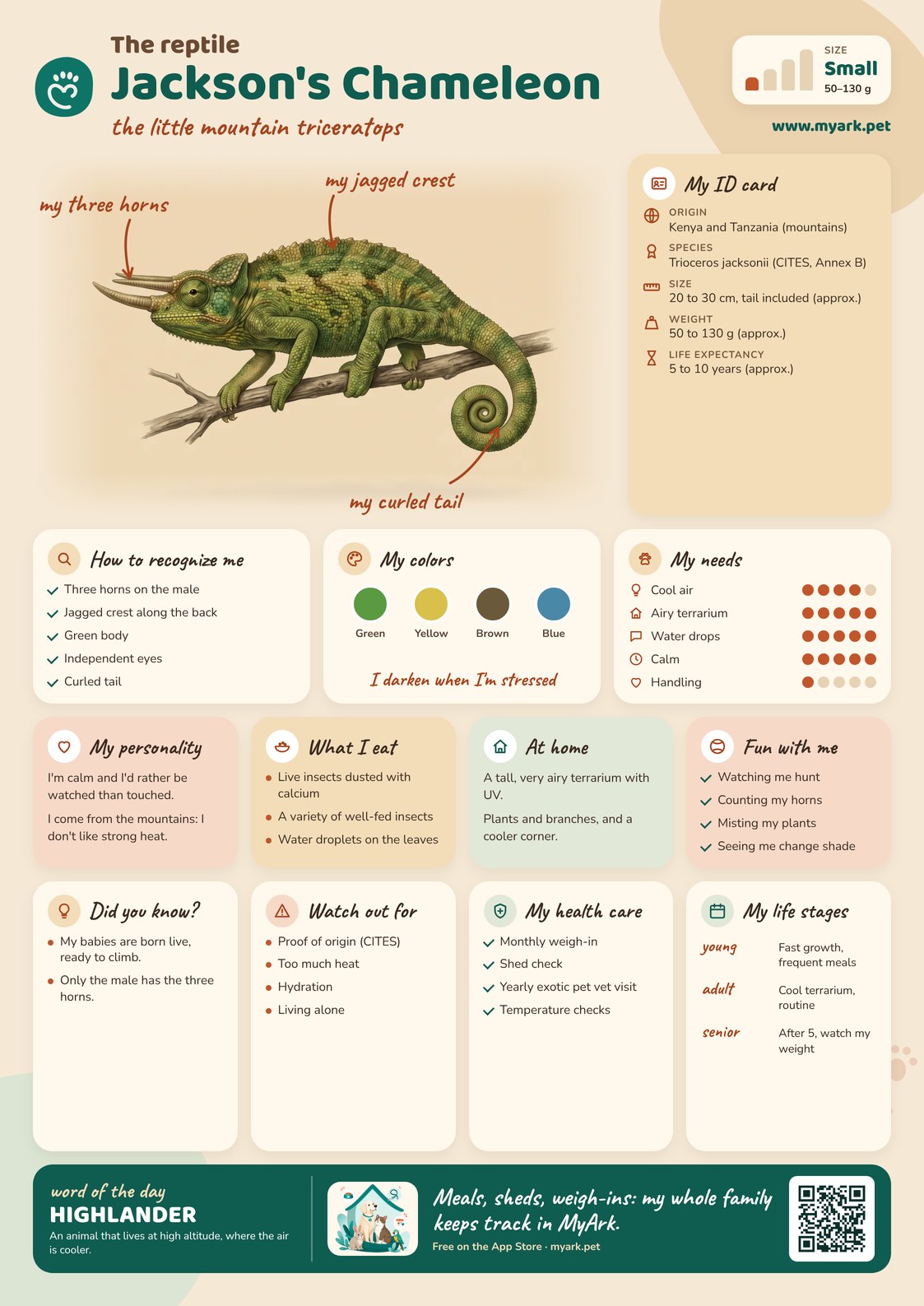
Jackson’s chameleon lives in the cool highlands of Kenya and Tanzania.
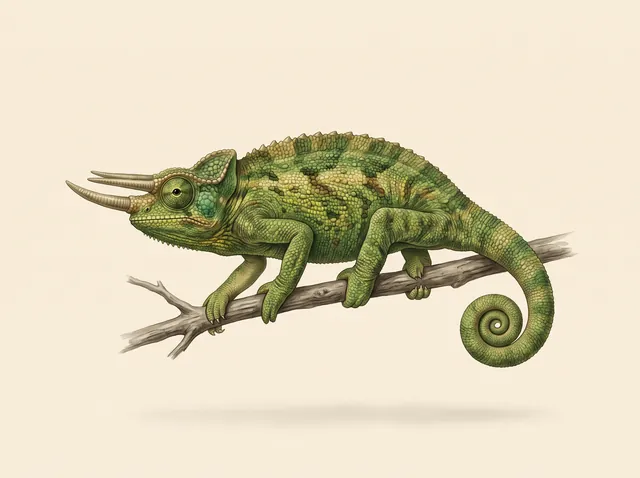
Its young are born alive, ready to climb; only the male has three horns.
How to recognise me
- three horns on the male
- saw-toothed crest on the back
- green body
- independent eyes
- curled tail
My colours
- Green
- Yellow
- Brown
- Blue
What a Jackson’s chameleon needs day to day
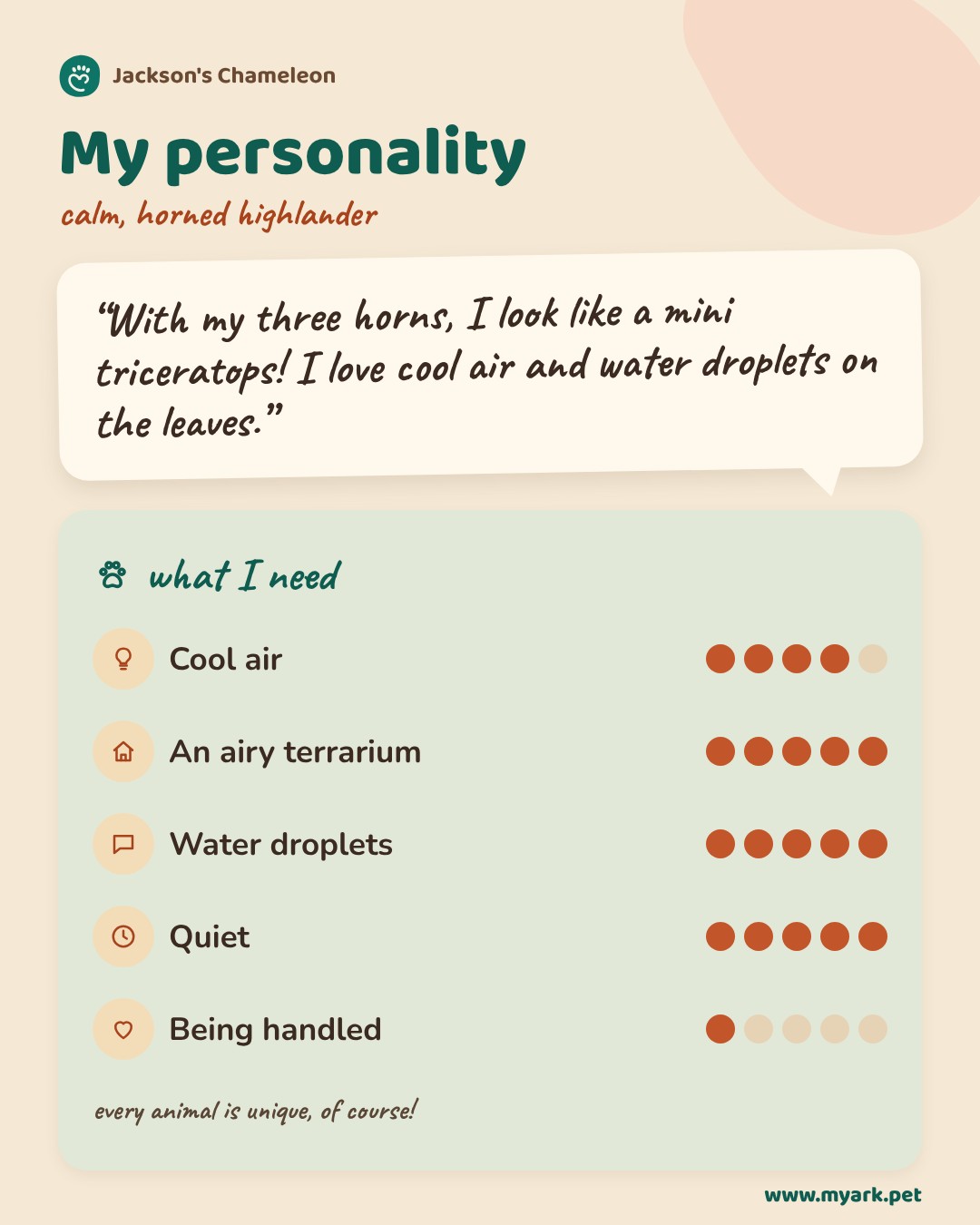
“With my three horns, I look like a mini triceratops! I love cool air and water droplets on the leaves.”
Its needs are demanding: a screened enclosure, misting, UVB, live insects and calm.
At a glance
- Cool air
- 4 out of 5
- A ventilated enclosure
- 5 out of 5
- Water droplets
- 5 out of 5
- Calm
- 5 out of 5
- Being handled
- 1 out of 5
every chameleon is unique, of course!
With me, we can go…
- catching insects with its tongue
- climbing branches
- basking under the lamp
- changing colour
Living with a Jackson’s chameleon: who does what
A chameleon is not a first reptile: it forgives very few technical mistakes. It is an animal to watch, not handle — and the misting, UVB and insects must never slip. Here is the Jackson’s chameleon’s routine at a glance, and how a household can split it without a single “did anyone…?” message.
The routine at a glance
- every day
- misting or drip running, morning and evening; live insects, dusted as planned; temperatures and humidity checked; a look at the chameleon, from a distance.
- every week
- uneaten insects removed; plants and branches cleaned; the insect colony fed and cleaned.
- every month
- a weigh-in; UVB and heat lamp checked; plants refreshed.
- every year
- a check-up with a reptile vet; UVB tube replaced as the maker advises.
Sharing it out
- Morning and evening misting on a rota.
- Feeding on one named person, logged.
- Children watch; nobody handles it.
Before it arrives, agree on…
- who mists, morning and evening
- who feeds and dusts the insects
- who keeps the insect colony
- the house rule: watch, don’t handle
- who looks after it during holidays — an experienced person
How MyArk helps the household keep track
Family pet chores
Misting, feeding and insect care on named people.
See the featurePet feeding tracker
Log each meal and dusting.
See the featurePet weight tracker
A monthly weigh-in: weight loss is an early warning sign.
See the featurePet sitter instructions
Holiday instructions: misting, UVB and feeding.
See the featureFeeding, enclosure and health routine
The set-up is demanding: a screened, ventilated enclosure, misting or a drip system, UVB, dense plants and gut-loaded insects.
What I eat
- live insects dusted with calcium
- varied, well-fed insects
- water droplets on the leaves
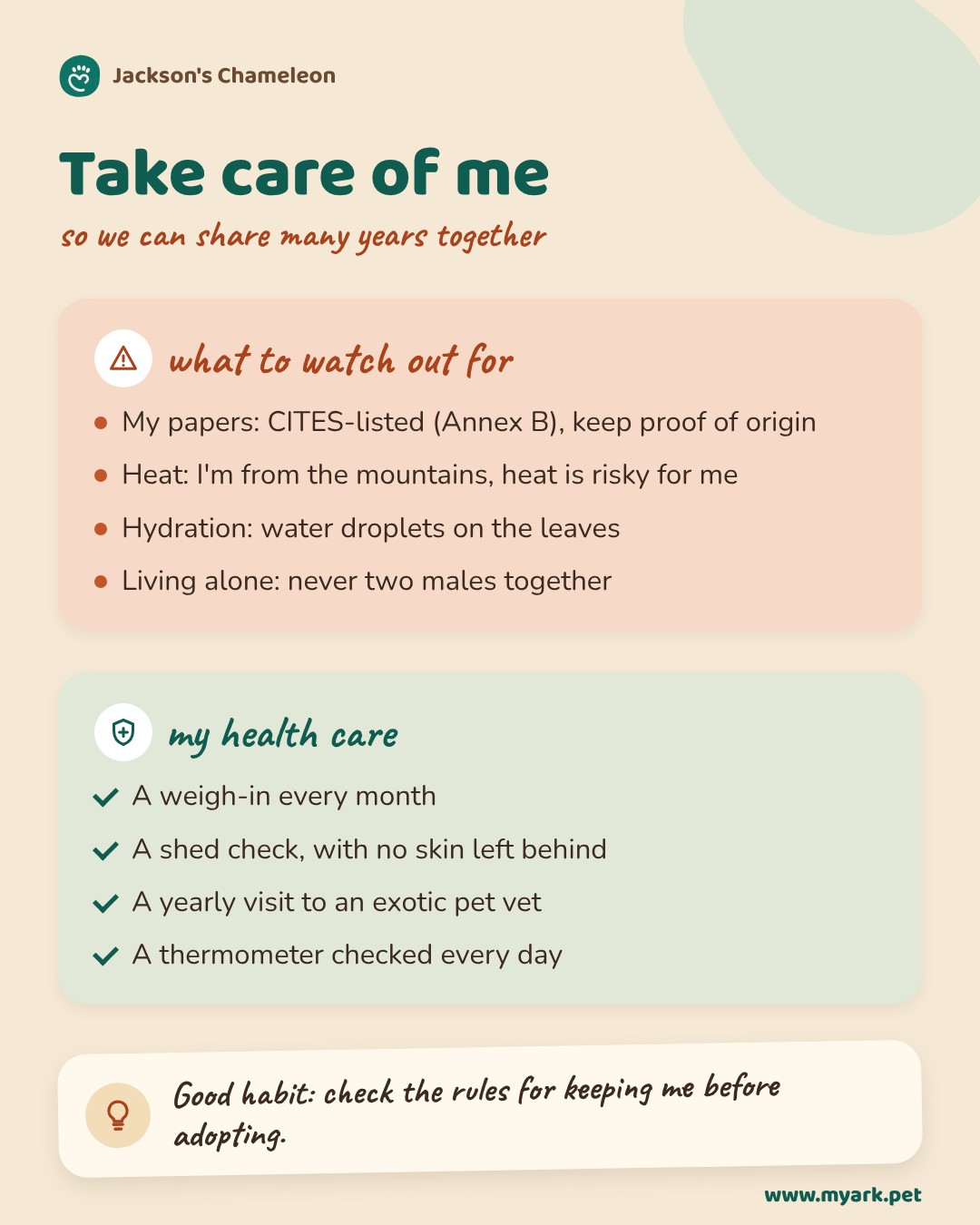
My health routine
- misting or a drip every day: dehydration is a major cause of death
- calcium and vitamins dusted on insects, as advised by your vet
- UVB replaced on schedule and a regular weigh-in
- a reptile vet found before there is a problem
The stages of my life
- young
- Small insects every day, frequent misting.
- adult
- A steady set-up, varied insects, calm.
- older
- Fewer meals and a closer watch on weight and hydration.
What to keep an eye on
MyArk describes the points to watch through the set-up, hydration and simple checks rather than a list of diseases: chameleons forgive very few technical mistakes.
Papers
A CITES species: keep its proof of origin and check your country’s rules.
Heat
I come from the mountains: I fear the heat.
Hydration
Water droplets on the leaves.
Living alone
Never two males together.
And, as for every chameleon:
- a screened, ventilated enclosure — never a closed glass box
- a drip or misting system: chameleons don’t drink from a bowl
- UVB lighting, replaced as the maker advises
- dense plants offering places to hide from view
Is it the right chameleon for your household?
Chameleons need a screened enclosure, misting, UVB, live gut-loaded insects and a calm room with no other chameleon in view. They are for experienced keepers; check the rules and any CITES papers required in your country.
- Home
- A screened, planted enclosure in a calm room, out of sight of other chameleons.
- Children
- To watch only.
- Other pets
- Keep cats, dogs and other reptiles out of its sight.
- First reptile
- Not a first reptile.
- Time
- Misting twice a day, without fail.
Jackson’s chameleon: straight answers
Does Jackson’s chameleon need heat?
Mild warmth only: it comes from cool highlands.
Do both sexes have horns?
Only the male.
Does it need papers?
Yes: keep its CITES proof of origin.
What colours does the Jackson’s chameleon come in?
The usual colours are green, yellow, brown and blue.