
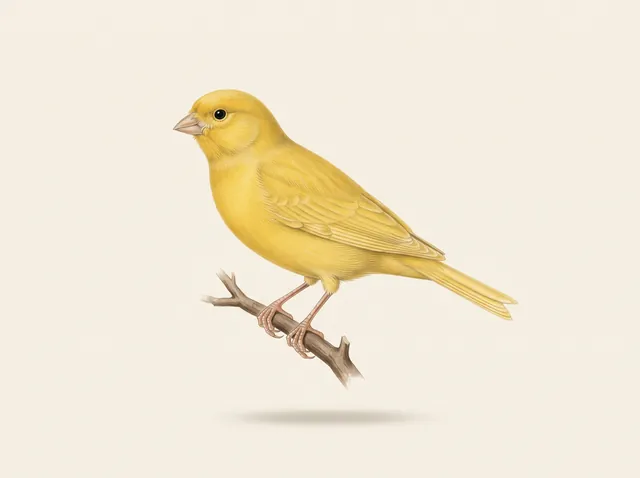
A small bird that hides its illness
According to the MSD Veterinary Manual, birds hide illness so as not to appear vulnerable. VCA Animal Hospitals adds that by the time signs appear, the bird has often been ill for several days to several weeks, and that serious illness can set in very quickly.
In canaries, time matters even more: according to Dorrestein’s handbook of avian medicine, a small songbird that goes more than 24 hours without eating can develop serious complications.
Signs to watch for
- Fluffed-up feathers, a canary sitting puffed up, sleeping more with its eyes closed.
- Perching low or sitting on the cage floor.
- Less singing or calling, less activity.
- Laboured breathing: open beak, a tail that bobs with each breath, wheezing.
- Eating or drinking more or less than usual, regurgitation.
- Loss of balance, head tilt, falling off the perch.
- Soiled feathers around the vent, runny eyes or nostrils.
When a canary stops singing
According to VCA, a canary that is stressed, moulting, ill or has just moved to a new environment may stop singing. Dorrestein adds that males sing mainly in spring, and that a canary that has been ill may not start singing again until the following spring, even once it has recovered.
Reading the droppings
A dropping has three parts: the faeces (the formed green or brown part), the urates (the white part) and the urine (the clear liquid). According to VCA and an avian vet writing for the World Parrot Trust, these are abnormal:
- fewer droppings (it is eating less);
- soft, black or red faeces, or faeces with blood;
- whole seeds in the droppings, to be reported especially if the bird is losing weight, according to Dorrestein;
- much more urine, or yellow, green or pink urates.
Paper on the cage floor, changed every day, makes them easy to keep an eye on.
Plumage and canary-specific problems
- Feather cysts
- Common in some canary breeds, notably frilled or soft-feathered types, according to the MSD Manual. Only minor surgery prevents them coming back.
- Feather loss
- Outside the moult, a bare patch or damaged feathers should be checked by a vet (see our page on the canary moult).
- Kitchen fumes
- An overheated non-stick pan gives off fumes that can kill a bird with no other warning, according to the veterinary edition of the MSD Manual.
When to go to the vet
Spot a drop to the nearest gram
In a bird of 15 to 25 grams, weight loss can’t be seen by eye. Log every weigh-in in MyArk: the weight tracker, shared by the household, shows a drop before other signs.
- A weight chart for each bird
- A weekly weigh-in reminder
- Dated observations in the health record
- Your vet’s contact details on the pet sitter sheet
Common questions
How can I tell if my canary is ill?
The most common signs: fluffed-up feathers, a puffed-up bird sleeping a lot, perching low or on the cage floor, laboured breathing, abnormal droppings, poorer appetite, singing that stops. Any change in behaviour counts.
Why has my canary stopped singing?
The moult, stress, a move or illness can stop it, according to VCA. Females sing little. If the silence comes with other signs, or happens outside the moult in a good singer, see your vet.
My canary is fluffed up: is it serious?
A canary that sits fluffed up during the day, sleeps a lot and moves little is showing one of the most common signs of illness. In such a small bird, see your vet promptly.
My canary stays on the cage floor: what should I do?
It is a warning sign: a canary that no longer perches is often very weak. Call your vet the same day.
How long can a canary go without eating?
Very little time: according to a handbook of avian medicine, a small songbird that goes more than 24 hours without eating can develop serious complications. Don’t wait.
My canary has a lump under its feathers: what is it?
It may be a feather cyst, common in some breeds, or another kind of lump. Only your vet can tell the difference and suggest treatment.
Sources
Benchmarks checked on 25 October 2026 in the documents below, then rewritten in plain English. They do not replace an examination and advice from your vet, who adapts care to your pet and to where you live.
- MSD Veterinary Manual, Illness in Pet Birds (2025)
- VCA Animal Hospitals (Drs Rich, Hess and Axelson, vets), Recognizing the Signs of Illness in Pet Birds (2023)
- VCA Animal Hospitals (Drs Rich, Hess and Axelson, vets), Canaries – General Information (2022)
- G. M. Dorrestein, “Passerines”, Handbook of Avian Medicine, 2nd edn (2009), full text on PubMed Central
- MSD Veterinary Manual, Skin and Feather Disorders of Pet Birds (2026)
- World Parrot Trust, PsittaScene (Dr Brenna Fitzgerald, avian vet), Signs of illness (2009)
- MSD Veterinary Manual, veterinary edition, Toxicoses of Pet Birds (2026)