Where the Tan mouse comes from
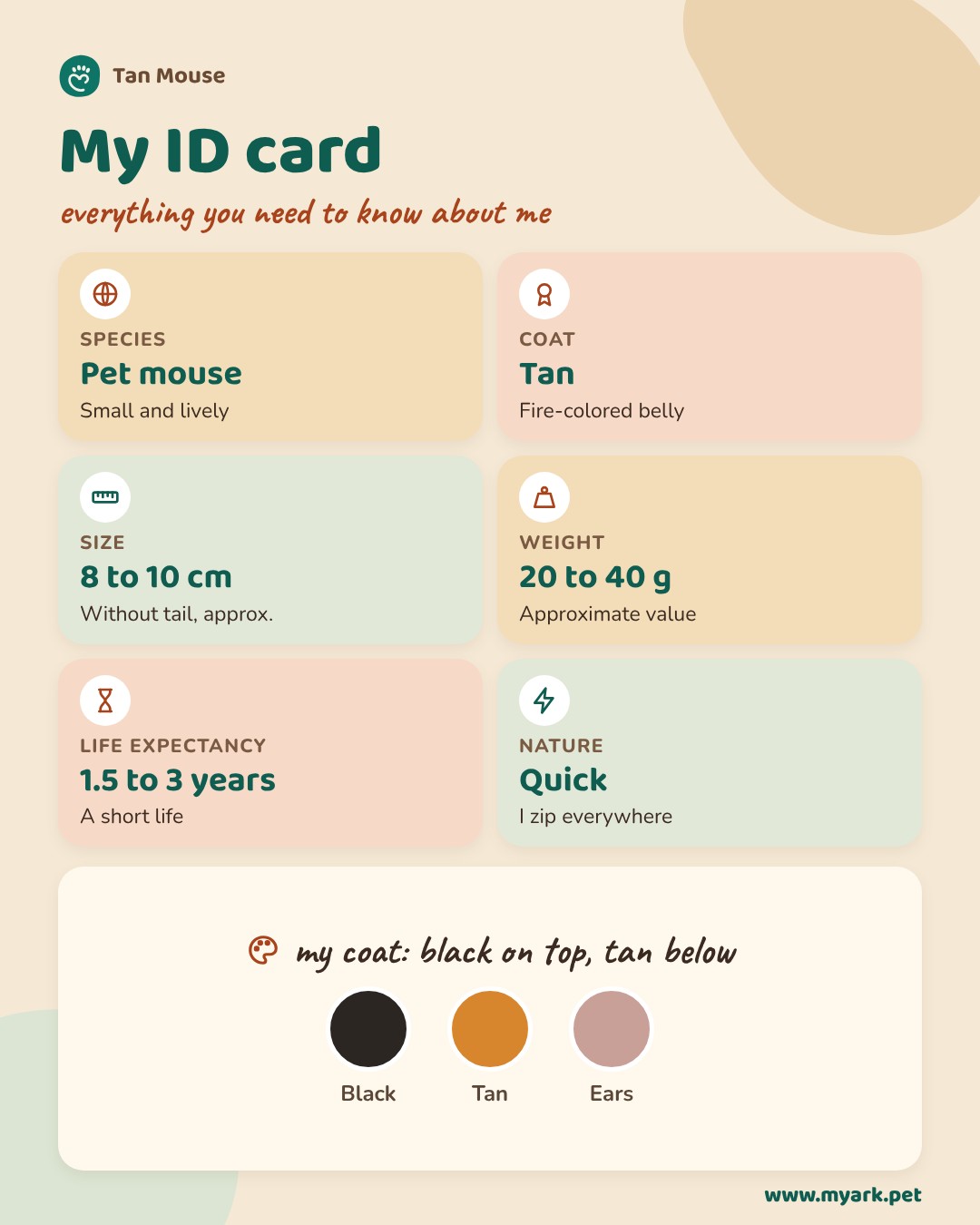
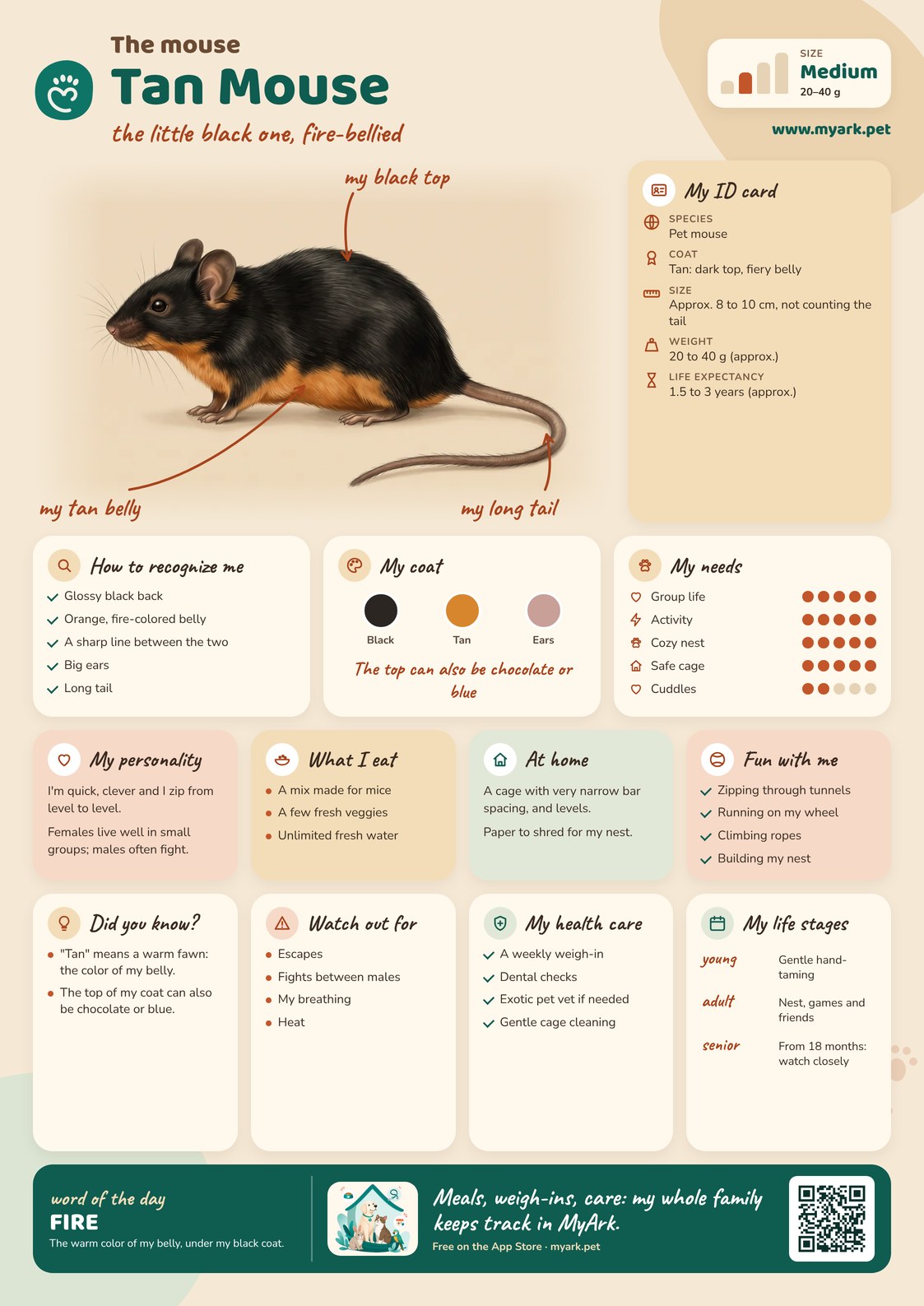
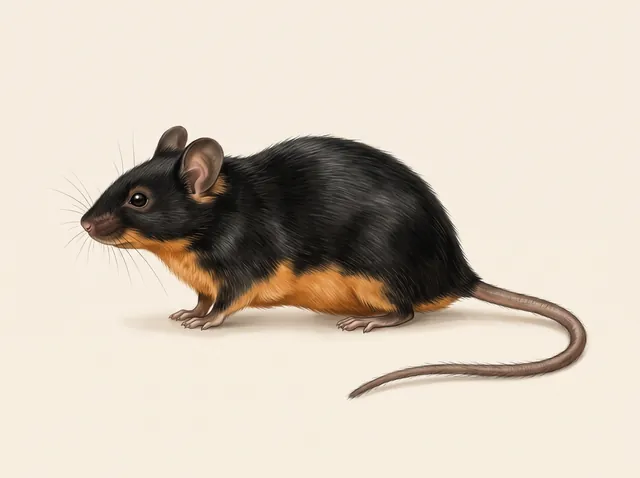
“Tan” refers to the warm colour of its belly.
The top of its coat can also be chocolate or blue.
How to recognise me
- glossy black back
- orange tan belly
- sharp line between the two
- large ears
- long tail
My colours
- Black
- Tan
- Dark ears
What a Tan mouse needs day to day
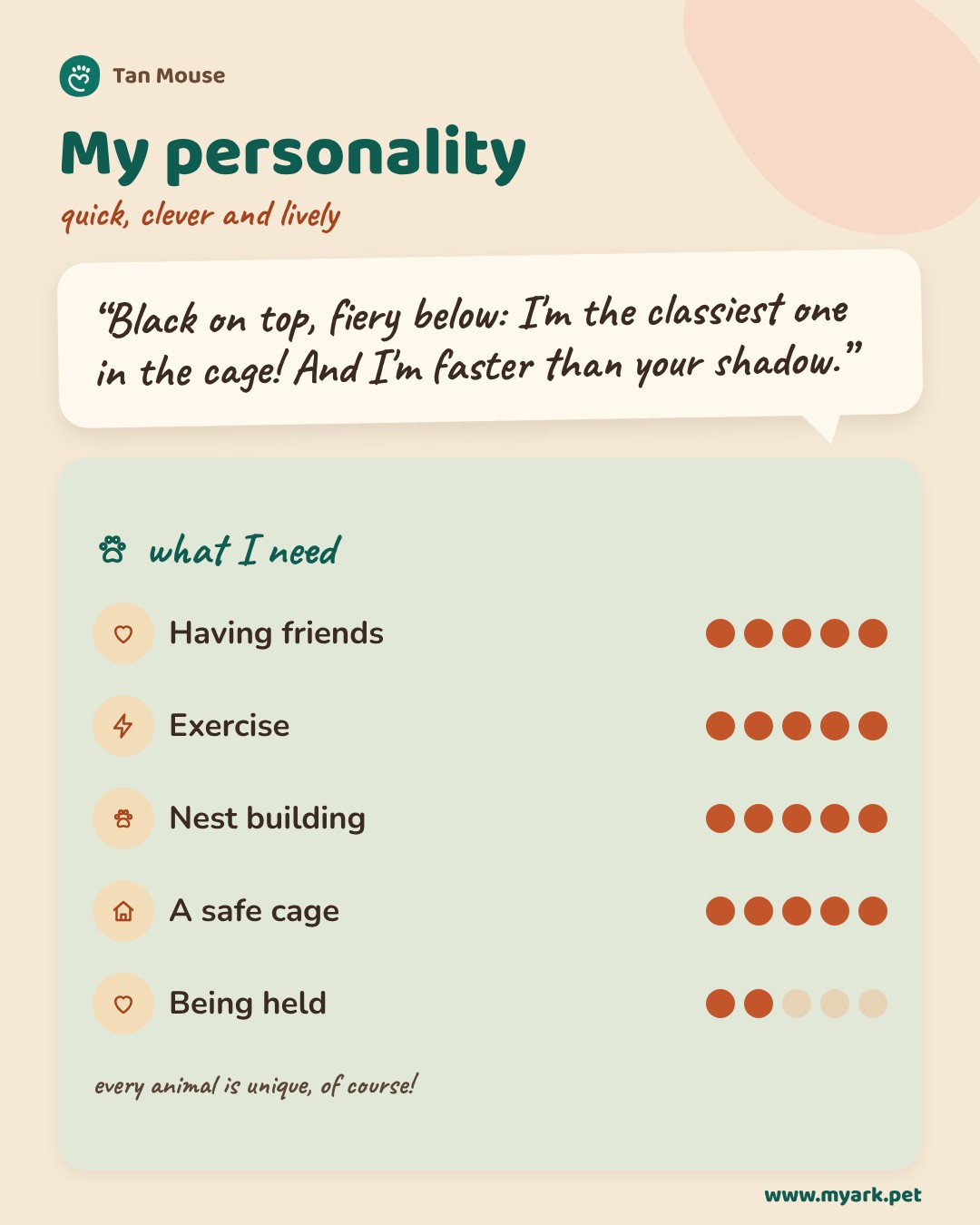
“Black on top, tan underneath: I’m the smartest in the cage! And I zip faster than your shadow.”
Its needs are real: companions, an escape-proof home, deep bedding and new things to explore.
At a glance
- Companions
- 5 out of 5
- Exercise
- 5 out of 5
- Nest-building
- 5 out of 5
- A secure cage
- 5 out of 5
- Being carried
- 2 out of 5
every mouse is unique, of course!
With me, we can go…
- climbing and running in its wheel
- building a nest
- exploring tunnels
- evening games with its companions
Living with a Tan mouse: who does what
A mouse is an animal to watch: quick and fragile, it is not suited to handling by young children. Its care is small but regular — food, water, deep bedding, new things to explore. Here is the Tan mouse’s routine at a glance, and how a household can split it without a single “did anyone…?” message.
The routine at a glance
- every day
- food and fresh water; a little fresh vegetable; a look at each mouse, in the evening.
- every week
- soiled bedding removed and topped up; toys and tunnels moved around; a weigh-in.
- every month
- a full clean, keeping some nest material; new cardboard and paper for nests; bars and lid checked.
- every year
- a check-up with a vet used to small mammals.
Sharing it out
- Food and water go on one person each day.
- Children watch; handling only over a table, with an adult.
- The weekly clean on a name.
Before it arrives, agree on…
- who does food and water every day
- who cleans the cage each week
- who checks the bars and lid
- how children watch — and handle only over a table, with an adult
- who looks after them during holidays
How MyArk helps the household keep track
Family pet chores
Food, cleaning and new enrichment on named people.
See the featurePet weight tracker
A weekly weigh-in: weight loss is an early warning sign.
See the featurePet health record
Note sneezes, lumps and vet visits in one shared record.
See the featurePet sitter instructions
Holiday instructions: food, water and escape risks.
See the featureFeeding, grooming and health routine
The coat needs regular brushing, more often during the moult.
What I eat
- a mouse food mix
- a little fresh vegetable
- fresh water at will
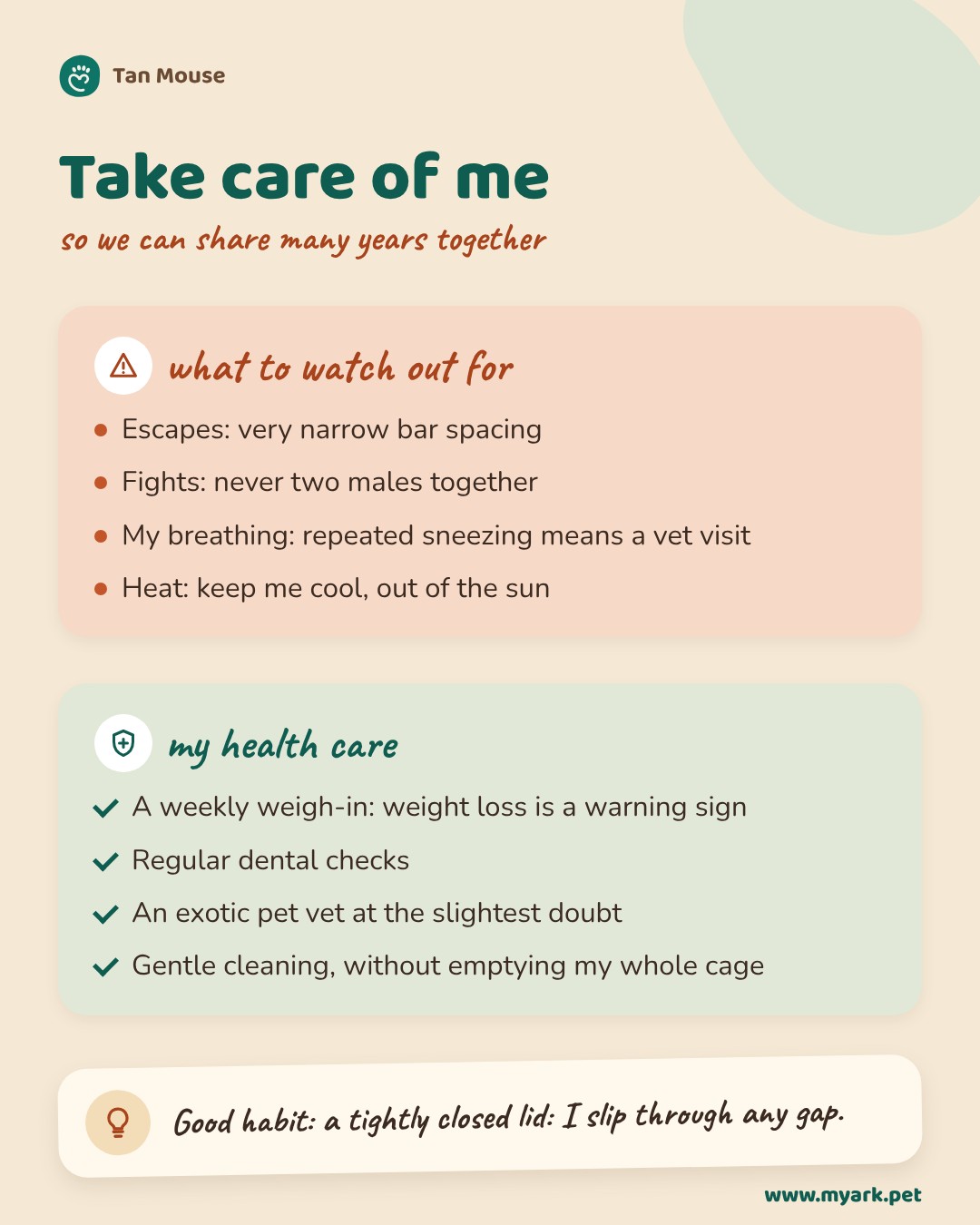
My health routine
- dust-free bedding: breathing problems are common
- a weekly feel for lumps and a look at the coat
- a weekly weigh-in
- a vet used to small mammals, found before there is a problem
The stages of my life
- young
- Gentle taming, over a table.
- adult
- A group of females, deep bedding and new things to explore.
- older
- From about a year and a half, closer watch on breathing and lumps.
What to keep an eye on
MyArk describes predispositions through visible body shape and simple checks rather than a list of diseases: it is what you can verify from the outside, and act on when choosing a breeder.
Escapes
Very narrow bars.
Fights
Never two males together.
Breathing
Repeated sneezing: see a vet.
Heat
Cool, out of the sun.
And, as for every mouse:
- a group of females: males get on badly
- deep bedding and enrichment that changes
- a cage with very narrow bars, or a fitted tank
- its night-time rhythm respected
Is it the right mouse for your household?
Mice need a group of females, an escape-proof home, deep bedding and new things to explore; they live a short life, often under three years. They are best for households happy to watch more than handle.
- Home
- An escape-proof cage or tank with deep bedding, in a calm room.
- Children
- To watch: too quick and fragile for young children to handle.
- Other pets
- Keep cats and dogs well away.
- First pet
- A good first pet for a household that likes watching.
- Time
- A few minutes a day, mostly in the evening.
Tan mouse: straight answers
What is a tan mouse?
A mouse with a coloured top and a tan belly.
Can a mouse live alone?
Females live better in a group; males often have to live alone because they fight.
Does it need special care?
No: the same as any mouse.
What colours does the Tan mouse come in?
The usual colours are black, tan and dark ears.