Where the Abyssinian comes from
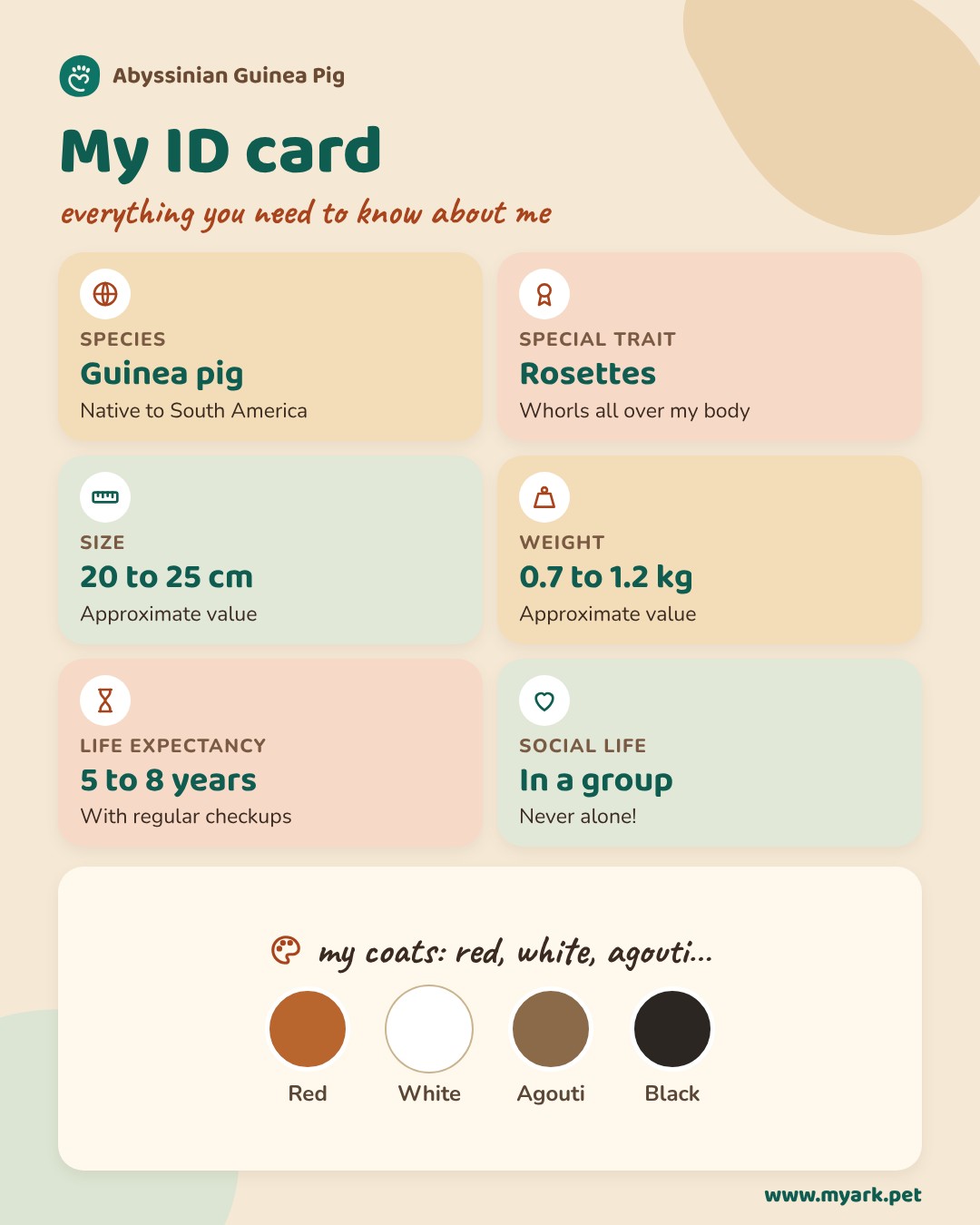
Despite its name, the Abyssinian does not come from Abyssinia (now Ethiopia) but rather from the Andes; it caused a sensation at Victorian shows in England.
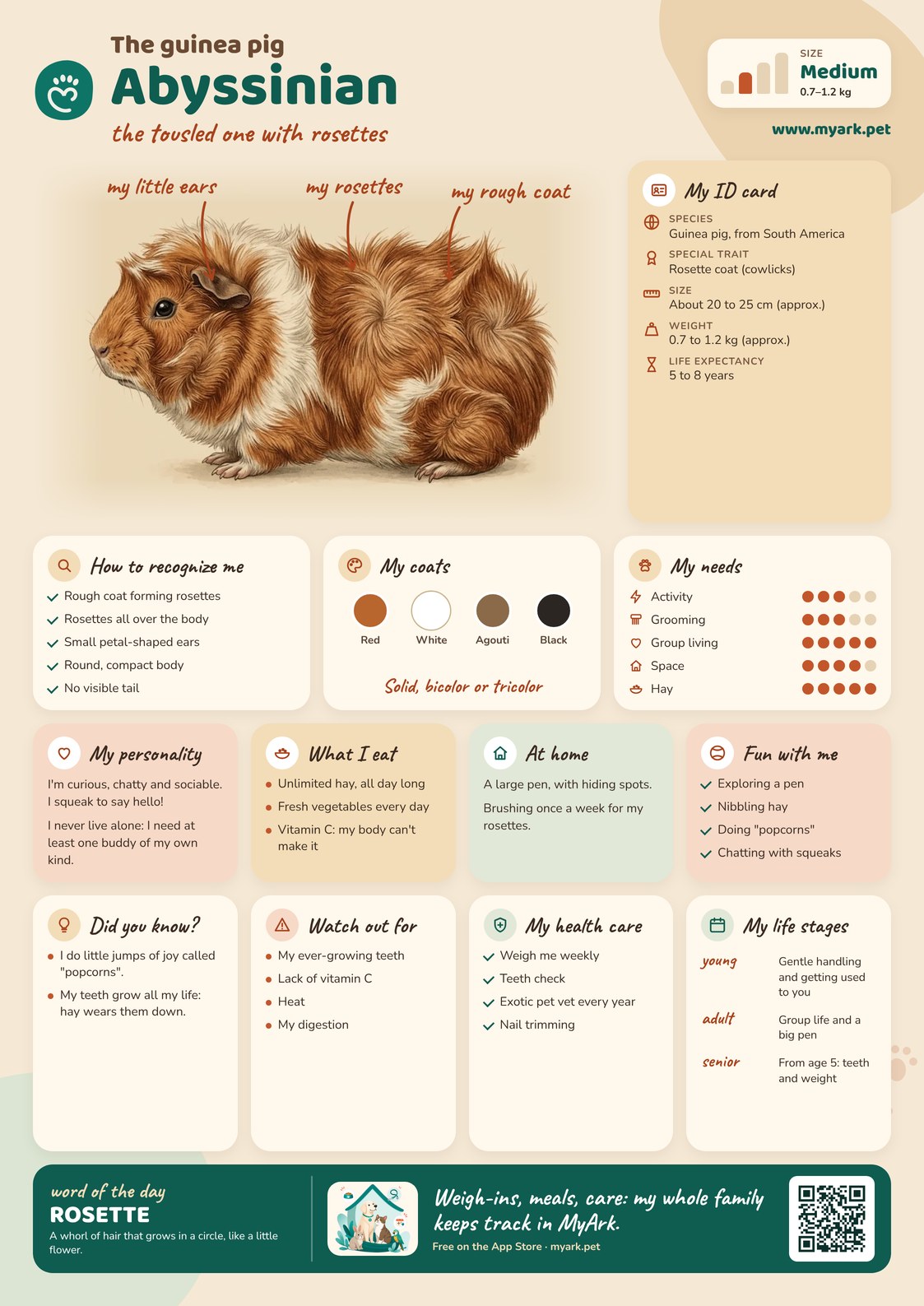
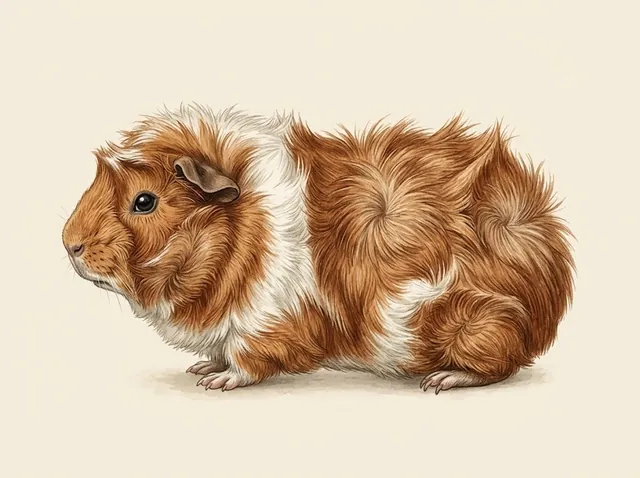
Its dense, harsh coat forms rosettes — symmetrical whorls — with ridges where two rosettes meet.
How to recognise me
- rough coat forming rosettes
- rosettes all over the body
- small petal-shaped ears
- round, compact body
- no visible tail
My colours
- Red
- White
- Agouti
- Black
What a Abyssinian needs day to day
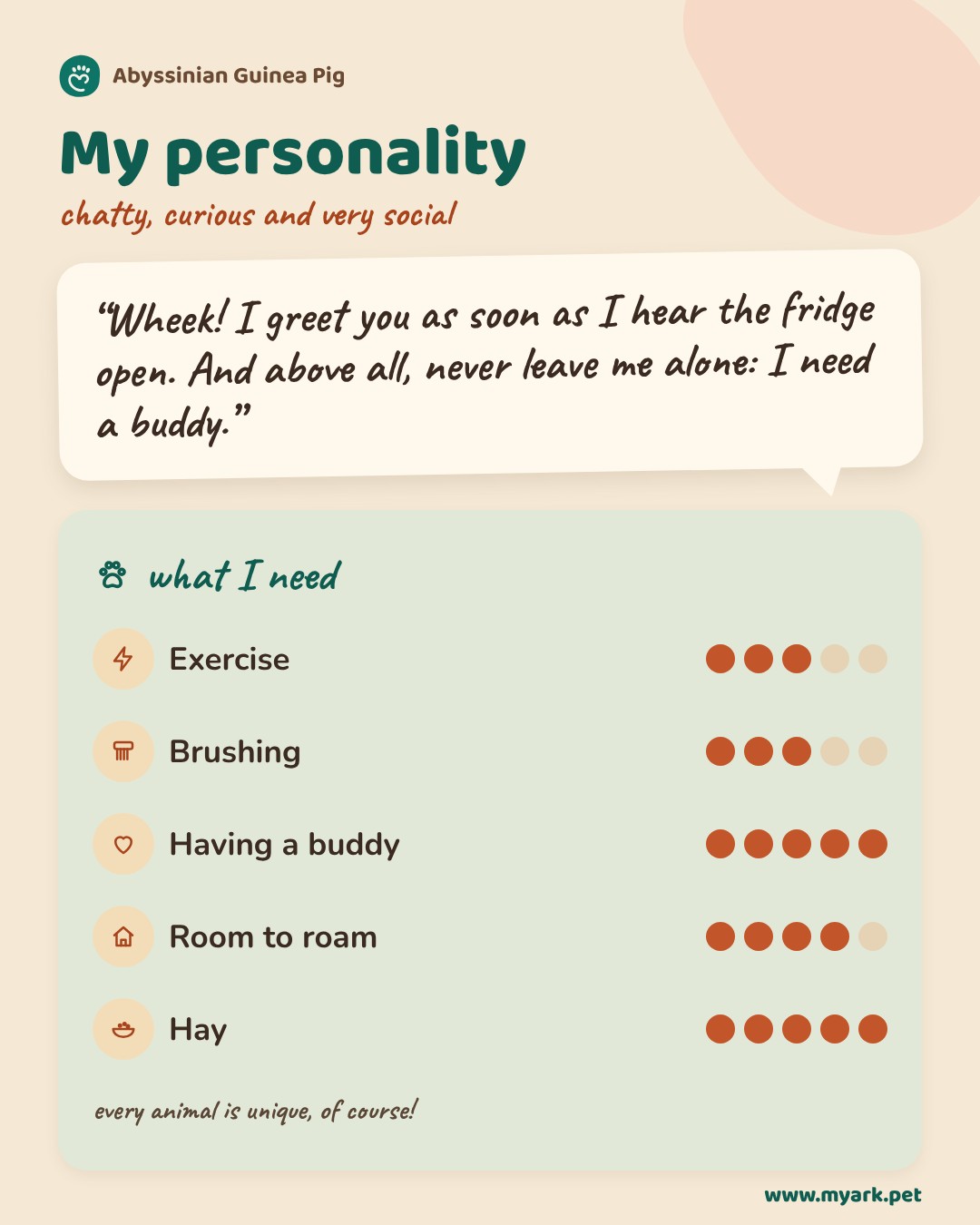
“Wheek! I greet you as soon as I hear the fridge open. And above all, never leave me alone: I need a friend.”
Its exercise needs are moderate: a large floor area to run, hides, a companion and hay all day.
At a glance
- Exercise
- 3 out of 5
- Grooming
- 3 out of 5
- A companion
- 5 out of 5
- Space
- 4 out of 5
- Hay
- 5 out of 5
every guinea pig is unique, of course!
With me, we can go…
- popcorning around the enclosure
- tunnels and hides
- vegetables from the hand
- lap time, sitting on the floor
Living with a Abyssinian: who does what
Guinea pigs are a good family pet as long as they live in pairs, on the ground rather than in a tiered cage — and their care is daily: hay, fresh vegetables, water, a clean floor. Here is the Abyssinian’s routine at a glance, and how a household can split it without a single “did anyone…?” message.
The routine at a glance
- every day
- unlimited hay; fresh vegetables rich in vitamin C (peppers, leafy greens); a few pellets; fresh water; soiled bedding removed.
- every week
- a full clean of the enclosure; a weigh-in; a check of teeth, claws and bottom.
- every month
- claws clipped if needed; a check of the skin and ears; hides and toys checked or replaced.
- every year
- a check-up with a vet used to small mammals.
Sharing it out
- Hay and vegetables go on named people, morning and evening.
- Children sit down to hold them, close to the floor.
- The weekly weigh-in on a name.
Before it arrives, agree on…
- who does the hay and the vegetables, morning and evening
- who cleans the enclosure each week
- who does the weekly weigh-in
- how children hold them — sitting down, close to the floor
- who looks after them during holidays
How MyArk helps the household keep track
Pet feeding tracker
Log hay and vegetables, and notice quickly if one stops eating.
See the featureFamily pet chores
Hay, vegetables and cleaning on named people.
See the featurePet weight tracker
A weekly weigh-in: weight loss is an early warning sign.
See the featurePet sitter instructions
Holiday instructions: daily vegetables and vitamin C can’t be skipped.
See the featureFeeding, grooming and health routine
The coat needs regular brushing, more often during the moult.
What I eat
- unlimited hay, all day
- fresh vegetables every day
- vitamin C: I can’t make my own
My health routine
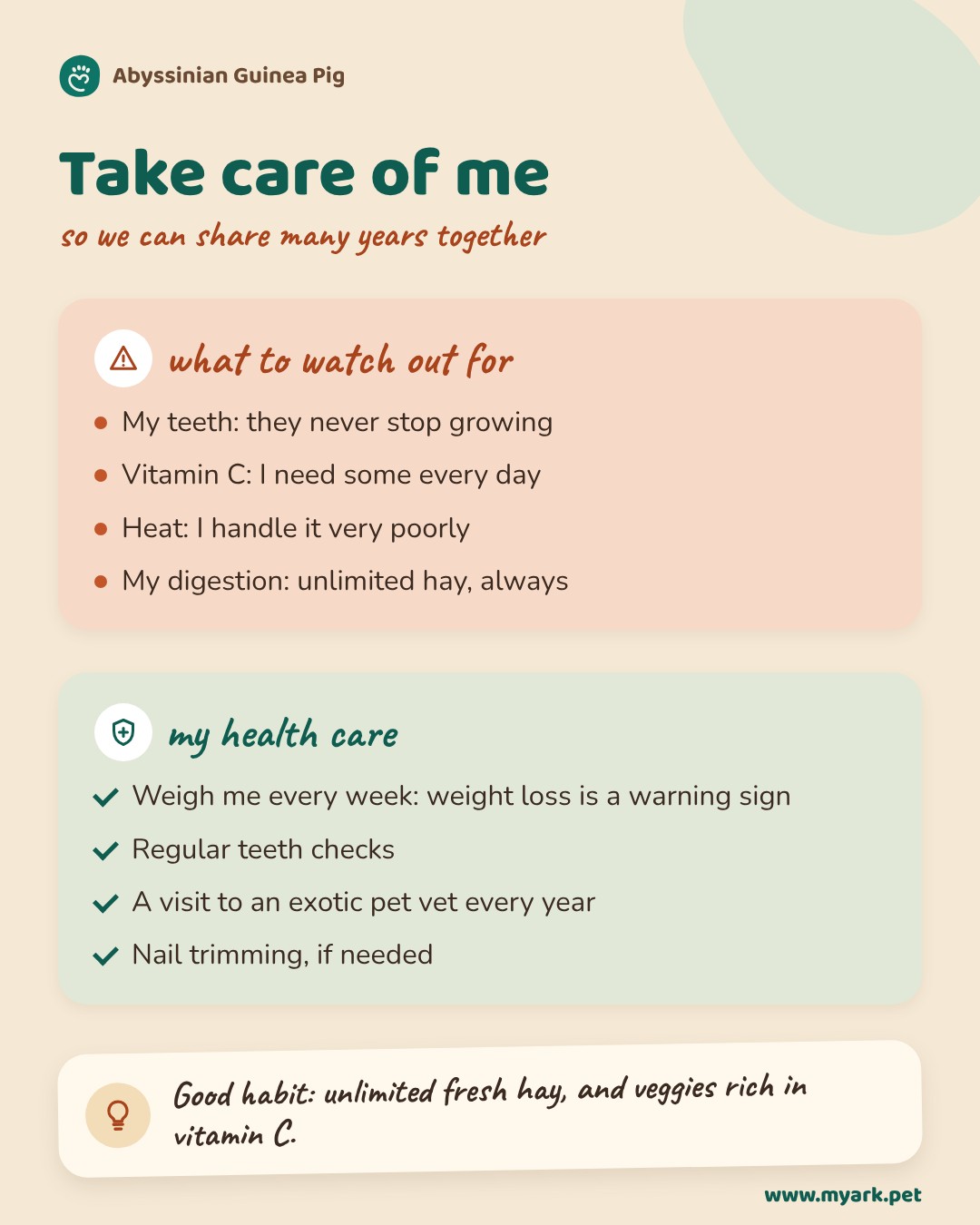
- vitamin C every day, from fresh vegetables: guinea pigs cannot make their own
- teeth, claws and the hair around the bottom, checked every week
- a weekly weigh-in: weight loss is often the first sign of illness
- a vet used to small mammals, found before there is a problem
The stages of my life
- young
- Gentle handling and getting used to the household.
- adult
- Hay, fresh vegetables, a companion and room to run.
- older
- From about 5 years old, closer watch on weight and teeth.
What to keep an eye on
MyArk describes predispositions through visible body shape and simple checks rather than a list of diseases: it is what you can verify from the outside, and act on when choosing a breeder.
Teeth
They grow all its life: unlimited hay wears them down.
Vitamin C
It needs some every day.
Heat
It copes very badly with heat: shade and cool in summer.
Digestion
Unlimited hay, always; not eating is an emergency.
And, as for every guinea pig:
- vitamin C every day: the species cannot make it
- a companion of its own kind — a vital need, not an option
- unlimited hay and plenty of floor space, without levels
- fresh vegetables every day
Is it the right guinea pig for your household?
Guinea pigs need a companion, a large floor area, hay all day and fresh vegetables rich in vitamin C. They are chatty, gentle and easier to handle than rabbits — and rescues often have bonded pairs waiting for a home.
- Home
- A large enclosure on the ground, indoors or in a sheltered spot — not a tiered cage.
- Children
- Gentle with calm children who sit on the floor.
- Other pets
- Needs a guinea pig companion; keep it away from cats, dogs and rabbits.
- First pet
- A good first pet.
- Time
- Hay and vegetables twice a day, and a weekly clean.
Abyssinian: straight answers
Where does the Abyssinian come from?
From South America, despite its name.
Does it need grooming?
A light brush now and then.
Do Abyssinian guinea pigs need a friend?
Yes: always at least two — a companion is a vital need.
What colours does the Abyssinian come in?
The usual colours are red, white, agouti and black.