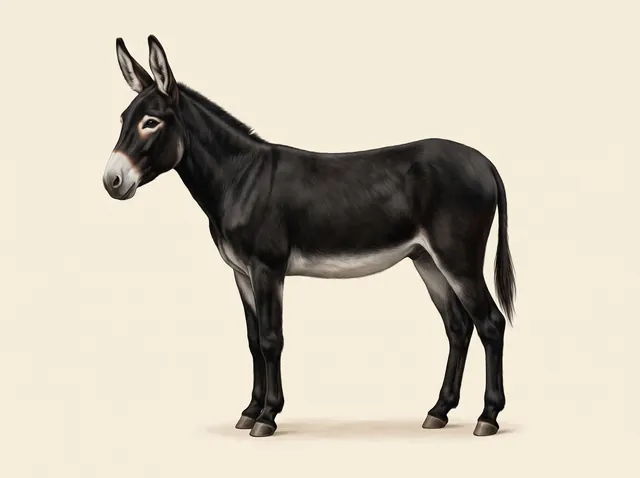
Where the Catalan donkey comes from
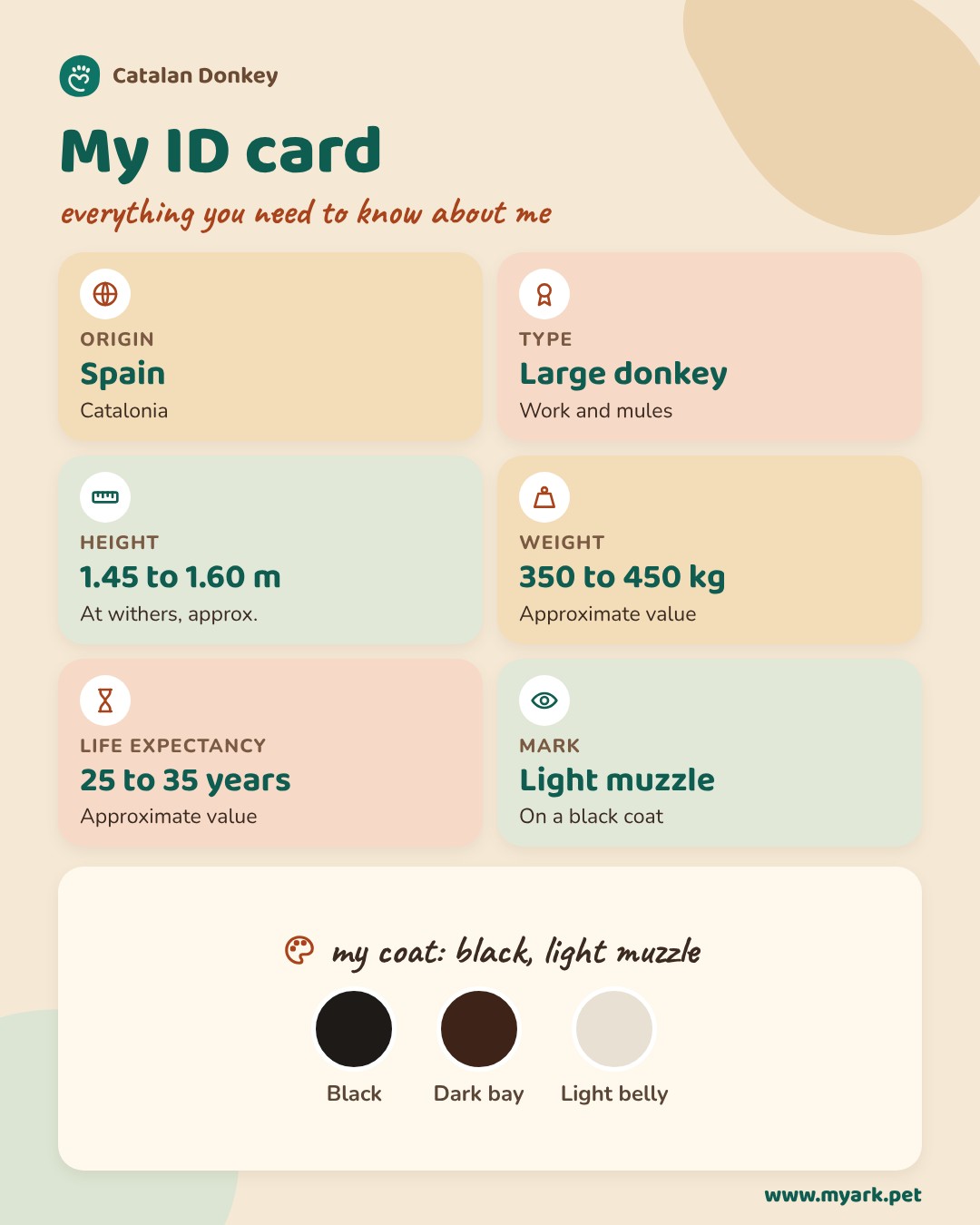
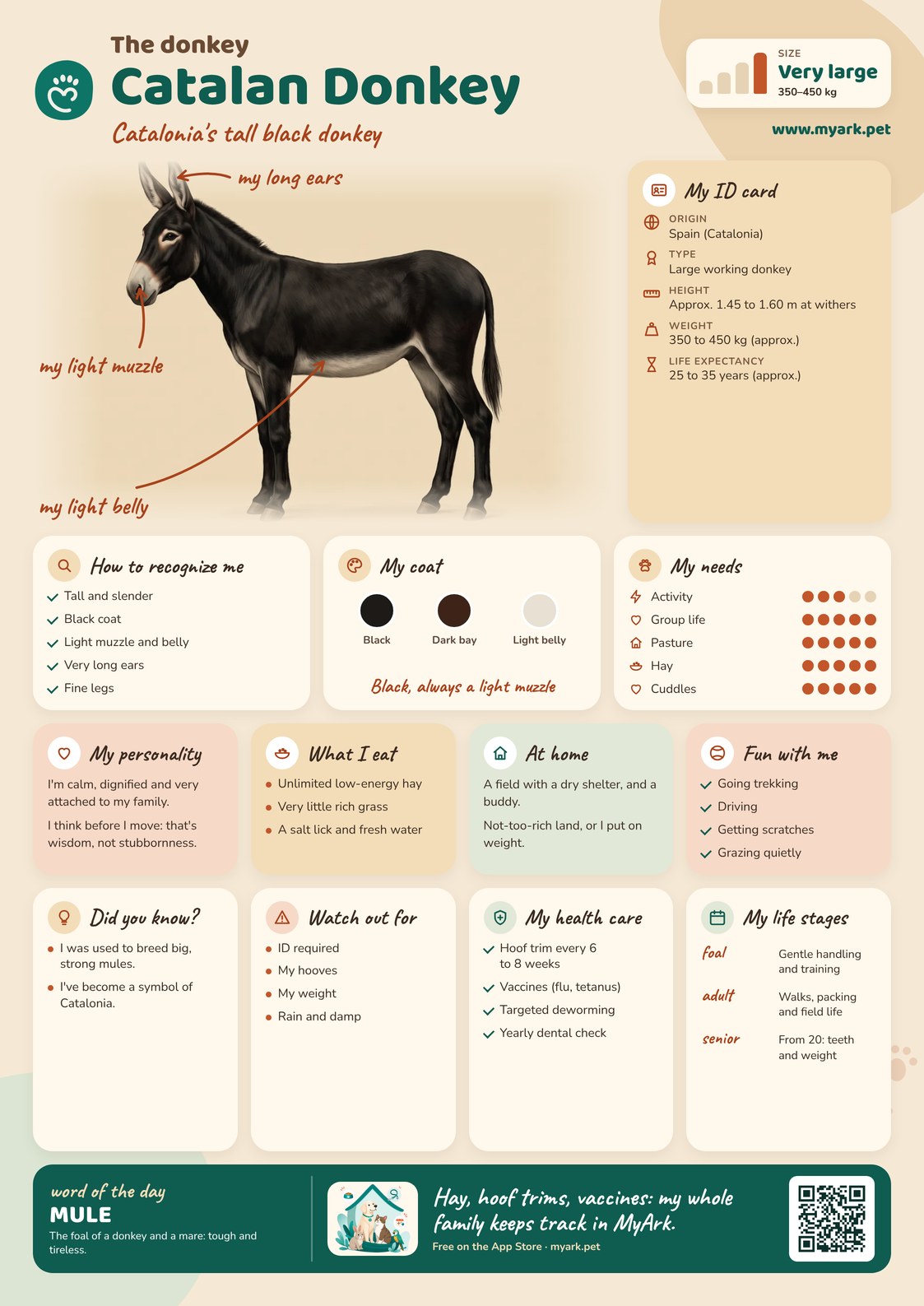
The Catalan donkey is a tall native donkey of Catalonia, with a black coat, historically used to produce mules.
It has become a symbol of Catalonia.
Height at the withers: about 1.40 m on average.
How to recognise me
- tall and slender
- black coat
- pale muzzle and belly
- very long ears
- fine legs
My colours
- Black
- Brown bay
- Pale belly
What a Catalan donkey needs day to day
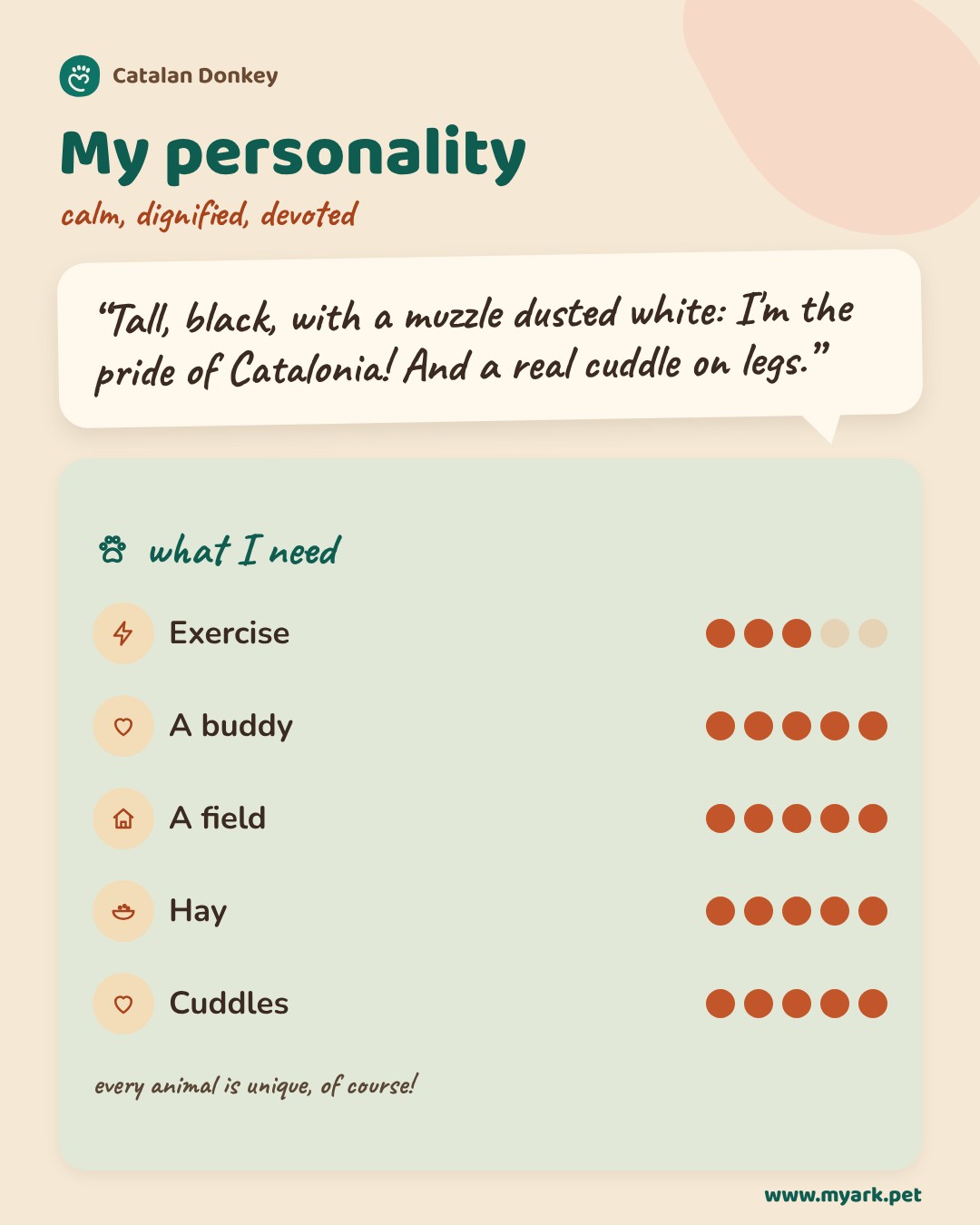
“Tall, black and with a white-powdered muzzle: I’m the pride of Catalonia! And a real cuddle on legs.”
Its needs are moderate: a companion, a dry shelter, sparse grazing and walks.
At a glance
- Exercise
- 3 out of 5
- A companion
- 5 out of 5
- A field
- 5 out of 5
- Hay
- 5 out of 5
- Cuddles
- 5 out of 5
every donkey is unique, of course!
With me, we can go…
- walks on a lead
- a dust bath
- grooming and scratches
- a hike carrying a light pack
Living with a Catalan donkey: who does what
A donkey lives thirty to forty years — a longer commitment than a dog, often underestimated — and its care is daily: hay, water, a look at its feet and its mood. Here is the Catalan donkey’s routine at a glance, and how a household can split it without a single “did anyone…?” message.
The routine at a glance
- every day
- hay or straw, fresh water and a salt lick; a look at each donkey: eating, walking, mood; a quick pick-out of the hooves; the shelter and fences checked.
- every week
- droppings picked up from the field; the shelter cleaned and bedding renewed; a grooming session.
- every month
- a body-condition check (neck and back fat); hooves checked, trimmed every six to ten weeks; grazing rotated or restricted.
- every year
- vaccination as advised by your vet; a teeth check; faecal tests to decide on worming; passport and records kept up to date.
Sharing it out
- Morning and evening checks on a rota.
- Children help with grooming, with an adult.
- Farrier visits on a calendar, on a name.
Before it arrives, agree on…
- who does the hay and water, morning and evening
- who picks out the hooves, and who books the farrier
- how grazing is limited in spring
- how children approach — calmly, with an adult
- who looks after them during holidays
How MyArk helps the household keep track
Family pet chores
Hay, water and hoof picking on named people.
See the featurePet weight tracker
Regular condition checks: donkeys put on weight very easily.
See the featurePet health record
Farrier, vaccines, teeth and faecal tests in one shared record.
See the featurePet sitter instructions
Holiday instructions: no rich grass, and what to watch for.
See the featureFeeding, grooming and health routine
The coat needs regular brushing, more often during the moult.
What I eat
- poor hay at will
- very little rich grass
- a salt lick and fresh water
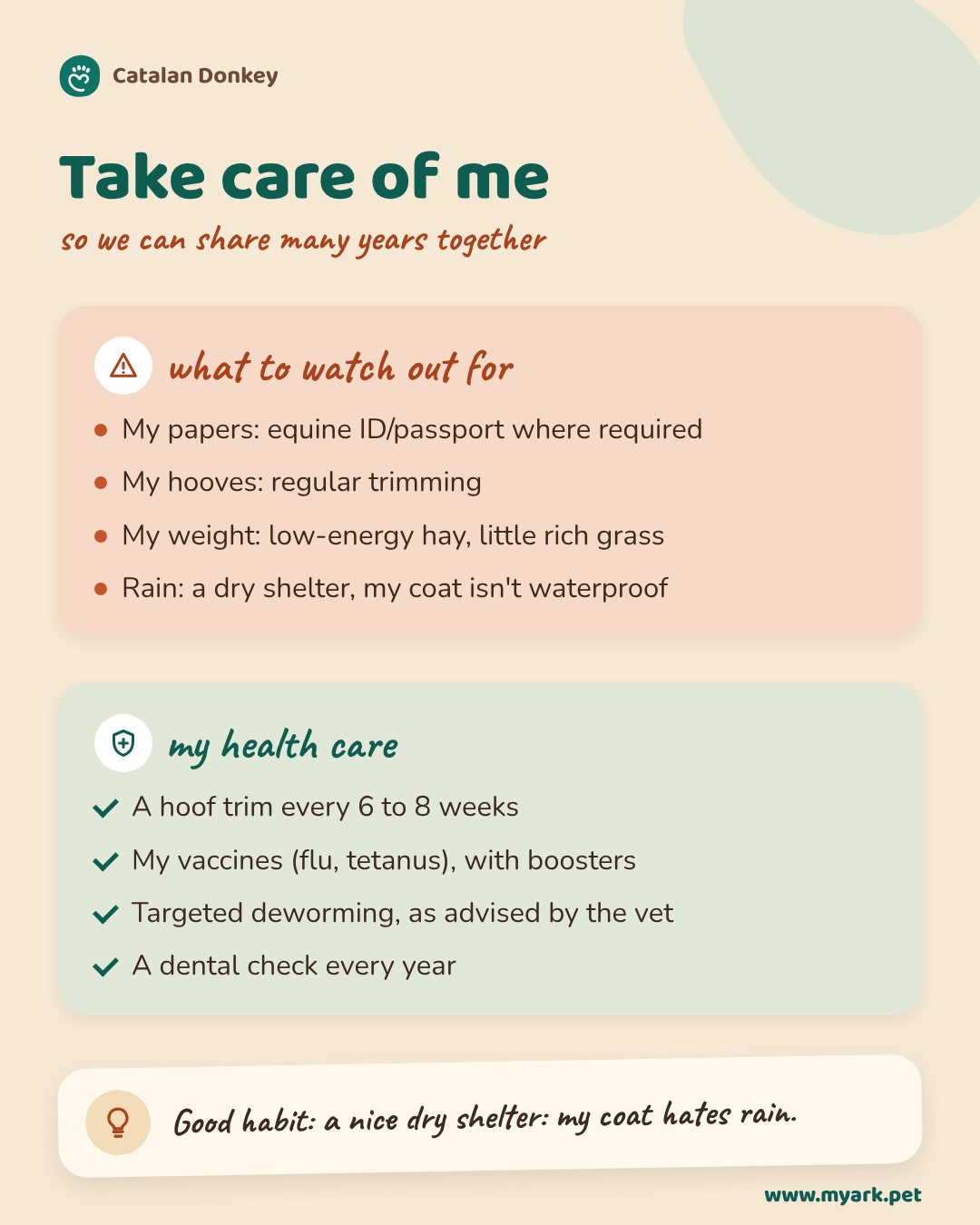
My health routine
- hooves trimmed every six to ten weeks
- teeth checked every year by a vet or equine dentist
- worming based on faecal tests, and vaccination as advised by your vet
- a vet who knows donkeys: they hide pain far more than horses
The stages of my life
- foal
- With its mother and the herd, and gentle handling.
- adult
- Straw and hay, sparse grazing, a companion and regular hoof care.
- older
- From about 20 years old, closer watch on teeth and weight.
What to keep an eye on
MyArk describes predispositions through visible body shape and simple checks rather than a list of diseases: it is what you can verify from the outside, and act on when choosing a breeder.
Papers
A passport and microchip are usually compulsory: check your country’s rules.
Hooves
Trimmed regularly.
Weight
Poor hay, little rich grass.
Rain
A dry shelter: my coat isn’t waterproof.
And, as for every donkey:
- at least one companion of its own kind: a lone donkey goes downhill fast
- a very fibrous, low-sugar diet — not a horse’s diet
- a dry shelter at all times: its coat copes badly with long rain
- hooves trimmed regularly, often neglected
Is it the right donkey for your household?
A donkey lives 30 to 40 years, needs a companion, a dry shelter, sparse grazing and a farrier: it is a commitment for decades. Its passport and microchip are usually compulsory, and donkey sanctuaries often have pairs waiting for a home.
- Land
- A field with sparse grass, a dry shelter and strong fencing.
- Children
- Gentle, but tall: always with an adult.
- Other animals
- Lives best with another donkey; can share with calm sheep or goats.
- First donkeys
- A good first donkey for a household with space.
- Time
- A few minutes morning and evening, every day, and regular hoof care.
Catalan donkey: straight answers
Is the Catalan donkey tall?
Yes: one of the tallest donkey breeds.
Is it affectionate?
Very.
Can a Catalan donkey live alone?
No: a donkey needs at least one companion, ideally another donkey.
What colours does the Catalan donkey come in?
The usual colours are black, brown bay and pale belly.